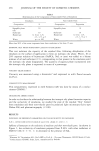
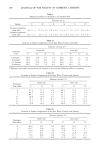
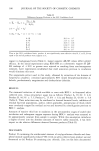
258 JOURNAL OF THE SOCIETY OF COSMETIC CHEMISTS Table I Determination of the Composition of Non-volatile Parts of Emulsions Emulsions Non-volatile Parts Composition % Composition Proportion Lipophile phase 10 Lipophile phase 10 (oil) Surfactant 10 Surfactant 10 Humectant 0, 0.62, 1.25, Humectant 0, 0.62, 1.25, 2.5, 3.75 or 5 2.5, 3.75 or 5 Water q.s. to 100 Water 5 More than 90% of the water evaporates from these emulsions in less than 15 min. ISOTROPIC OILY PHASE FORMATION CAPACITY OF EMULSIONS This test indicates the capacity of the residual film, following dehydration of the emulsion on the surface of application to form an isotropic oily phase. Water, 10 or 20% aqueous solution of humectant (NaPCA, NaL or urea) was added to a binary mixture of oil and surfactant (1/1), corresponding to that present in the emulsions until the isotropic oily phase disappeared. The quantity of aqueous phase incorporated into the isotropic oily phase is expressed in terms of a percentage. VISCOSITY MEASUREMENT Viscosity was measured using a rheometer • and expressed in milli Pascal seconds (m. Pa.s). CONDUCTIVITY MEASUREMENT This measurement, expressed in milli Siemens (mS) was done by means of a conduc- timeter CD6NG. 2 MICROSCOPIC OBSERVATIONS In order to elucidate the relationship between the isotropic oily phase formation capacity and the occlusivity of emulsions, we studied the state of the residual "film" formed from emulsions and their non-volatile parts by polarized light microscopy (Leitz type Dialux Pol) and photomicrography (x 100). RESULTS INFLUENCE OF DIFFERENT PARAMETERS ON THE OCCLUSIVITY OF EMULSIONS P.H.S., ESTER SURFACTANT-SODIUM LACTATE. (HLBS 8.5 AND 11.5) Influence of humectant on the occlusivity of emulsions and their non-volatile parts, As shown in Figure 1, the occlusivity of emulsions prepared from P.H.S. with ether surfactant at HLB 8.5 (Oc.% = 51. _+ 2) decreased in the presence of NaL. • Rheomat 30: Viscosimbtre AG., Ets LAMY et Cie S.A., 19 avenue Thimonnier, 69300 Caluire et Cuire. 2 Conductimeter CD6NG: Solea, Lyon, manufactured by Prolabo.

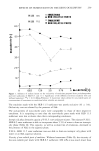
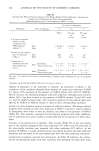
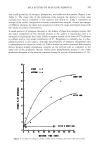
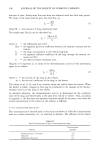
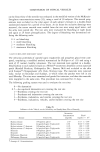
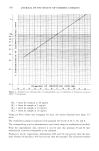
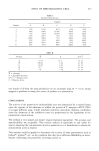
EFFECTS OF HUMECTANTS ON EMULSION OCCLUSIVITY 259 60 50 40 30 H.L.B. 8.5 H.L.B. 11.5 0 EMULSIONS ß NON VOLATILE PARTS [] EMULSIONS ß NON VOLATILE PARTS 20 lO , , , , '( ) 0 0.62 1.25 2.5 3.75 Na-LACTATE % Figure 1. Influence of sodium lactate on the occlusJvJty of emulsions prepared from perhydrosqualene and ester surfactants of HLB 8.5. and 11.5. Significance of the difference between emulsions with and without humectant: **p 0.01 (Mann-Whitney). % humectant values shown for non-volatile parts are concentrations of humectants in emulsions before volatiles are removed. The emulsion made with the HLB 11.5 surfactant was poorly occlusive (16 q- 3%). Occlusivity was not altered by the presence of NaL. The occlusivities of non-volatile parts were comparable to those of their respective emulsions. It is surprising to note that the non-volatile parts made with HLB 11.5 surfactant were less occlusive than their corresponding emulsions. Isotropic oily phase formation capacity of P. H.S.-ester surfactant mixture. The mixture P. H. S.: HLB 8.5 ester surfactant is able to incorporate about 5.5 % of water to form an isotropic oily phase (Table II). This capacity, as well as occlusivities of emulsions, decreased in the presence of NaL in the aqueous phase. P.H.S.: HLB 11.5 ester surfactant was not able to form an isotropic oily phase with water or an NaL aqueous solution. Viscosity of non-volatile parts of emulsions. Without humectant (Table II), the viscosity of the non-volatile part made with HLB 8.5 surfactant (180 mPa.s) was much lower than
Purchased for the exclusive use of nofirst nolast (unknown)
From: SCC Media Library & Resource Center (library.scconline.org)