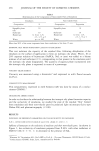
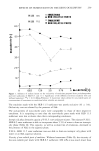
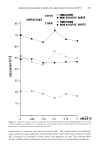
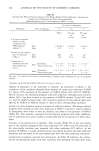
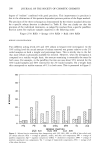
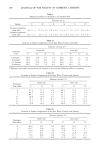
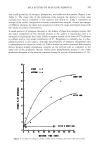
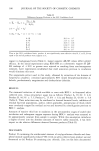
ESCA STUDIES OF SKIN LIPID REMOVAL 295 10 8 -- SLS AEOS o 0 5 IO 15 20 25 50 55 WASHING TIME (MIN.} Figure 5. Increase in nitrogen content of skin versus washing time with SLS and AEOS. parameters seems to indicate that skin lipid removal depends on the polarity of the solvent. TREATMENT WITH SODIUM LAURYL SULFATE (SLS) AND SODIUM LAURETH--6.5 SULFATE (AEOS-6.5EO) Skin samples were washed for different amounts of time with 2% wt. concentration solution of SLS and AEOS (6.5EO). After each treatment, samples were rinsed for ten minutes in distilled water. The surface composition of the skin after each treatment with SLS and AEOS is tabulated in Tables VI and VII. Skin samples rinsed only with water were also studied as controls. No changes in the surface composition of the skin were observed with the water-treated samples, thus ruling out the possibility of major water-soluble material present at the skin surface. It should be noted from Tables VI and VII that only the outer side of the epidermis was studied although occasional checks on the inner side showed that more skin lipid is removed from the inner side than the outer side. Tables VI, VII and Figure 5 show that skin lipid removal is greater

296 JOURNAL OF THE SOCIETY OF COSMETIC CHEMISTS due to SLS treatment than AEOS treatment. Relatively large increases in the sulfur content due to SLS and AEOS treatments (Tables V! and VII) indicate deposition of these surfactants at the skin surface. This skin lipid removal data is consistent with skin swelling and human irritation results obtained with these surfactants (10,19), demonstrating a greater activity for SLS than for AEOS. ACKNOWLEDGEMENTS Thanks are due to Anthony Moskwa for help in taking ESCA spectra. Thanks are also due to Kathy Fernee for supplying skin samples for this study. The author thanks Drs. F. J. Loprest, C. Robbins, and L. Rhein for useful comments and suggestions. REFERENCES (1) F. D. Malkinson, The Epidermis, W. Montagna and W. C. Lobitz, Eds. (Academic Press, New York, 1964), p 435. (2) P.M. Elias, Epidermal lipids, membranes and keratinization, Int. J. Dermatol, 20, 1-19 (1981). (3) H. J. Yardley and R. Summerly, Lipid composition and metabolism in normal and diseased epi- dermis, Pharmac. Ther., 13, 357-383 (1981). (4) R. Scheuplein and L. Ross, Effect of surfactants and solvents on the permeability of epidermis, J. Soc. Cosmet. Chem, 21, 853-873 (1970). (5) G. Swanbeck and N. Thyresson, A Study of the state of aggregation of the lipids in normal and psoriatic horny layer, Acta Dermatovener, 42, 445-457 (1962). (6) R. D. B. Fraser, T. P. MacRae, G. E. Rogers, and B. K. Filshie, Lipiris in keratinized tissues, J. Molec. Biol, 7, 90-95 (1963). (7) P.M. Elias, L. Bonar, S. Grayson, and H. P. Baden. X-Ray diffraction analysis of stratum corneum membrane couplets, J. Invest, Dermatol, 80, 213-214 (1983). (8) P.M. Elias, B. E. Brown, P. Fritsch, Jon Goerke, G. M. Gran, and R. J. White, Localization and composition of lipids in neonatal mouse stratum granulosum and stratum corneum, J. Invest Dervaztol, 73, 339-348 (1979). (9) H. D. Onken and C. A. Moyer, The water barrier in human epidermis, Arch Demi., 87, 584-590 (1963). (10) C. R. Robbins and K. M. Fernee, Some observations on the swelling of human epidermal membrane, J. Soc. Cosmet. Chem., 34, 21-34 (1983). 11) R. J. Scheuplein, Mechanism of percutaneous adsorption. I. Routes of penetration and the influence of solubility, J. Invest. Dermatol, 45, 334-346 (1965). 12) K. Siegbahn, C. Nordling, A. Fahlman, R. Nordberg, K. Hamrin, J. Hedman, G. Johansson, T. Bergmark, S. E. Karlsson, I. Lindgren, and B. Lindberg, ESCA Atomic Moleculees and Solid State Structure Studies by Means of Electron Spectroscopy (Almgvist and Wiksells, Uppsala, Sweden, 1967). 13) M. K. Bahl, ESCA studies on some niobium compounds,J. Phys. Chem. Solids, 36, 485-490 (1975). 14) G. M. Gray, R. J. White, R. H. Williams and H. J. Yardley, Lipid composition of the superficial stratum corneum cells of pig epidermis, British J. Dermatol, 106, 59-63 (1982). (15) J. E. Kirk, Hand washing, Acta Dermato-Venereo Logica, Vol. 46, Supplementurn 57, (1966), p 26. (16) Robert G. Crounse, Keratin and the barrier, Arch. Environ. Health, 11, 522-528 (1965). (17) M. A. Lampe, M. L. Williams, and P.M. Elias, Human epidermal lipids Characterization and modulations during differentiation, J. Lipid Res., 24, 131-140 (1983). (18) Rudolph D. Deanin, Polymer Stucture.' Properties and Applications (Cahners Publishing Company, Inc., Boston, 1972), p 305. (19) Genji Imokawa, Comparative study on the mechanism of irritation by sulfate and phosphate types of anionic surfactants,J. Soc. Cosmet. Chem., 31, 45-66 (1980).
Purchased for the exclusive use of nofirst nolast (unknown)
From: SCC Media Library & Resource Center (library.scconline.org)