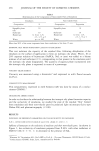
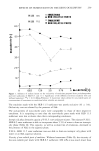
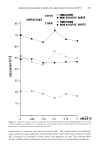
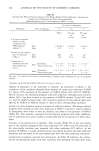
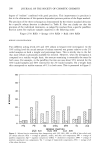
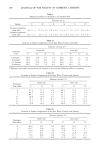
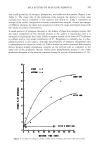
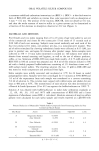
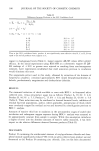
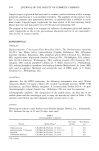
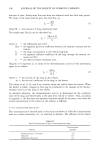
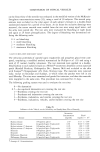
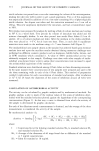
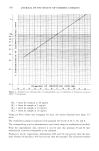
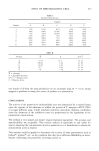
314 JOURNAL OF THE SOCIETY OF COSMETIC CHEMISTS sterile solution was poured into a test tube containing the culture of the microorganism, shaking the tube very well in order to get a good suspension. Two cc of this suspension was aseptically diluted by addition of it to a test tube containing 18 cc of physiologically sterile solution. An aliquot was taken and the extinction measured in a 1-cm cell at 460 •. This new suspension represented the inoculum, and had a transmittance equal to 50%. Petri dishes were prepared for analysis by melting a flask of culture medium and cooling to 50 ø C in a water bath. Two percent by volume of inoculum was added and the mixture thoroughly shaken. It was then poured into sterile Petri dishes (12-cm di- ameter, 40 cc of culture medium per dish). After the medium in the dishes solidified, they were placed at +4 ø C for at least one hour. Then, in each dish 6 equidistant reservoirs were made in the medium using a 6-7-mm diameter drill (Figure 1). The imidazolidinyl urea sample chosen as the standard was selected based upon chemical analysis data and upon the excellent results obtained during numerous challenge tests performed on different cosmetic products such as shampoos, bubble baths, lotions, and an O/W emulsion which contained it. A value of 100% antimicrobial activity was arbitrarily assigned to this sample. Challenge tests done with other samples of imida- zolidinyl urea showed lower activity unless their concentrations were increased to equal the antimicrobial equivalent of the standard. Standard solutions were distributed among 6 Petri dishes in three alternating reservoirs. In the same manner three concentrations of test samples were prepared and used to fill the three remaining wells in each of the 6 Petri dishes. This method of preparation yielded 6 replications for each concentration of standard and sample. After incubation at 32 ø C for 24 hours the diameters of the zones of inhibition around all wells were measured. CALCULATION OF ANTIMICROBIAL ACTIVITY The activity can be calculated by graphic analysis and by mathematical methods. For graphic analysis a plot is made of the median values of the zones of inhibition deter- mined with the standard solutions plotted against the logarithms of the corresponding concentrations (Figure 2). In this way a curve is obtained from which the activity of the sample is determined by graphic calculation. For each of the dilutions tested a measurement is obtained, and the average of the three measurements is considered the activity of the sample. By mathematical analysis (4), Activity = Antilog I- •- where: I (SC• + SC2 + SC4) - (SS• + SSi + SS4) 1 log I (SS4 + SC4) - (SS• + SC•) ' = Conversion factor for diluting standard solution SS4 to standard solution SS2 and standard solution SS•. SS• = Average of the diameters of all rings found due ro diffusion of the standard at 5 mg/ml concentration. SS2 = Idem for standard at 10 mg/ml.

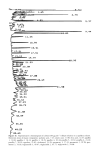
ASSAY OF IMIDAZOLIDINYL UREA 315 Edge of plote ! / / / / / ! Figure 1. Agar Petri dish zone of inhibition test.
Purchased for the exclusive use of nofirst nolast (unknown)
From: SCC Media Library & Resource Center (library.scconline.org)