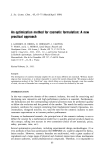
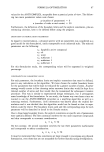
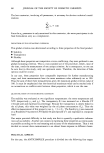
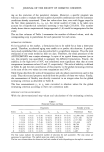
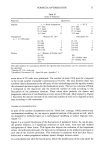
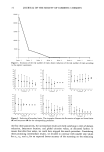
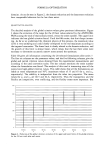
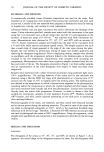
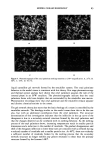
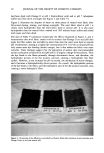
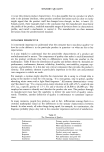
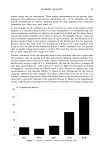
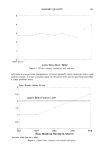
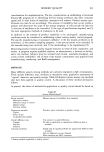
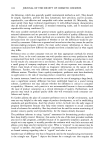
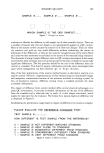
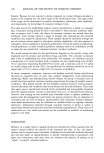
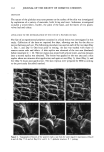
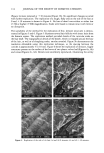
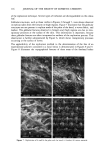
MODEL CREAM RHEOLOGY 83 Figure 4. Photomicrographs of the cetyl palmitate melting transition at 250 x magnification. A. 25øC. B. 40øC. C. 45øC. D. 49. IøC. liquid crystalline gel network formed by the emulsifier system. The cetyl palmitate behavior in the model cream is consistent with this theory. Hot stage photomicroscopy and thermal optical analysis have shown that cetyl palmitate assumes the role of the internal phase in an O/W emulsion. The photomicrographs indicate that the cetyl palmitate forms solid wax droplets that are surrounded by the emulsifier wax matrix. Photomonitor recordings show that cetyl palmitate and the emulsifier remain separate and distinct chemical entities in the cream. The gel network theory also states that the basic rheology of a cream is controlled by the emulsifier network. The rheology studies on the model cream show this to be the case also, but with an additional contribution from the cetyl palmitate. The structure determination of this investigation indicates that the inflection in the up curve of the rheograms is due to a secondary network structure formed by the cetyl palmitate and that the changes observed can be correlated with its melting behavior. As the melting process of the cetyl palmitate shows, increasing temperatures result in smaller particle dimensions and a reduction in the number of crosslinks. The gradual disappearance and shift of the rheogram inflection to lower shear rates are consistent with a network having a reduced number of crosslinks and a smaller particle size. At 40øC, there are evidently a sufficient number of crosslinks broken by the melting process that the secondary network structure no longer exhibits any greater resistance to shear than the primary structure formed by the Lexemul AR ©.

84 JOURNAL OF THE SOCIETY OF COSMETIC CHEMISTS The inflection can be treated as a secondary spur formation with yield value q'i. By definition, spur formations and yield values are associated with three-dimensional net- work structures (2). The thermal optical analysis studies have verified the three- dimensional nature of both the primary and secondary network structures of the cream formed by the Lexemul AR © and cetyl palmitate, respectively. REFERENCES (1) G. M. Eccleston, The microstructure of semisolid creams, Pharmacy International, 63-70 (March 1986). (2) B. W. Barry, "Rheology of Pharmaceutical and Cosmetic Semisolids," in Advances in Pharmaceutical Sciences, H. S. Bean, A. H. Beckerr, and J. E. Carless, Eds. (Academic Press, New York, 1974), Vol. 4, pp. 1-72. (3) G. M. Eccleston, The influence of fatty alcohols on the structure and stability of creams prepared with polyethylene glycol 1000 monostearate/fatty alcohols, Int. J. Cosmet. Sci., 4, 133-142 (1982).
Purchased for the exclusive use of nofirst nolast (unknown)
From: SCC Media Library & Resource Center (library.scconline.org)