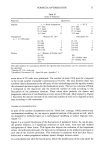
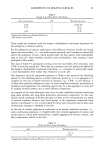
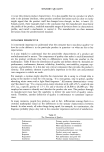
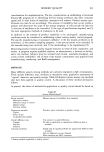
88 JOURNAL OF THE SOCIETY OF COSMETIC CHEMISTS Table I Cationic Adsorption Onto Human Hair mg/gm Adsorbed at 10-min. reaction time Cationic species pH 3.6 pH 6.9 Cation mol. wt. DTAB 2 8 228 CTAB 2 8 284 DTDMAC a 4 8 536 CS b 8 8 629 a Ditallow dimethyl ammonium chloride (see structure 3 below). b Culversoft S-75. The structure originally provided by Culver Chemical Co. for this high-molecular- weight quat corresponds to (2-heptadecyl-l-methyl-1 [(2stearoyl amide) ethyl] imidazolinium methyl sulfate)]. The structures originally assigned to many imidazolinium compounds have been found to be incorrect, and more recently open-structure compounds have been found to be the correct structures. The important point here is not the exact structure, but that this is a very high-molecular- weight quaternary ammonium compound and that its behavior is consistent with the trend found for the other quaternaries of this table. •3 + [CH 3- (CH2)17] 2 -N- CH 3 CI- (3) DTDMAC The data of Table I show two different effects as a function of pH. At the more acid pH (3.6), we see increasing adsorption with increasing molecular weight, i.e., increasing adsorption to hair as the hydrophobic character of the quaternary ammonium moiety increases. Therefore, at the lower pH, we see the hydrophobic effect however, at the higher pH (6.9), the hydrophobic effect is not apparent. At pH 3.6, the hair is close to its isoelectric point (7), and so the surface of the fiber is essentially neutral. As the pH of the system is increased, more carboxylate groups are formed in the hair. This ion- ization effect makes the hair more negatively charged and more receptive to the charge- driven process for a positively charged cationic adsorbing species. As a result, the lower-molecular-weight and less hydrophobic quaternary ammonium compounds adsorb more to the hair at neutral or higher pH. This result is consistent with the charge to hydrophobic continuum hypothesis. ADSORPTION OF QUATS IN THE PRESENCE OF LIPIDS Most hair conditioner formulations in the marketplace consist of cationic surfactants in combination with lipids such as fatty alcohols rather than as just plain cationic surfac- tants. The preferred pH for these products is also acidic, near 4.5, a pH more conducive to hydrophobic adsorption than to charged adsorption of the cationic surfactant. Fur- thermore, in these systems, there is evidence to suggest that aggregates of cationic and lipid adsorb, in contrast to adsorption by individual cationic surfactant molecules (8). In addition, data of Table II show that as the ratio of lipid to cationic in the formula increases, the ratio of lipid to cationic adsorbed onto the hair also increases. Therefore, as the adsorbing species develops more hydrophobic character (more lipid/cationic), it is not repelled by the hair, but continues to adsorb to the keratin. Thus, in conditioner formulations, by using combinations of cationic surfactant with lipids and by increasing

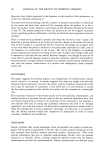
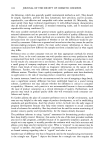
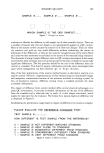
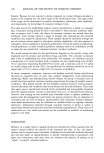
ADSORPTION TO KERATIN SURFACES 89 Table II Adsorption of Cationic Plus Lipid by Hair Ratio in formulation (Lipid/cationic) Ratio adsorbed (Lipid/cationic) 0.68 a 0.41 1.00 a 0.76 2.27 a 1.22 1.50 b 1.22 4.00 b 3.93 a Stearalkonium chloride and cetyl alcohol. b CTAC and cetyl alcohol. the ratio of lipid to cationic surfactant in the formulation, the mechanism of adsorption acquires more hydrophobic character, which is consistent with the charge to hydropho- bic continuum hypothesis. ADSORPTION OF AMODIMETHICONES TO HAIR FROM AN ANIONIC SHAMPOO To determine if it is possible to provide for a hydrophobically driven process by chang- ing the structure of the cationic conditioner, and to provide some learning about current 2-in-1 conditioning shampoos, we decided to examine the adsorption of three different amodimethicone polymers of varying hydrophobicity. These cationic polymers were emulsified in the same 19% ammonium lauryl sulfate shampoo near neutral pH. The polymers were similar structurally (see structure 4 below and Table III), although they differed primarily in their hydrophobicity (see the charge ratios [amine equivalents] in Table III). The amine equivalents are essentially the unit weight titratable by one equivalent of acid, and therefore they increase numerically with decreasing amine con- tent or charge density. CH3 •,Si - O - (Si- O)x - (Si- O)y -Si- CH 3 / / CH 3 CH 3 (CxI--I2)n CH 3 NH- CH:- CH•- NH: Arnodimethicones (4) In addition, we were informed by the supplier that the molecular weights also increased with decreasing amine content however, the molecular weights were not provided to us. Nevertheless, both increasing molecular weight and decreasing amine content should make the polymers more hydrophobic. The data of Table III show increasing adsorption with decreasing amine content (in- creasing numerical value of amine equivalents), clearly in support of a hydrophobically driven mechanism of adsorption. Although one might argue that charge is still involved in the adsorption process, the hydrophobic character is clearly more important than charge to the relative adsorption differences found for these polymers in this simulated
Purchased for the exclusive use of nofirst nolast (unknown)
From: SCC Media Library & Resource Center (library.scconline.org)