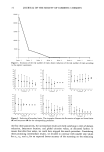
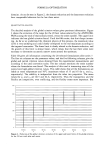
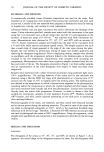
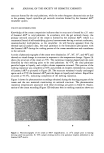
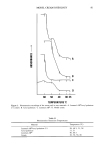
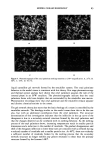
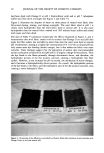
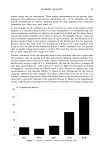
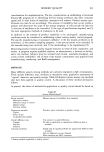
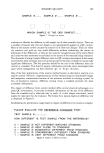
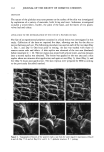
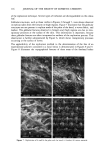
102 JOURNAL OF THE SOCIETY OF COSMETIC CHEMISTS Mean Scores-Tackiness 3 I 0'5 f 0 • 0 1 2 3 4 5 6 7 8 ø MODIFIED SUNSCREEN I ORIGINAL SUNSCREEN Figure 6. Product skinfeel--tackiness: moisturizing lotion with sunscreen. The main objective of establishing a manufacturing facility sensory program is to design an efficient and effective way to evaluate and control variability of key sensory attributes that are driving consumer appeal. This must necessarily include examination of the raw materials and processing steps that might affect the final sensory impression of the product. A Sensory QC program should include examination of all raw materials and key in-process samples, establishing ingredient as well as in-process sensory specifications on key materials, identifying reference standards for use in sensory quality assays, and establishing a management policy regarding the disposition and handling of marginal or subquality materials. If the emphasis and time spent on evaluation of raw materials seems excessive, it is important to understand what sensory contributions the raw materials make to the perception of the finished product. Also, in the longer term, it allows for the critical evaluation of a few raw materials that have been identified as key influencers of sensory character rather then allowing for complex troubleshooting evaluations of the finished product. This approach helps to build in quality rather than taking expensive emergency remedial steps to repair a poor-quality product to make it marketable. The most compelling reason to monitor sensory performance on a regular basis is that experience has shown that an out-of-spec product will very often result in a negative consumer response and lowered acceptability. Once consumer confidence is undermined, it is extremely difficult to get it back. Another reason to establish a sensory specification is that the naturally occurring variability, if left uncontrolled, represents too wide a range to be consistent with the intended product concept. The variables requiring control are the critical sensory parameters whose margins for error are very small. These parameters and their influence on consumer acceptability, as well as the prudence of controlling them, need to be clearly understood by management. Once management accepts and supports the concept of sensory quality, there are key

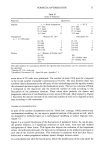
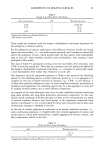
SENSORY QUALITY 103 considerations for implementation. The key considerations in establishing a functional Sensory QC program are 1) identifying the key sensory attributes that drive consumer appeal and 2) what limits of variability consumers will tolerate. Product sensory spec- ifications can then be set accordingly. The amount of variability that occurs within a product will determine the scope of the sensory program. It will provide the basis for 1) selection of attributes to be controlled, 2) the type of specifications required, and 3) the most appropriate methods of evaluation to be used. In addition to the amount of product variability to be anticipated, manufacturing conditions must be considered in establishing a plant sensory quality control program. The specific manufacturing circumstances influence 1) the key sensory attributes to be monitored, 2) the product sampling program, 3) the process points to be included, 4) the manufacturing sites involved, and 5) the methodology to be implemented (5). Monitoring product sensory quality requires resources in terms of time, manpower, and money. A program requires qualified subjects, an administrator, a location or facility, and a test method. Subjects must be screened and trained, standards developed, and action criteria established. All of these steps require commitment and approval from manufacturing, marketing, and R&D management. METHODS Many different sensory testing methods are currently employed in QC environments. These include difference tests, attribute or descriptive tests, qualitative assessments of "typical" character, and quality ratings. Table III displays various sensory test methods that have been applied to quality control. A discussion of these method alternatives follows. In general, the choice of methods for application to quality control should be based on Table III Sensory Methodologies* Rating methods Descriptive analysis Difference rating vs control Quality ratings Attribute ratings Designation methods Typical In/out of spec Acceptable/unacceptable Overall difference tests Triangle Duo-trio A/Not/A Consumer preference Measure amount of variability from standard Provide a yes/no evaluation vs product concept Very sensitive to small differences No data on qualitative or quantitative differences from a standard Sample may be equally preferred yet significantly different from standard Data on differences are not obtained Plant employees are NOT consumers * Sensory methods applicable to quality control.
Purchased for the exclusive use of nofirst nolast (unknown)
From: SCC Media Library & Resource Center (library.scconline.org)