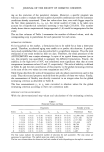
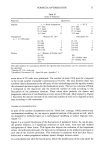
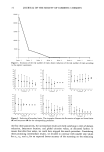
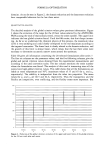
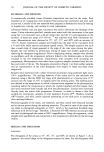
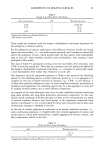
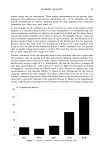
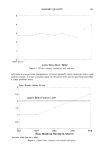
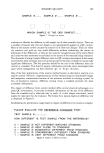
FORMULA OPTIMIZATION 73 domains. As can be seen in Figure 2, the domain reduction and the barycenter evolution have comparable behaviors for the last three series. QUANTITATIVE ANALYSIS The detailed analysis of the global criterion values gives pertinent information. Figure 3 shows the evolution of the range for the 20 best values selected by the ANTICOM- PLEX among the total of trials already tested, versus the series number. The upper limit indicates the best global criterion found. Until the fifth series, this limit keeps increas- ing. As far as we understand the chemical physics of this process, the maximum value (216) is very satisfying and could closely correspond to the real maximum accoMing to the imposed constraints. The lower limit is closely related to the domain reduction, and the growth of this limit is almost linear, which means that the last three series were necessary to determine accurately narrow zones around the optimum. Table III gives all information concerning the 20 selected formulations after series 7. The first six columns are the parameter values, and the five following columns give the global and partial criterion values obtained from the experimental measurements and according to the used conversion scales. The last column mentions the series number where the formulation was found. The analysis of this total is interesting since all the points have high global criterion values. This table shows that all the formulations are stable at room temperature and 50øC (maximum values of 35 and 65 for y• and Y2, respectively). The stability is independent from the other two properties. The mean values for Y3 and Y4 are 40.5 and 64.6, respectively. Thus the transparency and the fluidity are competitive, even conflicting, and the fluidity seems more important. But 250 200 150 100 Series Series Series Series Series Series Series 1 .2 3 4 5 6 7 Figure 3. Evolution of the global criterion: evolution of the upper and lower limits of the global criterion for the 20 best trials after each series.

74 JOURNAL OF THE SOCIETY OF COSMETIC CHEMISTS Table III Information About the 20 Best Trials Parameters x 1 x2 x3 x4 x5 Criteria Global x 6 criterion Y • Y2 Y3 Y4 Series 12.50 10.00 47.50 11.50 10.00 47.00 12.00 10.00 46.00 11.50 10.00 47.50 16.50 10.00 43.50 18.50 10.00 44.00 14.00 10.00 46.00 10.50 10.00 48.50 14.50 10.00 46.50 17.00 10.00 45.50 14.50 10.00 44.00 15.00 10.00 45.00 15.00 10.00 46.00 16.50 10.00 42.00 13.50 10.00 45.00 13.50 10.00 44.00 14.00 10.00 47.50 20.00 10.00 40.00 27.50 7.50 32.50 20.00 10.00 42.50 23.50 23.50 23.50 23.50 23.50 23.50 23.50 23.50 23.50 23.50 23.50 23.50 23 50 23 50 23 50 23 50 23 50 23 50 24.00 23.50 4.50 2.00 216 35 65 50 66 5 6.00 2.00 212 35 65 50 62 7 6.50 2.00 212 35 65 50 62 7 5.50 2.00 210 35 65 50 60 7 4.50 2.00 210 35 65 40 70 6 2.00 2.00 209 35 65 40 69 7 4.50 2.00 208 35 65 40 68 7 5.50 2.00 207 35 65 50 57 7 3.50 2.00 207 35 65 40 67 6 2.00 2.00 207 35 65 40 67 7 6.00 2.00 207 35 65 40 67 6 4.00 2.50 206 35 65 40 66 5 3.50 2.00 205 35 65 40 65 7 6.00 2.00 202 35 65 40 62 6 6.00 2.00 202 35 65 40 62 7 7.00 2.00 200 35 65 40 60 7 3.00 2.00 200 35 65 40 60 7 3.50 3.00 198 35 65 32 66 4 4.50 4.00 194 35 65 32 62 5 2.50 1.50 190 35 65 16 74 5 Parameter values, global and partial criteria, for the 20 best trials after seven series. the lower mean value of the transparency could be due to the multiplication of two experimental measurements. Since the final narrow domains are in agreement with practical requirements for further developments (safety tests, manufacturing processes, etc.), it was decided to definitely stop the iterative procedure. CONCLUSION The variety of requirements in the cosmetic formulation (qualitative, high precision of development, etc.) implies the manipulation of many raw materials whose interactions cannot be modeled. So, in most cases, the user cannot control the system globally. One major practical interest of the ANTICOMPLEX method consists in reducing, by an iterative procedure, the initial domain of study. This feature enables us to find, through the lowest number of trials, the optimal formulae corresponding to a selected global criteria. This optimization works with a global exploration of the hyper space of the parameters and does not try to isolate some parameters and deal with them separately. It operates by successive random sampling of trials, which also decreases the risk of false optima. Different strategies are possible in order to explore deeply the results given by the ANTICOMPLEX method. The user could further either try to use a more restrictive
Purchased for the exclusive use of nofirst nolast (unknown)
From: SCC Media Library & Resource Center (library.scconline.org)