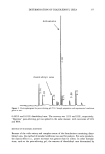
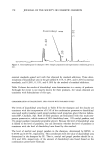
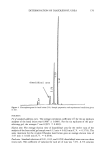
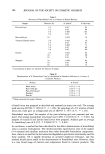
j. Soc. Cosmet. Chem., 45, 173-181 (July/August 1994) Determination of diazolidinyl urea in cosmetic formulations by capillary electrophoresis ROBERT J. GEISE, NANCY I. MACHNICKI, and ROBERT M. IANNIELLO, Analytical Department-Research and Development, International Specialty Products, i36i Alps Road, Wayne, NJ 07470. Received March 24, i994. Synopsis Capillary electrophoresis (CE) is demonstrated for the determination of the preservative diazolidinyl urea in cosmetic formulations. The extremely high resolving power of CE separates the compound from other detectable formulation components. This direct method is an improvement over traditionally used methods, which involve derivatization/degradation reactions. Due to complex matrices, the method of standard additions is used for quantitation. A negative charge is effected by the use of borate buffer (pH 9.3), and diazolidinyl urea elutes at ca. 4 minutes with detection at 215 nm. INTRODUCTION Diazolidinyl urea is the CTFA-adopted name for N-(hydroxymethyl)-N-(1,3- dihydroxymethyl-2,5-dioxo-4-imidazolidinyl)-N'-(hydroxymethyl) urea. It possesses broad-spectrum antimicrobial activity and effectiveness against yeasts and molds (1). It is found in a wide variety of consumer cosmetic products, from gels and lotions to shampoos and make-up. The synergistic combination of diazolidinyl urea with methyl and propyl paraben is widely used (1). Because it is a vital component of formulations, a method to determine diazolidinyl urea in these products is required. Traditionally, compounds such as diazolidinyl urea have been determined by chemical degradation to formaldehyde, followed by derivatization and quantitation of the deriva- tized formaldehyde (2). Examples of such derivatizing agents are chromotropic acid (3) and 2,4-dinitrophenylhydrazine (4). More recently, preservatives such as diazolidinyl urea have been studied by HPLC with post-column derivatization (5-7). However, these procedures have shortcomings. They do not determine the compound directly, but rather a derivative or derivatized degradation product (i. e., formaldehyde). These degradations and derivatizations may not be quantitative, especially in a complex matrix such as a consumer cosmetic product. Capillary electrophoresis (CE) is a high- resolution separation technique that separates components based on size and charge. The 173

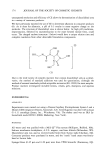
174 JOURNAL OF THE SOCIETY OF COSMETIC CHEMISTS unsurpassed resolution and efficiency of CE allow the determination of diazolidinyl urea in a variety of consumer products. We have previously reported the use of CE to determine allantoin in consumer products (8). As is done for allantoin, a pH of 9.3 results in some negative charge on the molecule. The structure of diazolidinyl urea is shown below. At high pH conditions, deprotonation, followed by tautomerization to the more favored enolate form, could occur. The charged enolate (structure 1 below) would have a unique elution time and complete resolution from other detectable formulation components. OH O HORN. N. ..ff OH o HO (1) Due to the wide variety of complex matrices that contain diazolidinyl urea as a preser- vative, the method of standard additions was used for quantitation, although the method of external standards yielded acceptable recoveries (80-120%) for most samples. Product matrices investigated included lotions, creams, gels, shampoos, and aqueous solutions. EXPERIMENTAL APPARATUS Experiments were carried out using a Dionex Capillary Electrophoresis System I and a Dionex 4400 integrator (Dionex, Sunnyvale, CA). Centrifugation was done with a Jouan G 4.11 centrifuge (Jouan, Inc., Winchester, VA). The shaker used was an IKA La- bortechnik model HS501 (DHK Marketing, New York). MATERIALS All water used was purified with a Milli-Q uv Plus system (Millipore, Bedford, MA). Sodium tetraborate decahydrate, A.C.S. reagent, was from Aldrich (Milwaukee, WI). Diazolidinyl urea was used as received (solid form) from Sutton Labs (Chatham, NJ). Consumer products were purchased in stores, and the "mock" hand cream was formu- lated at Sutton Labs. Syringe filters (0.45 I.tm and 0.20 I.tm) were from VWR Scientific (Piscataway, NJ).
Purchased for the exclusive use of nofirst nolast (unknown)
From: SCC Media Library & Resource Center (library.scconline.org)