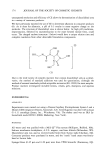
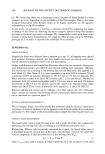
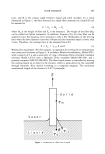
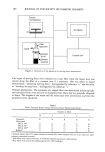
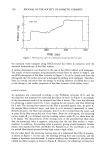
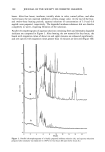
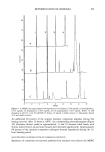
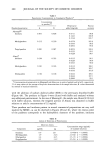
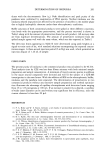
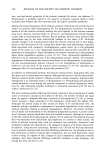
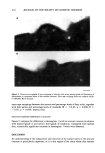
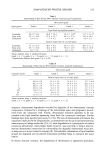
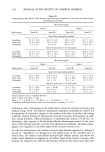
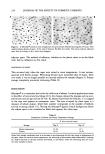
186 JOURNAL OF THE SOCIETY OF COSMETIC CHEMISTS Electro microbalance Liquid •- (•.•..s Fiber pecimen -- •Elevator (fine) '•,,Elevator (coarse) Comp Control unit Figure 2. Illustration of the apparatus for wetting force measurement. Two types of wetting force were evaluated on a hair fiber while the liquid level was moved along the fiber at a constant rate (1.1 mm/min). One was taken at liquid advancement, "advancing wetting force," distinguished by subscript "a," and the other at "receding wetting force," distinguished by subscript "r." Perimeter determination. The perimeter of a sample fiber was determined microscopically and calculated from cross sections of mongoloid hair fibers that are generally elliptical in shape. The lengths of the major and the minor axes were determined, and then the perimeters were calculated. Table I Water Transport Results Along Variously Treated Human Hair Fibers a Number of fibers 10 5 3 2 1 Untreated X X X X X Chlorinated DCCA 3% b O O /• /• X DCCA 6% b O O O /% X DCCA 10% b O O O /• X Rubbed c O O O /X X a Symbols denote that (¸): water transport occurred (X): water transport did not occur and (A): water transport sometimes occurred. b Hair fibers were treated with this % of DCCA (dichloroisocyanuric acid) solution. c Hair fibers were treated by rubbing against CC-1500 sandpaper.

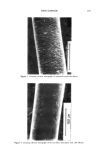
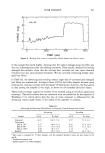
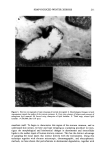
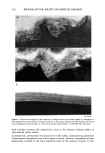
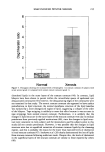
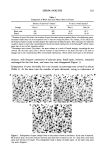
HAIR DAMAGE 187 Figure 3. Scanning electron micrograph of untreated human hair fibers. Figure 4. Scanning electron micrograph of the hair fiber chlorinated with 10% DCCA.
Purchased for the exclusive use of nofirst nolast (unknown)
From: SCC Media Library & Resource Center (library.scconline.org)