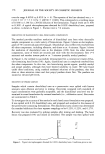
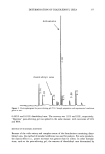
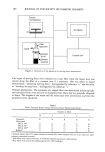
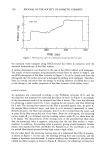
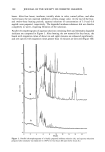
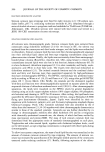
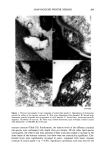
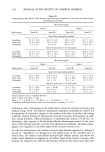
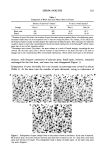
DETERMINATION OF DIAZOLIDINYL UREA 177 Allantoin diazolidinyl urea Figure 2. Electropherogram for pain-relieving gel (5%). Sample preparation and experimental conditions given in text. 0.005% and 0.01% diazolidinyl urea. The recovery was 112% and 92%, respectively. "Daytime" pain-relieving gel was spiked in the same manner, with recoveries of 93% and 88%. METHOD OF STANDARD ADDITIONS Because of the wide variety and complex nature of the formulations containing diazo- lidinyl urea, the method of standard additions was used for analysis. For some products, the matrix effect (i.e., poorer recovery) was greater than for others. In other formula- tions, such as the pain-relieving gel, the amount of diazolidinyl urea determined by

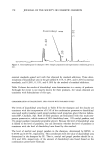
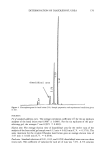
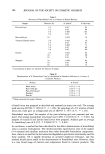
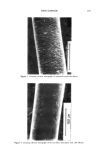
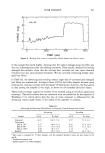
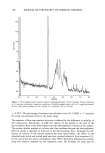
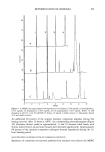
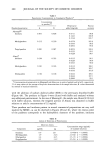
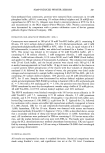
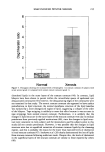
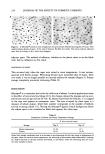
178 JOURNAL OF THE SOCIETY OF COSMETIC CHEMISTS diazolidinyl urea Figure 3. Electropherogram for shampoo (10%). Sample preparation and experimental conditions given in text. external standards agreed well with that obtained by standard additions. Three deter- minations ofdiazolidinyl urea in the gel yielded 0.31%, 0.29%, and 0.26% by external standards, and 0.28%, 0.31%, and 0.30% by the method of standard additions. Table II shows the results of diazolidinyl urea determination in a variety of products. Although the recipe is not exactly known for these products, the values obtained are consistent with formulations of this type. CORROBORATION OF DIAZOLIDINYL UREA FOUND WITH PARABEN LEVELS The levels of diazolidinyl urea found in Table II for the shampoo and the douche are consistent with the incorporation of 0.5% of the combination preservative diazolidinyl urea (and) methyl paraben (and) propyl paraben (and) propylene glycol (Sutton Labora- tories/ISP, Chatham, NJ). Both of these products are formulated with this multicom- ponent preservative, which consists of 30% diazolidinyl urea, 11% methyl paraben, and 3% propyl paraben (remainder propylene glycol). Because the level of diazolidinyl urea is linked to the level of parabens, one can determine whether the level of parabens is consistent with the level of diazolidinyl urea found by this method. The level of methyl and propyl paraben in the shampoo, determined by HPLC, is 0.050% and 0.015%, respectively. This corroborates with the value of diazolidinyl urea determined in the shampoo by CE. That is, methyl and propyl paraben should be ca. 33% and 10%, respectively, of the amount of diazolidinyl urea found (based on the combination preservative formula).
Purchased for the exclusive use of nofirst nolast (unknown)
From: SCC Media Library & Resource Center (library.scconline.org)