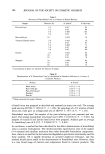
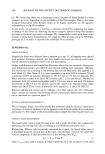
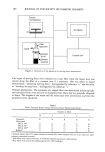
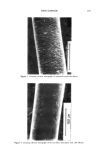
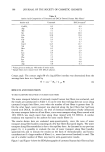
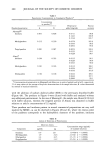
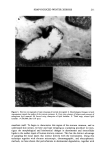
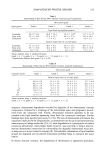
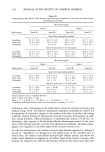
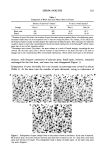
188 JOURNAL OF THE SOCIETY OF COSMETIC CHEMISTS Table II Amino Acid Composition of Untreated and DCCA-Treated Human Hair Fibers a Amino acid Untreated DCCA-treated b CysSO 3 0.5 0.9 Asp 6.0 6.1 Thr 7.1 7.1 Ser 11.2 10.9 Glu 12.8 12.8 Pro 9.2 9.3 Gly 5.5 5.4 Ala 4.7 4.7 Cys/2 14.5 13.7 Val 5.9 6.0 Met 0.5 0.5 lie 2.9 2.9 Leu 6.4 6.5 Tyr 2.1 2.1 Phe 1.5 1.6 Lys 2.6 2.6 His 0.9 0.8 Arg 5.8 6.1 Values given as moles per 100 moles of amino acids. Sample fibers were treated with 10% DCCA solution. Contact angle. The contact angle (0) of a liquid/fiber interface was determined from the wetting force data in a liquid by 0 = COS- 1 (F w / ,¾ LV P) (4) RESULTS AND DISCUSSION WATER TRANSPORT BEHAVIOR OF HUMAN HAIR FIBERS The water transport behavior of variously treated human hair fibers was evaluated, and the results are summarized in Table I. It can be seen that wicking does not occur along untreated (virgin) hair fibers, even when the number of hair fibers is greater than 10. On the other hand, water transport was observed along the hair fibers that had been treated with DCCA. In addition, the level of chemical modification clearly influenced the water transport behavior of hair fibers, since water transport along fibers treated with 10% DCCA was much easier than along those treated with 3% DCCA. A similar tendency was reported by the authors for some textile fibers (3). The results shown here are evaluated semi-quantitatively, since the rates of water transport along fiber bundles consisting of a few hair fibers fluctuated largely. The water transport along fiber assemblies is due to the capillary force. As discussed in our previous paper (3), it is possible to evaluate the rate of water transport along fiber bundles quantitatively and to discuss the results on the basis of thermodynamic and kinetic considerations if a large number of fibers (i.e., more than several hundred) is used. The use of a smaller number of fibers may lead to semi-quantitative results. Figure 3 and Figure 4 show the SEM photographs of untreated human hair fiber and hair

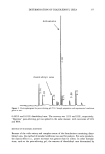
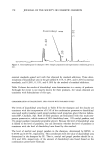
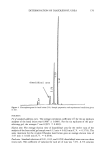
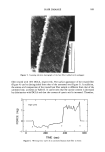
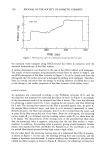
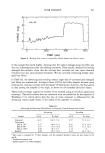
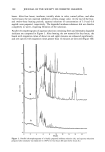
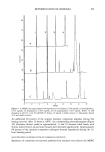
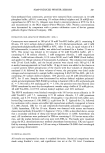
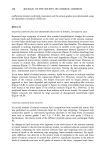
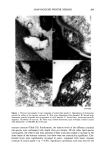
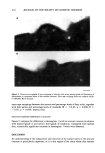
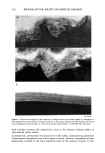
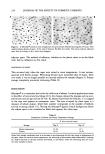
HAIR DAMAGE 189 Figure 5. Scanning electron micrograph of the hair fiber rubbed with sandpaper. fiber treated with 10% DCCA, respectively. The surface appearance of the treated fiber (Figure 4) can be distinguished from that of the untreated one (Figure 3). In addition, the amino acid composition of the treated hair fiber sample is different from that of the untreated one, as shown in Table II. It can be seen that the cystine content is decreased by chlorination with DCCA and that the content of cysteic acid is increased. Therefore, r'r- o -1 I I Hair-UT4 I I I I 0 200 400 600 TIME (sec) Figure 6. Wetting force curve of an untreated human hair fiber in water.
Purchased for the exclusive use of nofirst nolast (unknown)
From: SCC Media Library & Resource Center (library.scconline.org)