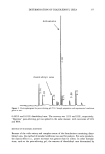
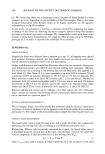
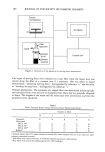
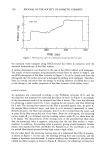
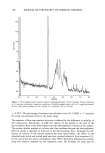
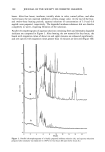
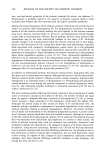
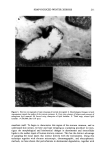
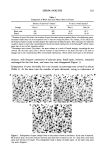
196 JOURNAL OF THE SOCIETY OF COSMETIC CHEMISTS 3.0 2.5 2.0 E 1.5 1.0 0.5 0.0 -0.5 0.0 1.0 2:0 3'.0 4 0 5:0 6'.0 7'.0 8'.0 Minutes Figure 1. Electropherogram of aqueous solution containing Germall ! !5 (8.2 mg/mL). Major component at 3.3 minutes is imidurea. Separation conditions: 10 mM phosphate buffer, pH of 6.1 applied potential, 30 KV fused silica capillary (50 cm, 50-•m i.d.) detection, UV at 190 nm. = 0.997). The percentage of imidurea was calculated to be 96.5 (RSD = 2.1 percent) for seven concentration levels in the linear range. The response of flow-rate sensitive detectors is affected by the difference in mobility of the components. Specifically, in CZE the velocity of the analyte is the sum of the electroosmotic flow of the bulk solution and the electrophoretic velocity of the analyte. The anionic species migrate at a slower rate than imidurea because the electrophoretic flow for anions is opposite in direction to the electroosmotic flow. Although the dif- ference in velocity of the various analytes has been noted before, the effects in the observed peak width and overall peak area have received relatively little attention (13). In the case of percent purity calculations, these effects have been addressed by normal- izing the detector response by the migration time. By dividing the peak area by

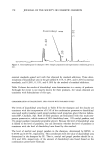
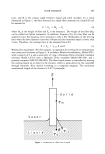
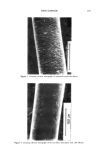
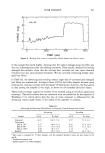
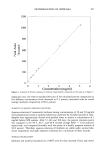
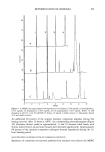
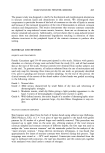
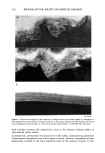
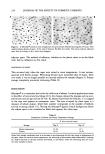
DETERMINATION OF IMIDUREA 197 1200 10oo 800 600 400 200 0 1 2 3 4 5 Concentration (mg/ml) Figure 2. Linearity of detector response to imidurea. Experimental conditions are the same as in Figure 1. migration time, the relative standard deviation of the calculated percent composition at five different concentration levels decreased to 0.2 percent, associated with an overall average imidurea composition of 96.6 percent. STABILITY OF AQUEOUS IMIDUREA SOLUTIONS Aqueous solutions of commercial imidurea having concentrations of 10 and 50 mg/mL were prepared and stored at ambient laboratory conditions for extended periods of time. Samples were appropriately diluted with purified water to achieve a concentration of 1 mg/mL before CZE analysis. After 51, 86, and 106 days, the percent imidurea purity was computed to be 96.5, 96.7, and 96.8 (overall average RSD = 0.18 percent), respectively, and compared favorably with the purity of a freshly prepared solution of 96.6 percent. Therefore, aqueous solutions of imidurea are stable under normal labo- ratory temperature and light exposure conditions for a minimum of three months. THERMAL DEGRADATION Imidurea raw material was placed in a 180øC oven for time intervals of four and twelve
Purchased for the exclusive use of nofirst nolast (unknown)
From: SCC Media Library & Resource Center (library.scconline.org)