72 JOURNAL OF THE SOCIETY OF COSMETIC CHEMISTS (6) M. L. Schlossman, Treated pigments: New ways to impart color on the skin, Cosmet. Toiletr., 105, 53-64 (1990). (7) G. H. Dahms, Formulating with a physical sun block, Cosmet. Toiletr., 107, 87-92 (1992). (8) P. Msika, F. Boyer-Denayrou, and H. Coutelle, Photoprotective microdispersion: A new concept in sunscreen formulation, 18th International IFSCC Congress, Venice, Italy, P 046, 390-401 (October 1994). (9) COLIPA: Sun Protection Factor Test Method ref. 94/289, The European Cosmetic, Toiletry and Perfumery Association (October 1994). (10) S. B. Goodman, J. A. Davidson, and V. L. Fornasier, Histological reaction to titanium alloy and hydroxyapatite particles in the rabbit tibia, Biomaterials, 14, 723-728 (1993). (11) S. Torgersen, G. Moe, and R. Jonsson, Immunocompetent cells adjacent to stainless steel and titanium miniplates and screws, Eur. J. Oral Sci., 103, 46-54 (1995). (12) L. Linder, T. Albrektsson, P-I. Brinemark, H-A. Hansson, B. Ivarsson, U. J/Snsson, and I. Lun- str/Sm, Electron microscopic analysis of the bone-titanium interface, Acta Orthop. Scand., 54, 45-52 (1983). (13) M. A. Listgarten, D. Buser, S. G. Steinemann, K. Donath, N. P. Lang, and H. P. Weber, Light and transmission electron microscopy of the intact interfaces between non-submerged titanium-coated epoxy resin implants and bone or gingiva, J. Dent. Res., 71 (2), 364-371, (1992). (14) E. A. B. Effah, P. D. Bianco, and P. Ducheyne, Crystal structure of the surface oxide layer on titanium and its changes arising from immersion, J. Biom. Mater. Res., 29, 73-80 (1995). (15) J.E. Ellingsen, A study on the mechanism of protein adsorption to TiO 2, Biomaterials, 12, 593-596 (1991). (16) T. Hanawa, "Titanium and Its Oxide Film: A Substrate for Formation of Apatite," in The Bone- Biomaterial Interface, J. E. Davies, Ed. (University of Toronto Press, Toronto, 1991), pp. 51-58. (17) T. Miyazaki, Surface treatments of titanium for a biomedical use, Bull. Kanagawa Dent. Col., 22 (2), 113-123 (1994). (18) J. O. Funk, S. H. Dromgoole, and H. I. Maibach, Sunscreen intolerance: Contact sensitization, photocontact sensitization, and irritancy of sunscreen agents, Dermatologic Clinics, 13 (2) 473-480 (1995). (19) H. Schatz, A.M. Kligman, S. Manning, and T. Stoudemayer, Quantification of dry (xerotic) skin by image analysis of scales removed by adhesive discs (D-Squames), J. Soc. Cosmet. Chem., 44, 53-63 (1993).

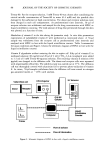
j. Soc. Cosmet. Chem., 47, 73-84 (March/April 1996) Dynamic hairspray analysis. I. Instrumentation and preliminary results j. JACHOWICZ and K. YAO, International Specialty Products, Wayne, NJ 07470. Received January 1996. Synopsis A new method, termed dynamic hairspray analysis, was developed to study the mechanical behavior of pre-set hair tresses, untreated and modified by hairspray resins, under a wide range of bending deforma- tions. The technique includes a vertically acting tensile meter designed to measure the force in both compression and extension modes. The instrument, including a sample holder and spraying devices, was housed in an environmental chamber equipped with a humidity controller. The drying of a hairspray was investigated by (a) applying low intermittent deformations to a preformed hair tress in order to determine the properties of untreated hair, (b) treating the fibers with a hairspray, and (c) measuring the changes both in adhesive properties of a hairspray solution on the surface and in mechanical stiffness of the fiber assembly as a function of drying time. This approach allows the simultaneous determination of parameters such as stiffness of untreated and resin-modified hair, duration of tack, maximum value of tack force, and time of drying. In addition to this, the data collected during the experiment provide information about changes in geometrical dimensions of hair after the application of hairspray and after subsequent drying. In order to test the resistance of fixative resins to high humidity, the kinetic measurements of stiffness and tackiness were also performed at 90% RH. INTRODUCTION The mechanical characteristics of hair, including bending and extension moduli, to- gether with surface parameters, determine their perceptible attributes such as body and feel. Hair fixatives can modify hair by imparting a permanent set and by increasing the stiffness of a fiber assembly. The key hair properties characterizing a hairspray formu- lation or a fixative resin include: ß Stiffness of a hair tress after the application of a hairspray and its complete drying. Twist retention analysis employing a torsional braid analyzer (1) and a bending test developed by BASF (2) have both been used to measure the mechanical properties of hair treated with fixative formulations. The bending test, which involved dipping a swatch of hair in a 3% ethanolic solution of a polymer, gave values ranging from 80 to 140 G as a measure of a stiffening effect (3). It was also found that an increase in stiffness is proportional to the viscosity (molecular weight) of polymer solutions as well as to the total amount of resin deposited on hair. In industrial practice, panel 73
Purchased for the exclusive use of nofirst nolast (unknown)
From: SCC Media Library & Resource Center (library.scconline.org)