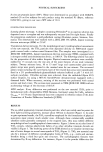
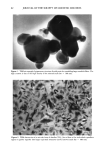
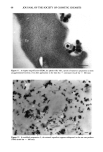
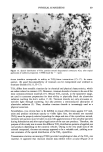
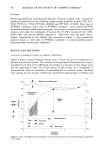
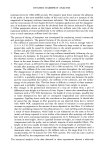
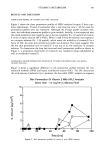
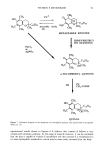
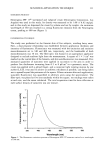
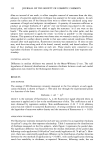
90 JOURNAL OF THE SOCIETY OF COSMETIC CHEMISTS lOO Skin Permeation Of Vitamin E Donor solution ß 13mg/ml in S.F. c: o E 80 60 40 20 0--0' HPLC Analysis ••: Radio Analysis oo /1 20 40 60 o : 0 o 80 1 oo Time (hrs) Figure 4. Comparison of skin permeation of vitamin E using HPLC with radioanalysis. vitamin E from other metabolites. The radiolabeled vitamin E promptly penetrated the skin, while nonlabeled vitamin E appeared after a remarkably long time lag (--48 hr). If the long time lag observed in HPLC analysis is caused by skin binding, since the binding also increases lag time (12), the permeation profile of radiolabeled vitamin E should be similar to that from HPLC analysis. This is not the case in Figure 4. It is therefore suggested that the long time lag may be due to significant metabolism of vitamin E during the initial period of time, when the enzyme responsible for vitamin E metabolism is still very active. During the initial period of time, most vitamin E in the skin may be metabolized. When the time elapses, however, the enzymes are deac- tivated gradually and intact vitamin E appears. IDENTIFICATION OF VITAMIN E AND ITS METABOLITES DURING SKIN PERMEATION Figure 5a shows the HPLC chromatogram of ot-tocopherol, ot-tocopherol quinone. Figure 5b shows the chromatogram of tritium-labeled ot-tocopherol. In Figure 5a, the upper panel of the chromatogram is an HPLC analysis of standard ot-tocopherol (a-T) and its primary metabolite, ot-tocopherol quinone (ot-TQ) with a UV detector at 280 nm. ot-Tocopherol and ot-tocopherol quinone show retention times at 13 minutes and 10 minutes, respectively. The peak at one minute is that for a solvent, methanol. In Figure 5b, the lower panel of the chromatogram is a purity test of radiolabeled ot-to- copherol using HPLC in line with a liquid scintillation counter. As the mobile phase flowed through the HPLC system, tritium-labeled ot-tocopherol was separated as a function of retention time. Most of the radioactivity of radiolabeled vitamin E was

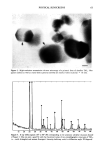
VITAMIN E METABOLISM 91 Identification •.0 4.•5 4. g' 3.5 2.5 2.0 t.• {3O 'cP$ xlo 280 130 .... gS• Oi3 ' ' • O•13g .... t5 130' ' ' Purity of [I:la]a-3,4-a-Tocopherui b [H312-3, 4- a-T 3.5 3.0' 2.• 1.5 0.5. 0t3" gO' ' 05 03 ' 10' 00 Figure 5. a: Chromatogram of ot-tocopherol and ot-tocopherol quinone in an HPLC assay with a UV detector. b: Chromatogram of radiolabeled ot-tocopherol with HPLC in line with a liquid scintillation counter. recovered with the same retention time as vitamin E, and so this tritium-labeled vitamin E was used for this study. With this technique, it was possible to exclude the interference caused by endogenous skin compounds that may leach out from the skin. This technique also allows for the metabolic pathway of radiolabeled ot-tocopherol during the skin permeation study to be traced. Figure 6 shows the chromatogram of a
Purchased for the exclusive use of nofirst nolast (unknown)
From: SCC Media Library & Resource Center (library.scconline.org)