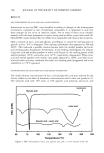
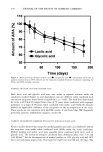
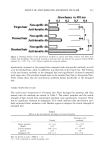
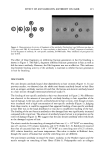
166 JOURNAL OF THE SOCIETY OF COSMETIC CHEMISTS The purpose of this study was to determine the compatibility and stability of lactic acid and glycolic acid in combination with other important ingredients of emulsions. Pre- formulation assessment of the compatibility of several AHAs with these excipients, using 1:1 mixtures and by analysis by differential scanning calorimetry (DSC) (4,5), showed possible incompatibilities. To further explore these interactions, the stability of combinations of lactic acid and glycolic acid and non-ionic emulsion excipients in aqueous solutions was determined at elevated temperatures. MATERIALS AND METHODS MATERIALS Lactic acid (88% aqueous solution), sodium lactate (60% aqueous solution), glycolic acid (98% powder), sorbic acid (99% powder), methyl paraben (99% powder), glyceryl monostearate, cetyl alcohol, isopropyl myristate, isopropyl palmitate, stearic acid, glyc- erol, polyethylene glycol 1000 monostearate, lanolin, and sorbitol were supplied by either Sigma Chemicals (St. Louis, MO), Saarchem (Krugersdorp, South Africa), Croda (North Humberside, UK) or BASF (Ludwigshafen, Germany). All solvents used were analytical or HPLC grade. Water for HPLC and oxygen-free water were used. COMPATIBILITY EVALUATION BY DIFFERENTIAL SCANNING CALORIMETRY (DSC) 1:1 Mixtures of all possible combinations of lactic acid, glycolic acid, and the excipients were made by grinding in an agate mortar and pestle 200 mg of each component. The mixtures were transferred to 5-ml glass vials, closed, and left for at least 24 hours to reach equilibrium. Samples, 5-10 mg, were weighed and hermetically sealed in round- bottomed aluminum DSC sample pans. These samples were then heated at 10øC per minute, from ambient to 300øC, in a nitrogen atmosphere (Shimadzu DSC50, Shi- madzu, Kyoto, Japan). The instrument was calibrated using an indium standard with a melting point of 156.4øC. ACCELERATED STABILITY STUDIES A series of kinetic runs was carried out at 25, 40, 80, and 120øC. Ten percent w/w solutions of lactic acid and glycolic acid, alone and combined with excipients, were prepared in water. To study the effect of lactic acid concentration on the stability of preservatives, solutions containing 5, 10, and 20% lactic acid and buffered with sodium lactate at a pH of 3.83 (pKa of lactic acid) were prepared. Solutions were bubbled with oxygen-free nitrogen for at least two hours to reduce the oxygen concentration. Each solution was filled in 10-ml amber ampoules under a nitrogen atmosphere, and the ampoules were then transferred to incubators kept at 25, 40, 80, and 120øC. At predetermined times, samples were removed from the ovens, chilled, and stored on ice for analysis. At least duplicate samples were removed.

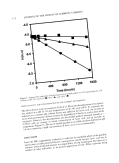
STABILTY OF LACTIC AND GLYCOLIC ACIDS 167 ANALYSIS OF AHA's AND EXCIPIENTS Assays for lactic acid and glycolic acid were performed using a Shimadzu LC-6A system with a C-3RA integrator (Shimadzu, Kyoto, Japan). The UV detector was set at 214 nm. A modified method described by Cheng and Gabbe (6) employing a 25 x 3.9-mm I.D., C•8 column (Micro Bondapack, 5pm, Waters, USA) and a mobile phase composed of water:acetonitrile (60:40 v/v) containing 3 mM ammonium dihydrogen phosphate was used. For the analysis of methyl paraben the same chromatograph and column were used. The mobile phase was water:acetronitrile (62:38 v/v). The wavelength of detection was 254 nm. Samples were diluted with the mobile phase. For both HPLC analyses a flow rate of 1 ml/min -• was used, and 20-pl samples were injected onto the column. Peak areas were used to quantify lactic acid, glycolic acid, and methyl paraben. Calibration data for the analysis methods are listed in Table I. Sorbic acid in aqueous solution has a strong absorption maximum at 258 nm due to the conjugated double-bond carbonyl system. During storage the intensity of this maximum decreases considerably and a new, very weak, absorption maximum appears between 215 and 225 nm (7). Degradation of sorbic acid in aqueous solution was followed by measuring changes in absorbency at 258 nm using a Shimadzu UV 2101 PC spectro- photometer (Shimadzu, Kyoto, Japan), and the concentration of unreacted acid was calculated from the absorbency values. Calibration data are listed in Table I. CALCULATIONS AND STATISTICAL ANALYSIS The kinetic parameters describing the degradation of the acids and excipients were determined by combination of the results from the appropriate analytical methods. By following the change in concentration as a function of time, the reaction order for degradation was estimated and used to calculate reaction rate constants, half lives, and shelf lives. Data at different temperatures were used to estimate activation energies for degradation. Activation energies, pH values, and half-life values were compared statis- tically at a 95% confidence level using the Student's t-test (Minitab, Minitab Inc., Pennsylvania, USA). Table I Calibration Data for HPLC or UV Spectrophotometric Analysis of AHAs, Methyl Paraben, and Sorbic Acid Standard Standard Correlation Concentration error of error of coefficient Compound (mg/ml- •) Slope slope Y-intercept Y-intercept (r) Lactic acid 0.05-0.10 17039 231 453 14 0.9998 0.20-1.00 28907 976 468 43 0.9996 Glycolic acid 0.20-1.00 22718 332 961 82 0.9999 Methyl paraben 0.03-0.15 11471 242 -431 11 0.9996 0.10-1.00 25996 768 -884 48 0.9999 Sorbic acid* 0.10-0.40 12.699 0.678 -0.0176 0.0008 0.9998 * UV spectrophotometric analysis.
Purchased for the exclusive use of nofirst nolast (unknown)
From: SCC Media Library & Resource Center (library.scconline.org)