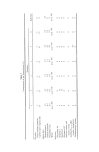
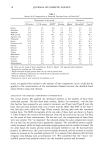
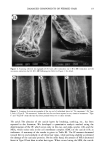
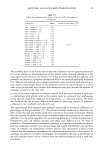
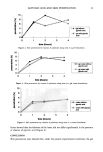
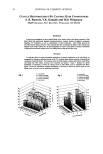
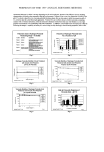
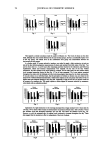
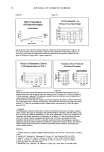
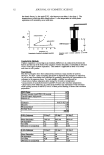
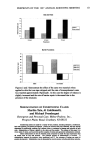
PREPRINTS OF THE 1997 ANNUAL SCIENTIFIC MEETING 51 recommend Polymer D, which is an easy dispersing acrylic acid copolymer, because of its efficient viscosity building characteristics and clarity when exposed to high pH environments. Polymer D has a very low dispersion viscosity at low pH (2.7), which is ideal for a low viscosity peroxide developer phase, but can also make a stable viscous gel at a pH of 3.6, which is ideal for a hair bleach gel application. Polymer D is an excellent choice to thicken peroxide-containing systems with or without surfactants, unlike the associative thickener studied here that may only thicken at a very high polymer concentration or in combination with other surfactants. In addition, cross-linked acrylic acid polymers offer the following advantages: capability to buffer pH, vertical cling (no-drip rheology), shear-thinning properties, and no odor. Polymers Used in Hydrogen Peroxide Thickening Study- 1% Solids POLYMER • INCI NAME DESCRIPTION Pølymlt A C•øme HIghly crOll-IIn kid hem •olym It • ice/Ik .cid. p•ymmt•d • cyclehew. Polymlr C ClrbOm .r Elly dilp•lin•, h•hly CrOll-ilnked hom•pollnnl M ic•11c idd, po•nn ifLTid In • .Cealb, and P•lfO Acryllm/C10-30 AJkyl EII¾ dllp•rllng, emil-linked copo•/mlt M Acfylll• C•o11•o¾11e•: ic lyli½ icld. polyllll• Fig. I Viscosity of Hydrogen Peroxide Gels As a Function of pH 1ooooo 10000 lOOO loo lo 1 Hydroge#Pore•dl'A'Ulld 2.7 3.6 4 pH • Fig. 2 Hydrogen Peroxide Stability of Gels Thickened with Acrylic Acid Polymers pH 4.0, 6% Peroxide Initill 4 Sloblilly W#kl ß 45 * c Peroxid, 'A' ulsd ..• Fig. 3 Viscosity Stability of Hydrogen Peroxide Gels Thickened with Acrylic Acid Polymers Polymer D, 6% Peroxide •oo,ooo lO,OOO • loo Inlbll I 2 4 Hydrogen Peroxide 'A' UlOd S[iblllt¾ Wlekl • 45' C Fig. 4 Viscosity Stability of Hydrogen Peroxide Gels Thickened with Acrylic Acid Polymers pH 4.0, 6% Peroxide 1oo.oo• •• -- _ 3. Polymer A lO,0O0 .,irl -i- i, Polymer B 1 .ooo 15, Polymer c 21, Poty•,r O •1. Poly•or E Hydrogen Pem•M, 'A' ..d High pH Viscosity Response of Peroxide Gels -- pH 10 1% polymer Concontrition Hydrooen Peruride 'A' ultd • Fig. 5 Fig. 6

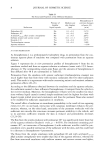
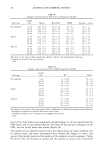
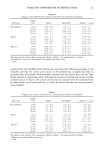
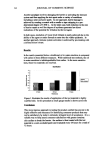
52 JOURNAL OF COSMETIC SCIENCE EVALUATION AND TREATMENT OF SENSITIVE SKIN A MULTI-FACETED APPROACH D. Maes, K. Marenus, N. Muizzudin, E. Goyarts, C. Fthenakis, M. McKeever, Este• Lauder Laboratories, Melville, NY 11747 Introduction: Users of cosmetic products, often perceive their skin to be "sensitive", as they experience transient adverse reactions such as itching, burning, redness, and in some cases edema. Although some of these adverse effects do not qualify as sensitive skin reactions, we believe it is necessary to understand the etiology of these cutaneous responses, tn order to develop products which not only will be milder, but in addition will reduce the reactivity of the real 'sensitive skin". To be able to create such technology, it is necessary to understand the mechanisms of the processes leading to skin sensitivity, and to develop the methodologies which will allow the accurate measurement of the factors involved in the development of a cutaneous reaction. Skin sensitivity can be evaluated on the basis of three different parameters: Skin permeability which is controlled by the barrier function of the Stratum Corneum, skin immune reactivity which dictates what type of reaction is going to take place (irritant or allergic), and skin neuro-sensory response. We propose to first review the correlation between these three factors and the development of sensitive skin. We then will review the most recent technologies available to control these factors in order to reduce significantly the reactivity of the skin to the environment. The etiology of sensitive skin: One of the most important cause of a cutaneous reaction, is certainly the disruption of the sk{n's barrier function. Even if this factor alone cannot account for all the different aspects of sensitive skin, •t remains certainly one of the most common factor leading to the development of chronic, sensitive skin. To evaluate such correlation, we measured the Trans Epidermal Water Loss on the facial cheek area of a group of individuals with sensitive skin, after removal of successive layers of the stratum Comeurn using adhesive tape. The results clearly showed that it took significantly less strips to destroy the barrier function of the individuals with sensitive skin compared to a group with normal skin. Similarly, measurements of the skin reactivity (blood flow), clearly separate the sensitive from the non-sensitive populations, showing a clearly distinct reaction to an irritant between the two groups. Additional measurements done in-vivo after application of Methyl nicotinate on the skin, showed a significant increase in the release of two key inflammatory mediators, Arachidonic acid and Prostaglandin E2, providing some additional insight on the possible mechanism behind the previously observed increase in blood flow. Similar conclusions were obtained as far as the neuro-sensory response is concerned as the group with sensitive skin experienced a stronger stinging reaction to lactic acid than the population with normal skin.
Purchased for the exclusive use of nofirst nolast (unknown)
From: SCC Media Library & Resource Center (library.scconline.org)