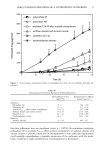
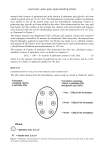
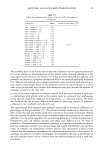
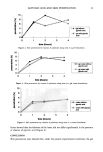
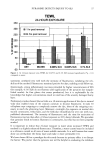
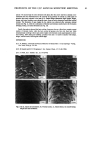
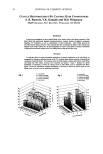
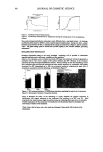
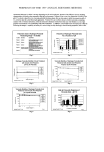
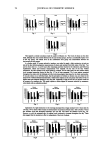
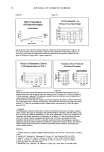
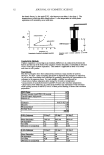
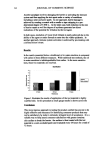
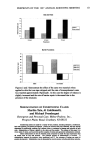
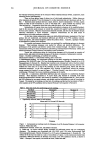
PREPRINTS OF THE 1997 ANNUAL SCIENTIFIC MEETING 57 SKIN-MOISTURIZING EFFECT OF POLYOLS AND THEIR ABSORPTION INTO HUMAN STRATUM CORNEUM T. Okamoto, Ho Inoue, S. Anzai, and Ho Nakajima Shiseido Basic Research Laboratories, 1050 Nippa-cho, Kohoku-ku, Yokohama-shi, Japan 223 Introduction Lack of water in stratum comeum results in dry and scaly skin. Humechants in skin-care cosmetics play an important role in the moisturizing of stratum cornenm. It is well known that glyceml has excellent skin- improving effects as a humeclant. Bissett and McBride demonstrated the skin-conditioning effects of glyceml on human and pig skinil Batt ct al. reported on the skin improving benefits of glyceml? • Rowlings et al. suggested the important role of glycerol for enhancing desmosome degradation of stratum corneum? However, systematic investigation on the dislribution ofglycerol in stratum corncure and its skin-moisturizing effect had not been conducted. In this work, we investigated (I) the adsorption ofpolyols in stratum comeum and (2) its skin-moisturizing mechanism. Experimental Materials: Glycerol, 1,3-butylene glycol, dipmpylene glycol, erythrilol and dig!ycerin were selected as a model of humectant of polyol and purchased from Tokyo Chemical Industry (Tokyo, Japan). Evaluation of skin-motsturizing effect: Healthy male volunteers were selected for this study. In each individual, 3 or 4 sites of the forearm skin were treated with polyol aqueous solutions. The skin-moisturizing effect was evaluated by skin surface conductance, measun•d with a high-frequency impedance meter, SKIKON-200 {lBS, I-!amamatsu, Japan). These measurements were performed at 23øC and 50% RH. In order to avoid the influence of residual humeclant, perspkation, and sebum, the skin surface was washed with water and soap 30 rain before the measurements. Penetration study of humectants into stratum corneum: Repeated tape-strippings were carried out on the skin treated with polyol aqueous solutions. The weight of collected stratum corneum was estimated from measurement of weight of a sheet of adhesive tape before and after the tape-stripping. The humeclant was extracted with methanol from stratum comeurn on the tape and analyzed by gas-chromatography. Hygroscopiclty of polyols: Water content of the humeelant at various relative humidity was measured with Karl Fischer's method. Results and Discussion In vivo skin-moisturizing effect and amount of polyol absorbed in stratum corneum: Fig. I shows the relationship between skin- moislurizing effect of glyccml or dipropylene glycol and its amount of humeclant in stratum corneum for. The skin-moisturizing effect increased linearly with the amount of absorbed humeelant in stratum corncum in both cases. If the delivered amount of both hum•clants in stratum cornenm was the same, the skin-moisturizing effect of dipropylene glycol was smaller than that of glycerol. The result shows that the moisturizing effect depend on the hygroscopicies of humectants. These results 0 20 40 60 80 100120 Polyol in stratum comeurn (pg/mg of tissue) Fig. I The relationship between skin-moisturizing effect and absorbed polyol The closed square (1) represents glyceml the open circle (O), dipmpylene glycol the open square (D), untreated control. Skin-moisturizing effect (y-axis) was evaluated from following equation. Skin surface conductance after application Skin-moisturizing effect = Skin surface conductance before application The lines wer• regression line, which wascaluclated from data points. suggested that skin-moisturizing effect was due to the amount of polyols in stratum corneum and its hygroscopicity. Time dependence of concentration profile of polyol in stratum corneum: In the case of one time application with 50% glyceml and dipropylane glycol aqueous solutions by a glass tube(3.2 em inner diameter) for 30 rain to the skin, skin-moisturizing effect of glyeerol was comparable to that of dipropylene glycol 30 rain after the application. Although the effect ofdipropylene glycoldecreased with time, no remarkable decrease of the effect of glycerol was observed. In order to clarify this difference, we investigated the time dependence of concentration profide of polyol in stratum corneum the changes in concentration profide ofpolyols with time. Fig. 2 demonstrates the polyol concentration profide across the sttmum corneum at 0, 1, and 6 h after the application, The x-axis, which indicates the integrated weight of stratum comeurn obtained by tape-stripping, corresponds to the depth ofhemy layer. Amount of absorbed dipropylene glycol at various depth of stratum comeurn immediatdy after application was greater than that ofglycerol, but decreased rapidly with time. However, the amount of glycerol absorbed at various depth of stratum cornenm showed no change with time. These results indicate that decrease in skin-moisturizing effect of dipropylene glycol with time is due to its disappearance from stratum comeum.

58 JOURNAL OF COSMETIC SCIENCE Accumulation of humectant in stratum corneum: After the application twice a day for 10 days by the above m•thod, the concentration profile ofdipmpylene glycol in stratum comeurn and the skin-moisturizing effect had no remarkable change. On the other hand, glyceml was accumulated in stratum comeurn upon the continuation of use for 10 days with showing its skin-moisturizing effect. When 20 mL of I 0 % glyceml aqueous solution was applied twice daily for 10 days to 20 cm 2 forearm skin and then stopped to apply, glyceml concentration profile in stratum comeurn and skin-moisturizing effect were investigated. Maximum concentration of glyceml in stratum comeurn was approximately 20-30% of weight of stratum comeurn, and skin-moisturizing effect corresponded to the amount of absorbed glyceml in stratum comeum. Conclusion These results suggested that (1) the skin-moisturizing effect depends on the amount of absorbed humeclant and their physico-chemical property in stratum corneum and (2) the excellent skin-moisturizing effect of glycerol is due to the high accumulation of glyceroi in stratum comeurn. References Glyceroi I) D. L. Bisse•t et al., J. 250 Soc. Cosmet. Chem., 35, 345 (1984) •. 200 2) M.D. Batt et al., J. Soc. Cosmet. Chem• 39, " • 150 367(1988) 3) A. Rawlings et al., • •o 100 Arch Dermatol Res, 287, 457 (1995) • "• 50 0 Dipropylene glycol 0 3 0 3 I I Stratum comeurn weight (mg)* Stratum comeum weight (mg)* Fig. 2 Concentration profile of polyoI in stratum corncure at 0, I, and 6 h after application The open square (D) represents the amount of polyol in sWatum comenm immediately after application the open circle (O), that after 1 h the closed square (1), that after 6 h. The asterisk (*) indicate the integrated weight of stratum corneum obtained by tape-stripping and correspond to the depth of horny layer. MEASUREMENT TECHNIQUES LEADING TO IMPROVED ON-HAIR PERFORMANCE OF LOW VOC HAIR SPRAYS G.T. Martino, J.L. Gormley, M.J. Vitale, J.G.L. Pluyter National Starch and Chemical Co., 10 Finderne Ave., Bridgewater, New Jersey 08807 INTRODUCTION The California Air Resource Board (CARB) and other State agencies are moving to reduce the volatile organic compound (VOC) emissions generated by cosmetic and household products, in order to improve air quality. As the VOC contern of hairspray formulations in the U.S. are lowered from -95% in the early 1990's to 55% VOC by June I, 1999, a great effort has been undertaken by formulators and raw material suppliers to maimain the proper performance propertiesL The most cost effective low VOC formulations involve the replacement of organic solvents with water. Unfortunately, water has a deleterious effect on just about every property that is critical to hairspray performance TM. Optimization of low VOC formulations requires a detailed knowledge of the correlation between the formulation physical properties and the on-hair performance properties. In this presentation, the relationship between fundamental physical / surface chemistry with hairspray performance will be discussed. Objective testing methods will be used to demonstrate the importance of physical properties such as wetting, viscosity, dynamic surface tension, pH, and polymer composition on performance properties such as spray aesthetics, drying time, hold, stiffness, and corrosion. RESULTS AND DISCUSSION WETTING: For a hairspray to perform optimally the formulation must coat adjacent hairs and create a bond, which results in the properties of hold and stiffness. The length, continuity, adhesion and toughness of this
Purchased for the exclusive use of nofirst nolast (unknown)
From: SCC Media Library & Resource Center (library.scconline.org)