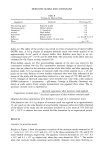
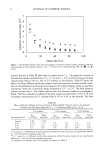
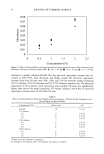
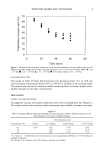
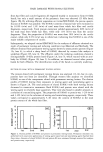
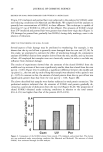
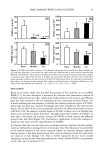
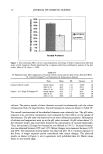
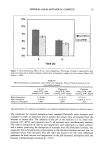
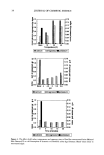
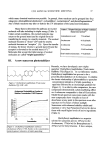
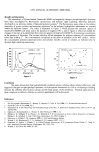
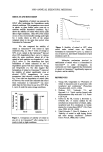
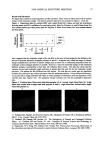
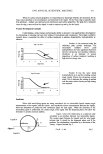
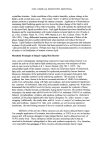
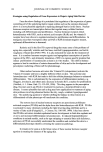
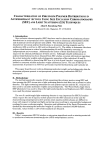
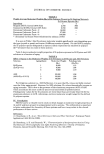
10 JOURNAL OF COSMETIC SCIENCE thinning solutions. Table IV shows that the flow behavior indexes (n) are less than 1 for all moisture masks prepared. Results in Table IV confirm the shear-thinning properties of moisture masks shown in Figure 1. The apparent viscosities of moisture masks increased with the increasing concentration of water-soluble chitosans used (of the same molecular weight), or increased with the increasing molecular weight of water-soluble chitosan used (of the same concentration of water-soluble chitosan), as shown in Table III. This may be due to the viscosity of o/w emulsion systems depends on the viscosity of continuous phase that in turn depends on the concentration and/or molecular weight of the polymer used in the continuous phase. Muzzarelli (8) reported that N- carboxymethyl chitosan can increase the viscosity of a solution. The viscosity-increasing capacity is related to the molecular weight of the chitosan. Li (24) reported that water- soluble chitosan obtained by ultrasonic treatment affected the flow consistency index, which increased with increasing molecular weight and concentration of water-soluble chitosans used in the system. Both reports confirm the above results. Moisture masks containing 2% methyl cellulose had a lower viscosity than that containing 0.5% U3 chitosan. This may be because the molecular weight of methyl cellulose is smaller than that of U3 chitosan. The effect of solution pHs between 6.3 and 6.7 on viscosity was not significant. COLOR OF MOISTURE MASKS The results in Figure 2 show the orange-red color of moisture masks increasing with increasing concenration of water-soluble chitosan used in the formula. This may be due to the astacene remaining at the time of chitosan preparation. An increase in the orange-red color of the moisture mask may appeal to consumers because of the warmth associated with this color. EFFECTS ON THE WATER-HOLDING CAPACITY OF MOISTURE MASKS The efficacy of moisture masks in terms of water-holding capacity of the skin was tested by the corneometer method (40-42). The corneometer measures changes of electrical capacitance that are related to the moisture content of the stratum corneum before and after applying a moisture mask. Results in Figure 3 show that after applying moisture masks containing different molecular weight water-soluble chitosans or methyl cellulose (86,000 Da), the electrical capacitance increase ratio increased, then decreased, and finally leveled off. This may be because after applying the moisture mask, the moisture content of the skin increased, and so the electrical capacitance increase ratio increased accordingly. As water evaporated over time, the electrical capacitance increase ratio decreased. Finally, the mask dried out, with the ingredients dissolved in water or the water-alcohol mixture forming a film on the surface of the skin that prevented further water evaporation, and therefore, the electrical capacitance increase ratio leveled off. Electrical capacitance increase ratios were 38%, 34%, 31%, and 26% for those moisture masks containing 2% U3 chitosan, 2% U30 chitosan, 2% U120 chitosan, and 2% methyl cellulose, respectively, after applying those products for 60 min. The results indicate that the water-holding capacity of moisture masks containing different water- soluble chitosans was significantly better than that of masks containing methyl cellulose. This may be due to the fact that either the molecular weight of water-soluble chitosans

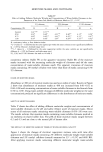
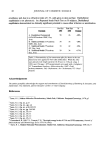
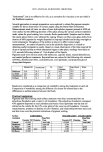
MOISTURE MASKS AND CHITOSANS 11 is larger than that of methyl cellulose or that chitosan and its derivatives have excellent water-holding capacities (9,28-31). The results in Figure 3 also show the water-holding capacity of moisture masks increasing with the use of water-soluble chitosans of higher molecular weight. FILM-FORMATION TIME OF MOISTURE MASKS The results in Table VI show film-formation times of moisture masks decreasing with the increasing concentration of water-soluble chitosans used (of the same molecular weight of water-soluble chitosan) or decreasing with the increasing molecular weight of water-soluble chitosans used (of the same concentration of water-soluble chitosan). This may be because film formation results from aggregation of film-forming compounds, i.e., the water-soluble chitosan, after the solvent evaporates (8). Therefore, film- formation time decreased with increasing concentration of film-forming agents and/or decreased with increases in their molecular weights. The reason that moisture masks containing 0.5 g U3 chitosan have film-formation times similar to those of masks containing 2.0 g of methyl cellulose may be due to the fact that the molecular weight of U3 chitosan is larger than that of methyl cellulose, as mentioned previously. CONCLUSIONS 1. Moisture masks containing different molecular weights and/or concentrations of water-soluble chitosans are pseudoplastic fluids. 2. The apparent viscosity of moisture masks increased with the increasing molecular weight and/or concentration of water-soluble chitosans used in the formula. This will improve the stability of the moisture mask, enhance skin hydration, shorten film- formation time, and improve skin compatibility. Thus moisture masks containing water-soluble chitosans will be useful in a wide range of applications. 3. These beneficial effects may be attributed to the good water-holding capacity, thick- ening, and film-formation properties of water-soluble chitosans. ACKNOWLEDGMENTS The authors would like to express their gratitude to the National Science Council, Republic of China (Project No. NSC 86-2313-B-019-006) for its financial support. REFERENCES (1) A. Domard, G. A. F. Roberts, and K. M. Varum, Eds., Advances in Chitin Science, Volume II. (Jacques Andre, Lyon, France, 1997). (2) R. H. Chen and H. C. Chen, Eds., Advances in Chitin Science, Volume III (RITA Advertising Co., Ltd., Taipei, Taiwan, ROC, 1999). (3) C. Y. Chang, The effect of adding chitinous materials on the qualities of the Alaska pollack kamaboko. MS Thesis, National Taiwan Ocean University (in Chinese), 1997. (4) G. Lang, E. Konran, and H. Wendel, "Chitosan Derivatives: Water-Soluble Products by Reaction with Epoxides," in Chitin in Nature and Technology, R. Muzzarelli, C. Jeuniaux, and G. W. Gooday, Eds. (Plenum Press, New York, 1986), pp. 303-306.
Purchased for the exclusive use of nofirst nolast (unknown)
From: SCC Media Library & Resource Center (library.scconline.org)