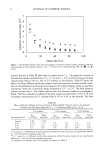
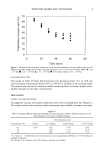
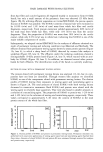
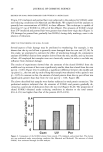
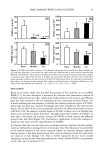
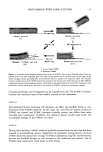
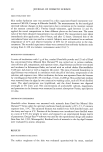
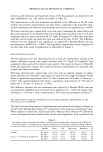
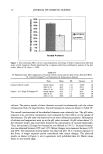
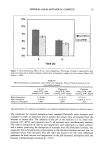
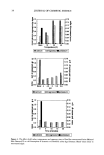
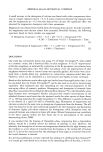
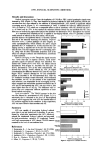
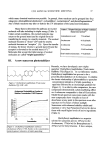
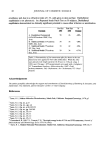
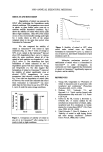
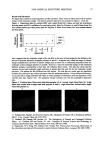
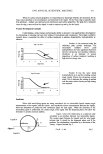
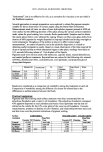
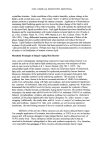
1999 ANNUAL SCIENTIFIC MEETING 45 Results and discussion Radical scavenging activity. Upon the irradiation of UVA/B to PBS, typical quadropict signals were detected by ESR (Figure 2). They were identified as hydroxyl radicals for their shift positions and the ob- servation that they were reduced by the addition of dimethylsulfoxide. APS showed a significant radical scavenging activity (Figure 3)' At a concentration of lmM, it reduced the hydroxyl radical amount by 30%, at 10ram by 75%, which was a comparable efteel to that of ascorbate, while AG showed less activi- ty, at 10ram only by 25%. In this reaction the reduclant (electron donor) was not ascorbate but AP, since there was no hydrolyzing agent added and no free ascorbate was detected by HPLC throughout the reaction. It is important that unhydrolyzed AP is capable of scavengqng radicals, since UV generates a consid- erable amount of radicals on the skin surface, which quite possibly destroys the epidermal barrier. It has been reported that one of the naturally occurring skin bacteria, Propioni- bacterium aches, a potent pathogen of acne ,•xflgaris, se- cretes coproporphyrines which enhance the active o,,o.'gen generation by UV irradiation (5). In this situation the scav- enging activity is required not in the skin but mostly out- side the skin. This fact suggests that AP's scavenging activ- ity, along with all other intracellular properties such as the effects on collagen synthesis and inflammation, contributes to acne treatments. Radical scavenging in sl{'in. Though the signal intensity was lower than that in aqueous solution, easily distin- guishable signals of hydroxyl radicals were identified. Pre- treated with 20ram (0.6% w/w) APS, the radical amount decreased by 50% (Figure 4). Ascorbate was also quite ef- fective, decreased by 55% at the same concentration. AG showed less activity 20mM reduced by 35%. At higher concentrations the difference herween APS and AG was even bigger. HPLC analysis detected no AP but considerable amount of ascotbate in the APS-pretreated skin. After the UV irradiation ascorbate content decreased, which indicated that ascotbate, not AP, on the contrary. to the experiments with solutions, was responsible for the scavenging activity. Miwa compared the intracellular ascorbate-enrichment rate of APS and AG and reported that APS's rate was tss4ce to nine times higher than that of AG (6). This difference well ex- plains those two compounds' different capabilities of intra- dermal radical scavenging. Lipid peroxidation. The TBARS amount in the skin svas also reduced by pretrcatment of APS (Figure 5). It is noteworthy that it remained in the level of non4rradiated control, which suggests that with APS the harmful effect of UV could he neglected in this condition. In this experiment, APS was more effective than ascotbate and AG. PBS I I I I +AsA ,•:- --•,•,• •,,,, •.-•, • ß, - -• N-•----, ,•, •-,•-, • ,q••..• 25 • 75 1 O0 Relative •dro•l radicat amouN (%) Fibre 3. Radical scaveng•g in aqueous solution. I I I I •s +•s '• •G ""• :¾'•': '•":? ::: '• •:•'•:•• ' '• • I I I I 0 25 • 75 l O0 Relat•e hydroxy radial amount Fibre 4. Radical scaveng•g in Summary APS was capable of scavenging hydrox3'l radicals even when it was not hydrolyzed to ascotbate. It •as con- Nor• firmed by whole-skin experiments that APS effectively reduced the intradermal hydrox.wl radicals and prevented uv •a the lipid peroxidation caused by UV irradiation. Treated •th high concentration of APS, dermat TBARS amount •o• •^ remained in the level of non-irradiated skin. /LIVirrad. 20ram APS References /uv irrad. l. Kameyama, K., J. Am. Acad. Dermato!., 34, 29 (1996) 2o,,• 2. Kobayashi. S., Fragrance J., 25 (3), 34 (1997) AJVirrad. 3. Kobayashi, S., Photochem. Photobio!., 64, 224 (1996) 4. Jurkiewicz, B.A., Photochem. Photobiol.. 59, 1 (1994) 5. Ryu, A., Fbaburic, 19 (1), I (1995) 6. Miwa, N., Fragrance J., 25 (3), 7 (1997) I I I I I I I I 0 5 lo 15 20 TBARS (nmol/mg protein) Fisure 5. Suppression ofTBARS tbrmation

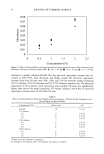
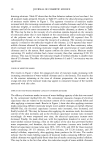
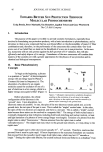
46 JOURNAL OF COSMETIC SCIENCE TOWARDS BETTER SUN PROTECTION THROUGH MOLECULAR PHOTOCHEMISTRY Craig Bonda, Peter Marinelli, Yin Hessefort, Jagdish Trived and Gary Wentworth The C.P. Hall Company I. Introduction The purpose of this paper is twofold: to provide cosmetic formulators, especially those involved in formulating sun protection products, with a basic introduction to photochemistry and to introduce to them a new compound that has a profound effect on the photo stability of many UV filter combinations and, therefore, on the performance of the sunscreens that contain them. Our work grows out of our belief that we stand on the threshhold of a new era in sun protection. In this new era, sunscreens will not only protect against the full spectrum of UV radiation, they will also efficiently and safely dispose of its energy. Formulators of the new sunscreens will combine their mastery of the cosmetic art with a greater appreciation for the physics of sun protection and its chemical and biological consequences. II. Basic Photochemistry Concepts To begin at the beginning: a photon is a quantum or "packet" of electromagnetic energy with an energy equal to Planck's Constant (h) times its frequency (v). The absorption of a photon by an organic molecule causes the excitation of one of a pair of electrons in a low energy orbital to a higher energy unoccupied orbital I (Figure 1). Before absorption, the orbital configuration of the electrons is the "ground" state. Upon absorption, two sm0et Triplet Figure 1: Schematic representation of photon absorption resulting in the excitation of an electron to the singlet state, the decay to the triplet state, and the emission of a photon before returning to the ground state. electronic states are possible. In one, the spins of the two electrons remain paired and, as in the ground state, the net spin of the pair is zero. This is called the "singlet" excited state. In the other, the spins of the two electrons are unpaired, and there is a net spin. This is called a "triplet" excited state because three states can be resolved in a magnetic field. 2 The energy of both excited states is eventually dissipated as heat (vibration, including both bond stretching and nuclear motion), or heat and light (emission of a photon of lower energy/longer wavelength). Emission of a photon from the singlet state is called "fluorescence." Photon emission from the triplet state is called "phosphorescence." The singlet state may return to the ground state directly, or it may decay to the triplet state. • The singlet state is often short-lived, typically 10 '9 - 10 '8 seconds. Therefore, reactions that proceed from it must be quite rapid. Of more importance to the sunscreen formulator are reactions that proceed from the (usually) much longer-lived triplet state, which may last 10 -4 seconds or longertl During the triplet state lifetime, the excited molecule looks and behaves as a diradical, 5 from
Purchased for the exclusive use of nofirst nolast (unknown)
From: SCC Media Library & Resource Center (library.scconline.org)