MOISTURE MASKS AND CHITOSANS 3 skin. Common absorbing humectants are glycerin, propylene glycols, and high- molecular-weight humectants such as hyaluronic acid and chitinous materials (28,29). Chitinous materials have (a) good occlusive and water-absorbing properties (9,28-31), (b) good surface activity properties, (c) very good film formation properties of chitosan (8,30,32), and (d) good thickening properties. Knorr (13) reported that microcrystalline chitin has better emulsion properties than does microcrystalline cellulose. Magdassi and Neiroukh (14) reported that chitin particles include both hydrophobic and hydrophilic groups and tend to be absorbed on the o/w interface of oil drops. In the presence of 0.005% (w/w) Tween 80, the emulsion system containing only 0.5% (w/w) chitosan showed good emulsion stability. Sakurai et al. (32) reported that application of 0.3% hydroxypropyl chitosan to skin will form a smooth and pliable film that has good water-holding properties. Gross et al. (33) reported chitosan film to be stable in high-humidity environments. It has better ab- sorbing properties on hair than do traditional polymers used in hair products, and it prevents static charging during brushing. N-carboxymethyl chitosan can increase the viscosity of a solution. The viscosity- increasing capacities are related to molecular weight (8). Li (24) reported that water- soluble chitosans obtained by ultrasonic treatment have an effect on the flow consistency index, which increased with increasing molecular weight and the concentration of water-soluble chitosans used in the system. Results of a one-time, cumulative irritation test on shaved rabbit skin and a one-time ocular test indicated that chitinous materials caused no irritation on shaved skin or cornea and left no extraneous material on the cornea (30). Those results indicate that chitinous materials are good ingredients for cosmetics. MATERIALS AND METHODS PREPARATION OF WATER-SOLUBLE CHITOSANS Chitosan was prepared by alkali deacetylation on chitin with 50% NaOH at 100øC for 3 h. The ratio of chitin to 50% NaOH was 1:20. Chitin was prepared from shrimp (Solemocera prominentitis) waste (34). Water-soluble chitosans were prepared by ultrasonic treatment (35) for 3, 30, and 120 rain to obtain U3 chitosan, U30 chitosan, and U120 chitosan, respectively. CHARACTERISTICS OF WATER-SOLUBLE CHITOSANS Molecular weight determination. The molecular weight of prepared water-soluble chitosans was determined with high-performance liquid chromatography (HLPC) by the method of Chen et al. (36). A column (7.8 mmx 30 cm) packed with TSK gel G5000 PWxL (Tosoh, Japan) was used. The mobile phase consisted of 0.2 M HOAc, 0.1 M NaOAc, and 0.008 M NaN 3. A sample concentration of 0.1% (w/v) was loaded and eluted with a flow rate of 0.5 ml/min by an LDC Analytical ConstaMetric 3500 pump. The elute peak was detected by an RI detector (Gilson, model 132, USA). The data was analyzed by Chem-Lab software (Scientific Information Service Corporation, Taiwan). Chitosans with known molecular weights (determined by light-scattering method) were used as a

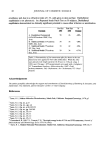
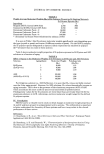
4 JOURNAL OF COSMETIC SCIENCE reference. The standard curve of elution volume and molecular weight was established. The weight-average molecular weights of the samples were calculated from the standard curve with the Chem-Lab software. Degree ofdeacetylation determination. The degree of deacetylation of prepared water-soluble chitosans from the ultrasonic method was determined by FTIR methods (37). Chitosan powder was mixed with KBr (1:100) and pressed into a pellet. The absorbances of amide 1 (1655 cm -•) and the hydroxyl band (3450 cm -•) were measured using a Bio-Rad FTS- 155 infrared spectrophotometer. The percentage of the amine group's acetylation in a sample is given by (A•655/A345o) x 155. Here, A•655 and A345o are the absorbances at 1650 cm -• and 3450 cm -•, •espectively. Solubility test. The solubility of water-soluble chitosans was determined by a method of Yalpani and Hall (38). The molecular weight, degree of deacetylation, and solubility of water-soluble chitosans used in these studies are listed in Table I. PREPARATION OF THE MOISTURE MASK Shown in Table II is the formula for the moisture mask, wherein 0.5% to 2.0% (w/v) water-soluble chitosans were used to replace the thickening agent (2.0% methyl cellu- lose). The buffer and the humectant were added to the water and heated at 70-80øC, and then the thickening agent and the film-forming agent were added and mixed well to form the aqueous phase at 70ø-80øC. The preservative and the surfactant were added to ethyl alcohol to obtain the oil phase at 70ø•80øC. The oil phase was poured into the aqueous phase and homogenized to obtain the product. CHARACTERIZATION OF THE PREPARED MOISTURE MASK Viscosity of the moisture mask. A 5-ml aliquot of moisture mask was placed onto a cone/ plate cell (pk 45) that was maintained at 25øC. Viscosity measurements were performed at shear rates of 0•100 s -t with a Haake Viscometer CV20 (Haake Mess-Technik Gmbh. Co., Germany). Absorbance test. The absorbance at 490 nm of the prepared moisture mask was measured by a spectrophotometer (Spectrophoto U-200, Hitachi Co., Japan) to be used as an index of moisture mask color. Table I Molecular Weight, Degree of Deacetylation, and Solubility of Water-Soluble Chitosans Prepared at Various Sonication Times at 300 W and 4 ø _+ 0.2øC Sonication time (min) Molecular weight Degree of Solubility (x 10 6 Da) deacetylation (%) in water (g/dl) U3 chitosan 2.42 83.2 0.955 a U30 chitosan 1.62 82.9 0.965 a U120 chitosan 1.17 84.2 0.966 a Values (n = 3) followed by the same superscript within the same column are not significantly different (p , 0.05 by Duncan's multiple range test). U3, U30, and U120 chitosans were obtained by ultrasonic treatment on a chitosan acetic acid solution for 3, 30, and 120 min, respectively, after which they underwent dialysis and freeze drying.
Purchased for the exclusive use of nofirst nolast (unknown)
From: SCC Media Library & Resource Center (library.scconline.org)