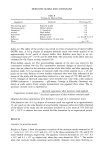
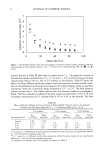
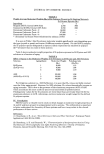
1999 ANNUAL SCIENTIFIC MEETING 69 CHARACTERIZATION OF ZIRCONIUM POLYMER DISTRIBUTIONS IN ANTIPERSPIRANT ACTIVES USING SIZE EXCLUSION CHROMATOGRAPHY (SEC) AND LIGHT SCATTERING (LS) TECHNIQUES Allan H. Rosenberg, Ph.D. Summit Research Labs, Huguenot, NY 12746-0626 I. Introduction Size exclusion chromatography (SEC) has been used to characterize aluminum polymer distributions in antiperspirant active ingredients such as aluminum chlorohydrate (ACH) and aluminum-zirconium-glycine salts (AZG). This technique has also been used to characterize zirconium polymer distributions in zirconium starting reagents used to synthesize AZG as well as in AZG actives themselves (1). The ability to determine the above polymer distributions is critical in understanding A1 and Zr chemistry occurring in antiperspirant active systems. Additionally the nature of these distributions has great impact on the clinical performance of these actives. Although valuable information on polymer distributions has been obtained from SEC studies, accurate information regarding the actual molecular weights and polydispersity properties of the individual A1 and Zr polymers are difficult to obtain from SEC due to a lack of good "marker" compounds that are needed to construct reliable molecular weight calibration curves. The use of SEC/LS to characterize A1 polymers in ACH was previously reported by Rosenberg and Carmody (2). This paper describes our work on obtaining molecular weight and polydispersity data for zirconium polymers present in antiperspirant systems using combination SEC/LS techniques. II. Methodology The method essentially consists of first separating the polymer species using SEC and then passing the SEC stream into a light scattering detector and then into a refractive index detector. The light scattering intensities for each polymer species and the R.I. response are then used to calculate molecular weights and polydispersity. The Wyatt Multi-Angle Dawn DSP photometer was used to obtain the light scattering data and high pressure SEC columns were used for polymer separation. The use of a multi-angle light scattering detector is very important for SEC/LS studies which require the use of aqueous mobile phases for the SEC columns as is the case for characterizing antiperspirant active systems since aqueous mobile phases are difficult to clean with respect to background light scattering noise resulting in unacceptable background readings for some scattering angles. Operation and calibration of the Dawn Photometer was checked by determining the molecular weight of a pullenen standard (45,000 daltons). Generally, values within _+ 2.5% of the standard are obtained. III. Results Table i summarizes SEC/LS studies on zirconium ingredients used as starting materials to synthesize aluminum-zirconium-glycine (AZG) antiperspirant actives.

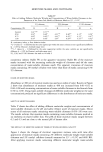
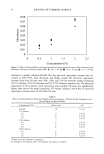
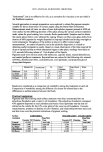
70 JOURNAL OF COSMETIC SCIENCE TABLE 1 Weight Average Molecular Weights (Mw) of Zr Polymers Present in Zr Starting Materials Zr Polymer Species (Mw) Ingredient Reagent ZrOCh Crystal (10% Soln) Commercial ZrOCh Crystal (10% Soln) Zirconium Carbonate Paste -1 a Zirconlure Carbonate Paste -2 a Zirconlure Carbonate Paste -3 • 1 2,700 6,700 16,000 57,000 140,000 2 8OO 850 --- - - Zirconium Carbonate Paste Solubiiized by addition of HC1 It is seen in Table 1 that Zr polymer molecular weights significantly vary depending upon the type (crystal or paste) and source (3 different sources of paste). For the ZrOC12 samples, the Zr polymer species designated as species 2 likely represents the smallest Zr polymer (gr +4 tetraruer) that can exist in these systems. Table 2 shows molecular weight properties of Zr polymers present in Zr/Glycine and AZG solutions as a function of aging. TABLE 2 Effect of Aging on the Molecular Weights of Zr Polymers in Zr/Gl¾cine and AZG Solutions Solution Aging(days) Molecular Weight Polydispersity (Mw) (Mw/Mn) Zr/Glycine i 9,800 1.13 (Zr/Gly=l/1) 3 9,900 1.08 5 8,900 1.19 AZG 1 22,000 1.08 (A1/Zr/Gly=3.5/1/1) 3 36,000 1.08 5 49,000 1.08 For Zr/glycine solution (i.e., ZrOC12/Glycine), it is seen that Mw values are fairly constant over the 5 day aging period. However, for AZG solutions, Mw values dramatically mcrease as aging increases. This is due to the presence of the aluminum component (ACH) of AZG which neutralizes the more acidic Zr species and accelerates Zr polymerization. Polydispersity values for the Zr polymers are lower than those previously observed for the aluminum polymers in ACH, mdicating a narrower molecular weight range for the defined Zr polymer species. IV. Conclusion SEC/LS can be a valuable tool to study in detail changes in molecular weight properties of A1 and Zr polymers present in antiperspirant active systems. This information is important to better understand the chemistry of these systems and how it may relate to the chnical performance of these actives. References (1) Rosenberg, A. H., et.al. "Novel Zirconium Salts and Their Synthesis" Eu?opean Patent Apphcation 0 653 203 A1 (1995). (2) Rosenberg, A. H. and Carmody, W., "Characterization o[Antiperspirant Actives Using Size Exclusion Chromatography and Light Scattering Detection " Society of Cosmetic Chemists Annual Scientific Meeting, New York City, Dec. 5th (1997).
Purchased for the exclusive use of nofirst nolast (unknown)
From: SCC Media Library & Resource Center (library.scconline.org)