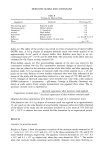
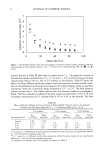
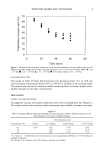
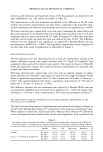
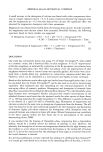
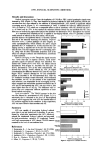
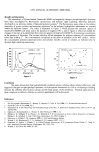
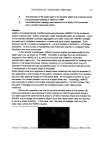
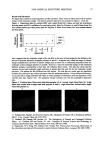
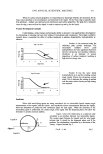
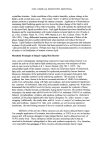
1999 ANNUAL SCIENTIFIC MEETING 59 When the surface tension properties of a liquid-liquid or liquid-gas interface are measured, the du Nouy ring is attached to the microbalance and immersed in the liquid. The du Nouy ring is typically made from platinum - iridium wire and has known dimensions and surface properties. The peak force measured when the ring is removed from the liquid, is used to compute •a and (•p for the liquid. Product Development Examples Understanding surface energy and having the ability to measure it can speed product development by eliminating or reducing trial and error testing of formulations and components. Force/depth isotherms instantly show a researcher the effect of surface treatments to enhance dispersability, hydrophobicity or adhesion 300 200 -100 -200 -300 -400 Exp A in water 0 2 4 6 8 10 Depth (fire) Product A was measured using the Wilhelmy plate powder technique. The force/depth isotherm shows good hydrophobicity but also significant hysteresis between advancing and receding isotherms. Hysteresis is an indicator of uneven deposition of surface treatment resulting in high and low energy sites -50 -100 -150 -200 -250 -300 -350 Exp B in water 0 2 4 6 8 10 Depth (rm•) Product B has the same initial hydrophobicity as A and the receding contact angle closely follows the advancing contact angle. This is indicates the coating is applied over the entire surface leaving no high energy sites exposed. Emulsions Liquid A Figure 2 Liquid B When solid emulsifying agents are being considered for two immiscible liquids contact angle measurements of the agents with the liquids and interfacial tension measurements between the liquids, allow the formulator to predict the best continuous phase for each agent. When the chemistry of the emulsifying agent is understood, the contact angle of the agent with the dispersed phase will allow the formulator to predict emulsion stability. Figure 2 shows the relationship of a spherical solid emulsifier to an interface between two immiscible liquids. The contact angle between the liquids and the solid agent indicate that A should be the dispersed phase and B the 0 medium. The relationship is described by a derivation of the Young- Dupree formula, Eq. 2. Cos 0 = 1- h/r Eq 2

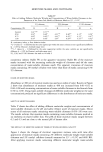
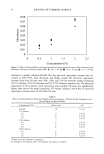
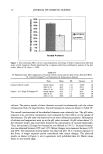
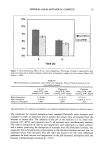
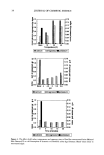
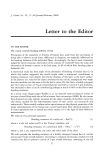
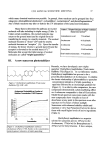
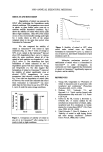
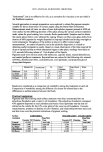
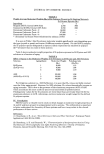
60 JOURNAL OF COSMETIC SCIENCE CONTACT ANGLE MEASUREMENTS TO PREDICT PERFORMANCE OF SURFACE TREATED PIGMENTS Jane Hollenberg •, Dylan Sujet 2, and M. Scott Price 2 •JCH Consulting, Red Hook, NY 12571 and 2Carde, South Plainfield, NJ 07080 Introduction: Although there are a wide variety of surface treatments which impart hydrophobicity to pigments, the property of hydrophobicity alone does not predict performance in actual cosmetic formulations. Most cosmetic chemists use the "shake test"{ to measure the resistance of hydrophobic pigments to wetting by water. Although the shake test can be a quick semi-quantitative indicator of hydrophobicity, any comparison of samples is subjective, and the method is not useful for studying wettability by non-aqueous systems. Previously •, a variety of applications based tests were used to distinguish between surface treatments, including viscosity measurement of suspensions. Contact angle measurements offer the potential of a quick, reproducible, quantitative screen to differentiate between degrees of hydrophobicity imparted to pigments surfaces, resistance to wetting by cosmetic oils, and wetting ability of various oils. The objective of this study was to take the contact angle measurements against different vehicles using pigments having different surface treatments to relate to wettability and functionality in actual formulations. Materials and Methods: For a drop of liquid resting on a solid, contact angle, 0, is the angle formed between the surface of the solid and a line tangent to the curve of the droplet at the point of contact between the solid and the liquid. The interaction between solids and liquids was first described by the Young 2 almost 200 years ago: ¾sv - ¾SL = ¾•,V COS 0 •liquid •sL •sv solid A liquid will wet the surface of a solid when 0 90 ø (cos 0 0). The lower the contact angle, the better the wetting of the solid by the liquid. For 0 90øC, the liquid will not wet the surface, and the higher the contact angle, the less the affinity of the liquid for the solid. Contact angle measurements can be utilized to calculate the surface fre6 energy of solids, a more comprehensive description of the properties of the solids, but are beyond the scope of this study. Measurement of contact angles between solids and liquids is subject to any variables which affect the purity of the surface, roughness of the surface, and purity of the liquid. The particulate nature of pigments further complicates development of a reproducible procedure. Relation of speed of vehicle uptake to capillarity has proven an excellent method for measuring contact angles of particulates with water using the Kffiss K-12
Purchased for the exclusive use of nofirst nolast (unknown)
From: SCC Media Library & Resource Center (library.scconline.org)