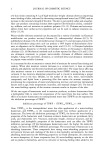
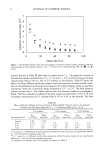
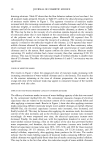
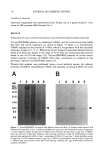
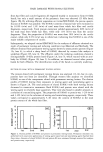
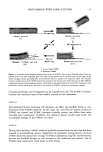
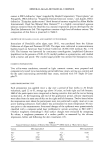
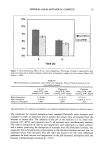
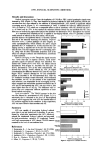
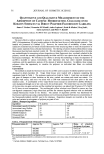
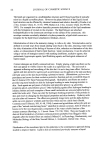
18 JOURNAL OF COSMETIC SCIENCE STATISTICAL ANALYSIS Statistical comparisons were performed by the Tuckey test or a paired Student's t-test using an SAS program (SAS Institute Inc.). RESULTS ESTIMATION OF SlOOA3 CONTENTS IN EXTRACTS AND EFFLUENTS DERIVED FROM HAIR FIBER Tricine/SDS/PAGE patterns of recombinant S lOOA3, and the total extracts from whole hair fiber and cuticle fragments, are shown in Figure 1A (lanes 1-3). Recombinant SlOOA3 migrated to the position of 10 kDa, which is in agreement with the calculated molecular weight of 11,713.3. Whole hair extract showed intermediate filament keratin bands with molecular weight in the range of 45-55 kDa and keratin-associated protein bands in the 10-30 kDa range (12). Tricine/SDS/PAGE patterns of cuticle extract showed superior resolution of SlOOA3 from other constituents as compared to the previously reported urea/SDS/PAGE pattern (3). Western blot analyses were performed using a novel antibody against the carboxyl terminus of SlOOA3. Recombinant SlOOA3 and naturally occurring SlOOA3 extracted A B (kd) 66.2 45.0 31.0 21.5 1 2 3 4 5 1 2 3 4 5 ß . 14.4 - 10.7 - 8.2' 6.2 - Figure 1. Tricine/SDS/PAGE of extracts and effluents from hair fiber. A: Protein bands stained with Coomassie brilliant blue. Lane 1, recombinant S100A3 (0.3 Fg) lane 2, whole hair fiber extract (10 pg) lane 3, cuticle fragment extract (10 Fg) lane 4, effluent with permanent waving lotion (3 Fg) lane 5, effluent from root-end part of hair fiber obtained under reducing conditions (3 Fg)- B: Immunoreactive bands detected with antibody for S100A3. Lane 1, recombinant S100A3 (0. ! Fg) lane 2, whole hair fiber extract (10 Fg) lane 3, cuticle fragment extract (1 Fg) lane 4, effluent with permanent waving lotion (0.2 Fg) lane 5, effluent from root-end part of hair fiber with reducing condition (0.1 Fg)- Arrow heads indicate the positions of S100A3.

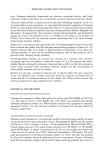
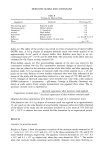
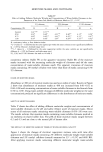
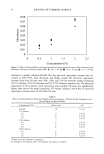
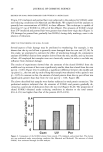
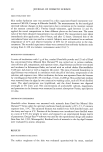
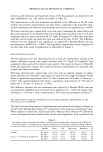
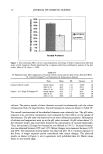
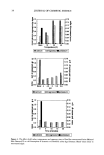
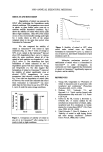
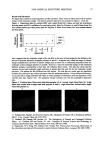
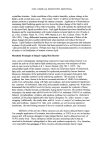
HAIR DAMAGE WITH S100A3 ELUTION 19 from hair fiber and cuticle fragments all migrated mainly in monomeric form (10 kDa band), but only a small amount of the polymeric form was observed (25 kDa band Figure lB). By utilizing efficient separation on tricine/SDS/PAGE, the precise quanti- fication of S100A3 was possible. The S100A3 contents of natural hair were estimated to be 0.10% (w/w) and 1.3% (w/w) of total mass from whole hair fiber and cuticle fragments, respectively. Total protein extraction yielded approximately 60% (w/w) of the total mass from whole hair fiber, while only 11% (w/w) was from the cuticle fragments. Thus, the proportion of S100A3 was more than 10% (w/w) in the cuticle extract, while only 0.2% (w/w) was in whole hair, indicating that S100A3 is one of the major soluble components of cuticle. Subsequently, we adopted tricine/SDS/PAGE for the analyses of effluents obtained as a result of permanent waving and reducing conditions (see Materials and Methods). The effluent obtained from permanent waving agents showed a smear protein pattern (Figure 1A, lane 4), in which a sharp band of S100A3 detected by western blot analysis is underlain (Figure lB, lane 4). The effluents under the reducing conditions showed a distinguishable 10 kDa protein band (Figure 1A, lane 5), which reacted with an anti- body for S100A3 (Figure lB, lane 5). In addition, we observed several other protein bands for both effluents. The identification study of the bands is currently underway. ELUTION OF S100A3 WITH A PERMANENT WAVING LOTION The protein eluted with permanent waving lotions was analyzed (13,14), but its com- ponents have not been yet identified. Through western blot analyses we identified S100A3 as one of the components eluted with permanent waving lotions. The elution profile of S100A3 during three exposures to waving agent and neutralizing agent is shown in Figure 2A. The total amounts of eluted S100A3 with both waving lotions decreased in consecutive treatments. Both S100A3 and protein were eluted with the waving agent in relatively large quantities. They were also found in smaller amounts in a solution of a neturalizing agent. The proportion of S100A3 to protein was 1-2% (w/w) and 3-8% (w/w) in the solutions of waving and neutralizing agents, respectively. These values correspond to approximately 5-40 times the content of S100A3 in the total protein extract of the whole hair fiber. 6 (A). 1st 2nd 3rd 250 '• 200 ._c 1 oo so (B) o o 1 st 2nd 3rd Figure 2. Elution profiles of S100A3 and protein in permanent waving lotion. Permanent treatment was performed with consecutive applications of waving agent (open box) and neutralizing agent (hatched box) three times. Amounts of eluted S100A3 (A) and protein (B) were estimated through western blot analyses and protein assay, respectively.
Purchased for the exclusive use of nofirst nolast (unknown)
From: SCC Media Library & Resource Center (library.scconline.org)