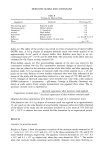
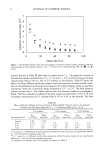
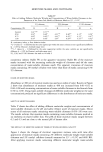
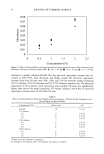
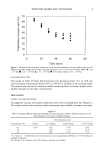
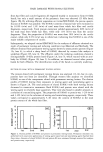
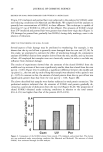
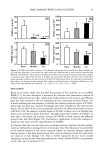
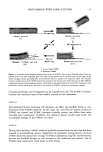
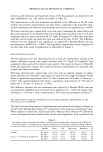
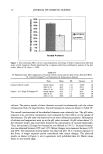
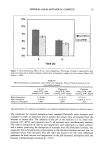
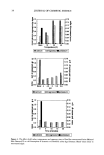
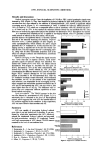
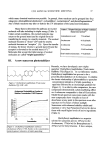
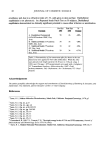
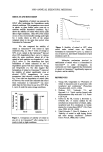
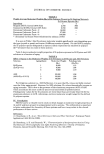
MOISTURE MASKS AND CHITOSANS 11 is larger than that of methyl cellulose or that chitosan and its derivatives have excellent water-holding capacities (9,28-31). The results in Figure 3 also show the water-holding capacity of moisture masks increasing with the use of water-soluble chitosans of higher molecular weight. FILM-FORMATION TIME OF MOISTURE MASKS The results in Table VI show film-formation times of moisture masks decreasing with the increasing concentration of water-soluble chitosans used (of the same molecular weight of water-soluble chitosan) or decreasing with the increasing molecular weight of water-soluble chitosans used (of the same concentration of water-soluble chitosan). This may be because film formation results from aggregation of film-forming compounds, i.e., the water-soluble chitosan, after the solvent evaporates (8). Therefore, film- formation time decreased with increasing concentration of film-forming agents and/or decreased with increases in their molecular weights. The reason that moisture masks containing 0.5 g U3 chitosan have film-formation times similar to those of masks containing 2.0 g of methyl cellulose may be due to the fact that the molecular weight of U3 chitosan is larger than that of methyl cellulose, as mentioned previously. CONCLUSIONS 1. Moisture masks containing different molecular weights and/or concentrations of water-soluble chitosans are pseudoplastic fluids. 2. The apparent viscosity of moisture masks increased with the increasing molecular weight and/or concentration of water-soluble chitosans used in the formula. This will improve the stability of the moisture mask, enhance skin hydration, shorten film- formation time, and improve skin compatibility. Thus moisture masks containing water-soluble chitosans will be useful in a wide range of applications. 3. These beneficial effects may be attributed to the good water-holding capacity, thick- ening, and film-formation properties of water-soluble chitosans. ACKNOWLEDGMENTS The authors would like to express their gratitude to the National Science Council, Republic of China (Project No. NSC 86-2313-B-019-006) for its financial support. REFERENCES (1) A. Domard, G. A. F. Roberts, and K. M. Varum, Eds., Advances in Chitin Science, Volume II. (Jacques Andre, Lyon, France, 1997). (2) R. H. Chen and H. C. Chen, Eds., Advances in Chitin Science, Volume III (RITA Advertising Co., Ltd., Taipei, Taiwan, ROC, 1999). (3) C. Y. Chang, The effect of adding chitinous materials on the qualities of the Alaska pollack kamaboko. MS Thesis, National Taiwan Ocean University (in Chinese), 1997. (4) G. Lang, E. Konran, and H. Wendel, "Chitosan Derivatives: Water-Soluble Products by Reaction with Epoxides," in Chitin in Nature and Technology, R. Muzzarelli, C. Jeuniaux, and G. W. Gooday, Eds. (Plenum Press, New York, 1986), pp. 303-306.

12 JOURNAL OF COSMETIC SCIENCE (13) (14) (16) (17) (18) (19) (20) (21) (22) (23) (24) (25) (5) R. A. A. Muzzarelli, Chitin (Pergamon Press, Oxford, 1977), pp. 3-12. (6) E. R. Hayes, D. H. Davies, and V. G. Munroe, "Organic Solvent System for Chitosan," in Proceedings of the First International Coherence on Chitin/Chitosan, R. A. A. Muzzarelli and E. R. Pariser, Eds. (MIT Press, Cambridge, MA, 1978), pp. 103-106. (7) P. R. Austin, "Chitin Solvents and Solubility Parameters," in Chitin, Chitosan, and Related Enzymes, J.P. Zikakis, Ed. (Academic Press, Orlando, FL, 1984), pp. 227-237. (8) R. A. A. Muzzarelli, M. Weckx, O. Filippini, and C. Lough, Characteristic properties of N- carboxybutyl chitosan, Carbohydr. Polym., 11, 307-320 (1989). (9) M. Izume, A novel humectant composed of a chitosan derivative succinyl chitosan, FragranceJ., 12, 112-117 (1996) (in Japanese). (10) P. Alexander, The foundation of beauty, Manufact. Chem., 27-33 (May 1991). (11) R. Wachter and E. Stenberg, "Hydagen © CMF in Cosmetic Applications: Efficacy in Different In Vitro and In Vivo Measurements," in Advances in Chitin Science, Volume I, A. Domard, C. Jeuniaux, R. Muzzarelli, and G. Roberts, Eds. (Jacques Andre, Lyon, France, 1996), pp. 381-388. (12) V. Horner, W. Pittermann, and R. Wachter, "Efficiency of High Molecular Weight Chitosan in Skin Care Application," in Advances in Chitin Science, Volume II, A. Domard, G. A. F. Roberts, and K. M. Varum, Eds. (Jacques Andre, Lyon, France, 1997), pp. 671-677. D. Knorr, Functional properties of chitin and chitosan, J. Food Sci., 48, 3641 (1982). S. Magdassi and Z. Neiroukh, Chitin particles as O/W emulsion stabilizers,J. Dispersion Sci. Technol., 11(1), 69-74 (1990). (15) M. Rinaudo, P. L. Dung, and M. Milas, "A New and Simple Method of Synthesis of Carboxymeth- ylchitosans," in Advances in Chitin and Chitosan, C.J. Brine, P. A. Sandford, and J.P. Zikakis, Eds. (Elsevier, New York, 1992), pp. 516-525. R. A. A. Muzzarelli, Modified chitosans carrying sulfonic acid groups, Carbohydr. Polym., 19, 231-236 (1992). M. Zheng and S. Hirano, Novel N-unsaturated fatty acid and n-trimethyl acetyl derivatives of chitosan, Carbohydr. Polym., 26, 205-209 (1995). K. Kurita, H. Yoshino, S.I. Nishimura, and S. Ishii, Preparation and biodegradability of chitin derivatives having mercapto groups, Carbohydr. Polym., 20, 239-245 (1993). S. Hirano, Y. Konda, and K. Fuji, Preparation of acetylated derivatives of modified chito- oligosaccharides by the depolymerization of partially N-acetylated chitosan with nitrous acid, Carbo- hydr. Res., 144, 338-341 (1985). H. Sashiwa, H. Saimoto, Y. Shigemasa, and S. Tokura, N-acetyl group distribution in partially deacetylated chitins prepared under homogeneous conditions, Carbohydr. Res., 242, 167-172 (1993). K. M. Varum, M. H. Ottoy, and O. Smidsrod, Water-solubility of partially N-acetylated chitosans as a function of pH: Effect of chemical composition and depolymerisation, Carbohydr. Polym., 25, 65-70 (1994). A. Otakara, in Development and Application of Chitin and Chitosan (Industrial Technology Association, Tokyo, 1987), pp. 161-164. J.S. Shyur, Preparation of water-soluble chitosan and its physico-chemical properties, MS Thesis, National Taiwan Ocean University (in Chinese), 1995. C. C. Li, Physico-chemical and rheological properies of water-soluble chitosan, MS Thesis, National Taiwan Ocean University (in Chinese), 1997. J.R. Chang, Effect of shear force, ultrasonic treatment or combined treatments on the physico- chemical properties of chitosan and its application on water-soluble chitosan processing. Master's Thesis, Department of Marine Food Science, National Taiwan Ocean University (in Chinese), 1996. (26) M. Tanaka, Recent development of skincare products in Japan from the bio-science standpoint, FragranceJ., 14, 9-15 (1994) (in Japanese). (27) S.S. Robert, S. Beverly, C. Prem, and F. Carol, The effect of lipid, with and without humectant, on skin xerosis. J. Soc. Cosmet. Chem., 47, 27-39 (1996). (28) S. Matsumura, H. C. Cheng, M. Minami, S. Yoshikawa, and T. Karitoni, Synthesis and water uptake and holding capacity of chitin and chitosan derivatives, Oil Chem., 38, 492-500 (1989). (29) E. Vandamme, Bacteria in front mirror: Biocosmetics via microbial synthesis, Agro Food Industry Hi. Tech., 3-8 (July/Aug. 1996). (30) M. Izume, Application of chitin chitosan in toilet products, Bio Industry, 6(7), 75-83 (1989) (in Japanese). (31) C. Fox, Polymers: Cosmetic and pharmaceutical applications. Cosmet. Toilerr., 71-79 (Nov. 1990).
Purchased for the exclusive use of nofirst nolast (unknown)
From: SCC Media Library & Resource Center (library.scconline.org)