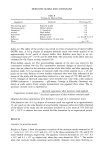
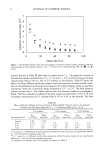
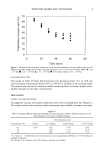
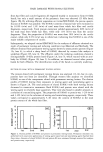
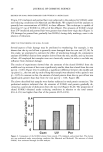
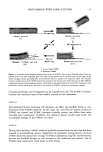
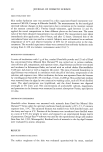
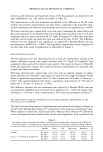
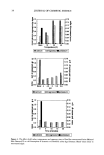
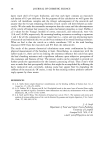
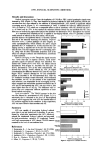
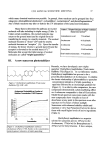
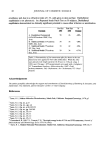
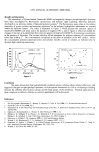
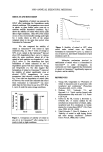
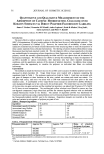
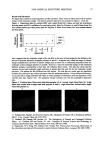
1999 ANNUAL SCIENTIFIC MEETING 51 Results and discussion The interactions of Pyrene-labeled Quatrisoft-LM200 and negatively-charged non-phospholipid liposomes have been investigated by fluorescence spectroscopy and dynamic light scattering, following protocols developed in our previous studies of liposome/polymer systems. 8 The fluorescence assay relies on the relative intensities of pyrene excimer and monomer emissions, 9 as the polymer hydrophobic substituents are inserted within the liposome bilayer. The effect is illustrated in Figure l, which presents the emission spectra of Quatrisofi LM200Py and water and in the pre.sence of negative NPL's, and in Figure 2, where are plotted the changes in the ratio IE/IM determined from emission spectra of Quatrisoft LM200 Py of increasing concentration in the presence of liposomes. The excimer emission all but disappears for polymer solutions of concentrations lower than 0.008 g L -•. This concentration corresponds to the point of saturation of the NPL surface. Above this concentration polymer-coated liposomes and polymer micelies coexist in solution, as indicated also by dynamic light scattering experiments. 4000 m 3000 • 2500 • 2000 m 1500 •O 1000 U. 500 0 350 LM200-Py + NPL 400 450 500 550 600 Wavelength (nm) Figure 1 1 0.8 o.6 0.4 0,2 0.3. 5 LM200Py in water + LM . + NPI -3 -2.5 -2 -1.5 -1 Log[HEC-PyN+C•2] (g L 'l) Figure 2 -0.5 Conclusion The study demonstrate that hydrophobically-modified cationic cellulose ethers interact eftkctively with negatively-charged non-phospholipid liposomes via hydrophobic interactions as well as via hydrogen bonding between the cellulose ether hydroxyl groups and the head groups of the membrane. Potential applications of these complexes as delivery vehicles in cosmetics applications will be discussed. References I See for example: Burnmeister, F. Bennet, S. Brooks, G. Costa. & Toil, 1996, I 11,49 and references therein 2 Suziki K Costa. & Toil. 1990, 95, 5. 3 Scheuplein, R. in The Physiology and Pathophysiology of the Skin, A. Jarrett, Ed. Academic Press, New York NY, pp 1669 (1978) 4 Egbaria, K. Ramachandran, C. Weiner, N. Skin Pharmacol. 1990, 3, 21. 5 Philipot, J. R. Milhaud, P. G. Puyal, C. O. Wallach, D. F. H. In Liposomes as Tools in Basic Research and Industry Philipot, J. R., Schubert, F., Eds. CRC Press: Boca Raton, FL, 1995 Chapter 3. 6 Polozova, A. Winnik, F. M. Langmuir 1999, 15, 4224 and references therein. 7 Winnik, F. M. Regismond, S. T. A. Goddard, E. D. Langmuir 1997, 13, 1 l 1. 8 Ringsdoff, H. Simon, J. Winnik, F. In Colloid-Polymer Interactions ACS Symposium Series, Dubin, P.. Tong, P. Eds. American Chemical Society, Washington, DC, 1993 216. 9 Winnik, F. M. Chem. Rev. 1993, 93. 587.

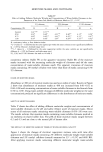
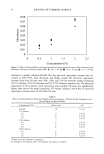
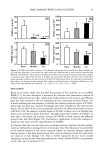
52 JOURNAL OF COSMETIC SCIENCE STABILITY ENHANCEMENT OF RETINOL THROUGH ENCAPSULATION IN CATIONIC VESICLES Duncan Aust, Ph.D., Christopher Judd and James Wilmott The Collaborative Group, East Setauket, NY 11733-4072 ABSTRACT Retinol is used in cosmetic formulations to help skin conditioning by increasing skin elasticity, thereby reducing wrinkles on skin surface. However, photo and air degradation of retmol make it difficult to formulate with. It is reported that retinols degrade faster if formulated m phospholipids. In our investigation, we formulated retinol in cationic bilayered vessels and compared its stability with both free retinol and with retmol formulated in lipid emulsions. Stability of retinol formulations (at 2% retmol) was tested at 50øC and under dark or light storing conditions. Samples were analyzed via reversed phase HPLC for retinol content. Our data indicated that formulation of retmol in cationic vesicles significantly improved stability of retinol even when stored under light. Cationic retinol vesicles also showed higher stability than the retinol m soy oil at 50øC. INRODUCTION Human skin is constantly exposed to external environmental insults, including bright sun light, atmospheric pollutants and extreme temperature (high and low) conditions. These environmental factors strongly influence skin condition by reducing skin elasticity and skin cell proliferation. A harsh environment can lead to premature skin aging, including breakdown of collagen that is characterized by wrinkles, sagging, dry skin and loss of "skin tone". Retinol (Vitamin A) is used m the skin care products to improve skin toning by increasing skin elasticity and by decreasing the appearance of wrinkles on the skin surface. Retinol has been proved to absorb into the skin and increase skin elasticity and cell proliferation. However, the concerns with retmol are that retinol is highly photosensitive and that it degrades rapidly in air. Therefore making stable formulation for cosmetic purposes a challenge. Most suppliers of retinol recommend to preserve finished retmol products in aluminum containers under inert gas. Preserving under an inert gas is not practical for common use. Therefore finished products containing retinol have limited shelf life. Young and Gregoriadis [1] have reported that formulating retinol with phosphohpids actually increased the decomposition rate ofretinol 6-fold. Here we report our studies on the stability of retinol formulated via high-pressure high-shear processing into cationic vesicles known as Catezomes TM and compare the stability with of free-retinol itself and with a surfactant- free emulsion formulation. We tested the stability at 25 and 50øC by quantitatively analyzing the retmol content at various time points. Our results indicated that the retmol formulated with Catezomes TM showed the highest stability, which was even better than the retinol raw material itself. MATERIALS AND METHODS To test the stability of Retmol itself and in the f'mished cosmetic products, 2% Retinol (From Retinol 10S, BASF, Mt. Olive, NJ) was formulated in cationic liposomes (proprietary Catezomes TM [2]) and m the surfactant-free emulsions containing small amounts of phospholipids by a proprietary high-pressure high-shear method. We also prepared a finished gel product from Catezomes TM, the surfactant free emulsion, and raw retinol (Retinol 10S) to test the stabilitites at room temperature and at 50øC. 40 ml aliquots of all samples were placed into separate containers and were held at 25øC or 50øC. Samples were assayed for retinol content at different time points (T=0, 7, 14, and 28 days) by diluting in methanol to obtain 40 to 110 /ml. Retinol was analyzed via HPLC (Waters Corp., Milford, MA) using Waters Symmetry C8 column (150 mm X 3.9 mm) by established protocols based on reported methods [3,4]. The mobile phase (0.1% H3POn/methanolJacetonitirle at 32/61/7 v/v) was pumped at 2 mlJmm through the column held at 40øC, and the detector was set at 324 nm. Using a linear gradient between 15.5 min and 21.5 mm elution time points the mobile phase composition was changed to 100% methanol.
Purchased for the exclusive use of nofirst nolast (unknown)
From: SCC Media Library & Resource Center (library.scconline.org)