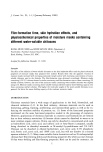
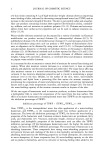
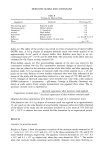
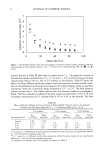
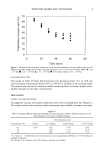
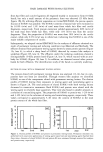
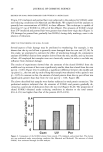
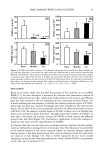
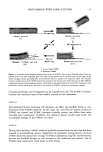
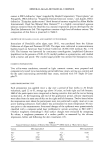
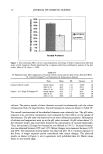
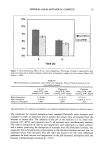
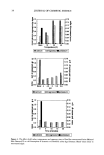
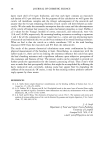
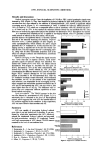
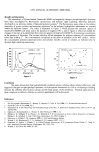
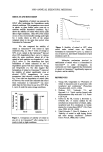
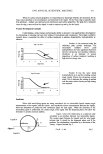
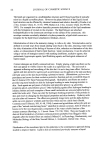
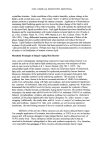
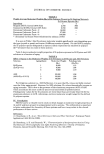
1999 ANNUAL SCIENTIFIC MEETING 53 RESULTS AND DISCUSSION Degradation of retinol was assessed by HPLC after incubating the formulations under desired conditions. The preparations were stored in plastic or glass bottles under room air to simulate realistic household conditions. Fig. 1 shows the stability of retinol when stored under dark or light conditions. Only 56% of the retinol in soy oil was recovered after storing under light for 4 weeks where as 82% of the retinol remained intact in the same time period when formulated in Catezomes TM We also compared the stability of retinol in Catezomes TM with retinol in lipid emulsions (Fig. 2). After 4 weeks of storage at 50øC, in air, retinol in the Catezomes TM showed about 30% degradation (Fig.2, curve 1) whereas under the same conditions, almost all of the retinol in lipid emulsion was degraded in 1 week (Fig.2, curve 3). Our observation that lipid formulation of retinol enhanced its rate of degradation agreed with that reported by Young and Gregoriadis [1]. Our data suggest that formulation of retinol in Catezomes TM improved the stability of retinol significantly even at elevated (50øC) temperatures. At room temperature, data showed a similar trend as in Fig. 2 but with less degradation of retinol (data not shown). Our results also indicated that retinol when formulated in Catezomes TM was more stable than the free retinol in soy oil at 50øC (Fig. 2, curve 2) under the same storage conditions. in dark in dark ß . ight Soy oil Cate•nrnes Figure 1. Comparison of stability of retinol in soy oil or in Catezomes TM after storing for 4 weeks in dark or light conditions. ioo o •lOO 1o o 4oe. 3e •. 2o o. io•. Time (Weeks) Figure 2. Stability of retinol at 50øC when stored under normal room air. Retinol formulated in Catezomes TM (curve 1), retinol in soy oil (curve 2), and retinol formulated in lipid emulsion (curve 3). Molecular mechanism involved in stabilization of retinol when it is formulated in Catezomes TM is under investigation. In conclusion our results suggested that formulation of retinol in Catezomes TM significantly improved its photo- and air stability. REFERENCES 1. Young AM, Gregoriadis G, "Photolysis of retinol in liposomes and its protection with tocopherol and oxybenzone" Photochern Photobiol, 63:3, 344-52, (1996) 2. Watkins, D.C., Vichroski, T.J., and Hayward, J.A. "Lipid vesicles formed with alkylammonium fatty acid salts" U.S. Patent # 5,874,105 3. Talwar D, Ha TK, Cooney J, Brownlee C, O'Reilly DS, "A routine method for the simultaneous measurement of retinol, alpha- tocopherol and five carotenoids in human plasma by reverse phase HPLC" Clin Chem Acta, 270:2, 85-100 (1998) 4. Vidal-Valverde C, Ruiz R, Medrano A, Z "Stability of retinol in milk during frozen and other storage conditions" Labensrn Unters Forsch, 195:6, 562-5 (1992)

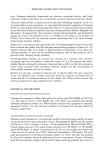
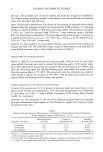
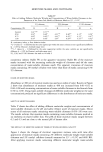
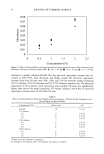
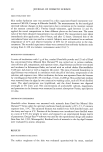
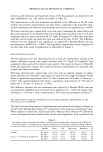
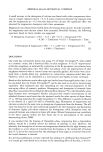
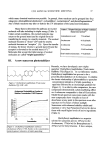
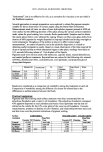
54 JOURNAL OF COSMETIC SCIENCE THE EFFECT OF HYDROPHOBICALLY- MODWIED HYDROXYETHYLCELLULOSE ON THE STRUCTURE AND RHEOLOGY OF A MODEL SURFACTANT SYSTEM IN THE LIQUID CRYSTAL REGIME Robert Y. Lochhead, Ph.D., and Cythia E Welch University of Southern Mississippi, Hattiesburg, MS 39406 Introduction The ordered phases formed by concentrated surfactant systems display interesting physical properties that have made the useful in cosmetic formulation. Polymers are often added to surfactant solutions to enhance their properties. A deeper understanding the molecular origin of these changes in system properties promises to enrich the bounty of useful products that can be formulated. In this study we chose to investigate the interaction of hydrophobically modified hydroxyethylcellulose (HMHEC) with a surfactant system that has been extensively characterized in the literature 1 Experimental: 1. Phase diagrams were constructed of the effect of hydrophobically-modified hydroxyethyl cellulose on the lyotropic liquid crystal and miceliar behavior of the octanoic acid/sodium octanoate/water system. All five HMHEC samples were gifts from the Aqualon Company and their properties are described in table 1. TABLE1: HMHEC •S DESCRIPTION ' Pdymsr x • %I',F' # t, lo per chain • -- 0.0 0 I-IV•EC-1 0 O. 54 5- 8 I-M-•C-2 0 O. 85 8 - 13 •C-3 0 1.91 19- 28 PlVtHEC4 9 0.72 7 - 11 CI"•O(CI'•C•O)4 - R CH20(CH2CH,zO)4H ([ [ OH OH a • --CH•CH=CH=O).---O---(C-•)•C• x=0or9 Oc amoic Acid / Sod'u• Oc aroate[KololdLMandellPEk•,'all Octanolc Acid Mi r lOO H a•lonal • J, 40 g r o q •o co eo lOO no. e
Purchased for the exclusive use of nofirst nolast (unknown)
From: SCC Media Library & Resource Center (library.scconline.org)