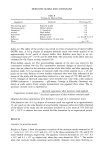
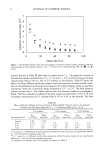
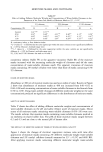
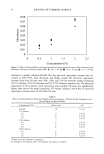
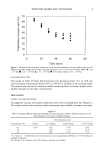
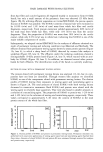
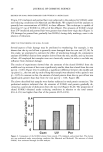
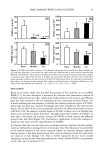
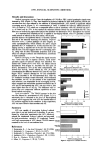
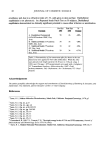
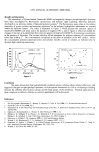
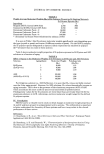
MINERAL-ALGAL-BOTANICAL COMPLEX 35 A small increase in the desorption of calcium was found with either temperature eleva- tion or a longer exposure time (p 0.1). A minor connection between the exposure time and the temperature (p 0.5) was also detected for calcium. No significant effect was observed for magnesium desorption with these parameters. Magnesium was released more readily from the biomass than calcium. In order to predict the magnesium and calcium release from saturated Dunaliella biomass, the following equations, based on linear models, are suggested: % Desorption of calcium = 105.1 - 15.5 x pH - 0.15 x Temperature (øC) -0.283 x Time(min)+ 0.021 x Temperature x Time (1) % Desorption of magnesium = 98.1 - 7.1 x pH + 0.1 x Temperature (øC) + 0.043 x Time(min) (2) DISCUSSION Our study has conclusively shown that using 5% of Triple D Complex TM, when added to a cosmetic cream, had a beneficial effect on skin roughness. A 43.2% improvement of the skin roughness, as indicated by a reduction in the Rz parameter, was achieved over four weeks of application time. This effect was almost twice the improvement of skin roughness observed when a control cream was topically applied. All results were calcu- lated from a double-blind test, performed on contact-free computer-aided laser pro- filometry, which can be considered as a non-invasive and highly accurate technique. Based on skin hydration results after eight and twelve hours from application time, it can be concluded that the Triple D Complex TM can be also used as an active moisturizing ingredient. Skin hydration and skin smoothing are two essential parameters of the anti-aging effects of cosmetic products. Biosorption and desorption of minerals from Dead Sea concentrated brine (Dead Sea Mineral Skin Osmoter TM) to the D/•naliella salina algae biomass were investigated. Results indicated that overall concentrations of the adsorbed elements were lower than the reported results for other species of algae: about 45 vs. 100 mg mineral/g dry weight biosorbent (7). This difference is mainly attributed to the absence of a rigid cell wall in Dunaliella alga. Biosorption of magnesium and calcium occurred at the same time as desorption of potassium from the biomass. The pH value was found to be the most influential parameter for the biosorption and desorption of elements: higher pH values enhanced the biosorption, while desorption from the saturated biomass was enhanced at lower pH values. Mineral biosorption may contribute to the water capacity within the skin tissue due to its participation in the natural moisturizing factor, NMF. It was assumed that the biomass of Dunaliella salina, originating from a hypersaline habitat, would be a suitable vehicle for delivery of minerals to skin. However, the relatively low biosorption of calcium and magnesium obtained for the algal biomass, and the tendency to a low release of minerals from the biomass at the normal pH of human skin (5.5), led to the conclusion that the advantage of these algae as a mineral vehicle for the tested elements is limited. In a previous publication, we have reported that adding 1% of Mineral Skin Osmoter TM to a control gel contributed to an increase in the smoothing effect of the skin, to 40.3%.

36 JOURNAL OF COSMETIC SCIENCE This phenomenon was reported as the "Dead Sea Anti-Wrinkle Effect" (1). The present study differed from the previous one by the use of a cream application, and by the addition of 5 % Triple D Complex TM. This Triple D Complex TM contains Mineral Skin Osmoter TM. The similar improvement achieved in skin smoothing in both studies suggests that the Dead Sea minerals play a significant role in the mechanism of the proven effect of antiwrinkling. Thus the minerals may be assumed to be a potent antiwrinkle agent. The mechanism of the beneficial activity of the minerals on the skin, and the role of other components of the Triple D Complex, namely the algae and plant extracts, will be further investigated. ACKNOWLEDGMENTS The authors would like to thank Dr. W. Voss of Dermatest for skillful profilometric and corneometric clinical measurements Dead Sea Works Ltd. for financial support the Pharmacist, Dr. I. Iaccony from AMI, for her essential support in formulation of the Complex Dr. E. Kvallen of IMI for his statistical analyses Dr. E. Cohen of Ben-Gurion University, Beer-Sheba, for supplying the algae and Ms. A. Alzaradel, Ms. M. Weis- buch, and Ms. M. Friedman of IMI for their technical assistance. REFERENCES (1) Z. Ma'or, S. Yehuda, and W. Voss, Skin smoothing effects of Dead Sea minerals, Int. J. Cosmet. Sci., 19, 105-110 (1997). (2) P. Morganti, "Skin Hydration," in Novel Cosmetic Delivery Systems, S. Magdasi and E. Touitou, Eds. (Marcel Dekker, New York, 1999), pp. 71-97. (3) L. R. Smith, The sea: The oldest and newest source for cosmetic ingredients, SOFWJ. 122, 11-28 (1996). (4) P.M. Elias, L. C. Wood, R. K. Feingold, Relationship of the epidermal permeability barrier to irritant contact dermatitis, Immunology and Allergy Clinics of North America, 17, 417-430 (1997). (5) G. K. M. Menon and K. R. Feingold, Integrity of the permeability barrier is crucial for maintenance of the epidermal calcium gradient, Br. J. Dermatol., 130, 139-147 (1994). (6) Z. Ma'or, S. Magdassi, D. Efron, and S. Yehuda, Dead Sea mineral-based cosmetics--Facts and illusions, Isr. J. Med. Sci., 32, 28-35 (1996). (7) B. Volesky, Biosorption of Heavy Metals (CRC Press, Boca Raton, FL, 1990). (8) M. Borowitzka and L.J. Borowitzka, "Dunaliella," in Micro-Algal Biotechnology, M. Borowitzka, and L.J. Borowitzka, Eds. (Cambridge University Press, 1988), pp. 27-58. (9) Yeda R&D Ltd, Production of glycerol, carotenes & algae meal, PCT No. 54881 (1978). (10) A. Ben-Amotz and M. Avron, Glycerol and [3-carotene metabolism in the halotolerant alga Dunaliella: A model system for biosolar energy conversion, TIBS 6, 297-299 (1981). (11) F.J. Wright, Beneficial effects of topical application of free radical scavengers,./. Appl. Cosmetol., 13, 41-50 (1995). (12) J. Wepierre, "Biological Activity of Active Ingredients and Cosmetics," in Cosmetic Dermatology, R. Baran and H. I. Maibach, Eds. (Martin Dunitz, 1994), pp. 9-20. (13) M.E. Jackson, "Assessing the Bio-Activity of Cosmetic Products and Ingredients," in Novd Cosmetic Delivery Systems, S. Magdassi and E. Touitou, Eds. (Marcel Dekker, New York, 1999), pp. 99-113. (14) Z. Ma'or and S. Yehuda, A skin care and protection composition and a method for preparation therof, WO 99/02128-PCT No. IL98/00311 (1998). (15) W. Voss, "Die Laserprofilometrie nach DIN 4768ff im Rahmen klinisch-dermatologischer Untersu- chungen," in 6th Forum Cosmeticurn Potsdam 14-15.4.94 (1994). (16) J. L. Leveque, Physical methods for skin investigation, Int. J. Dermatol., 22, 368-375 (1983). (17) C. W. Blichmann andJ. Serup, Assessment of skin moisture, Acta Derm. Venerol. (Stockh.), 68, 284-290 (1988). (18) ATCC Catalogue of Algae and Protozoa, 17th ed. (1991).
Purchased for the exclusive use of nofirst nolast (unknown)
From: SCC Media Library & Resource Center (library.scconline.org)