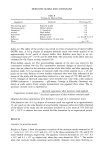
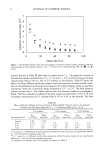
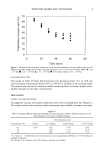
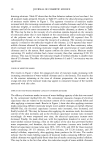
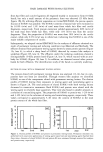
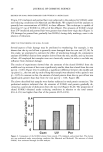
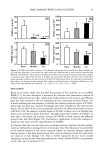
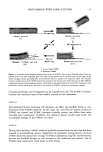
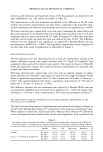
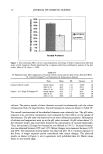
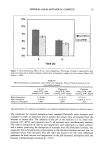
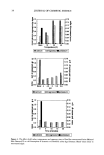
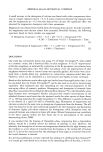
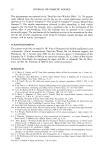
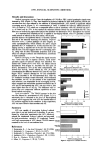
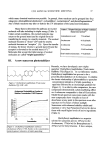
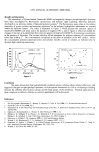
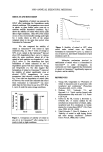
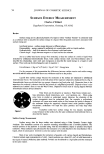
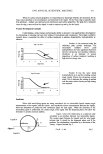
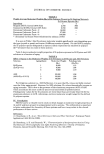
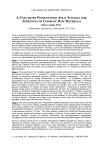
1999 ANNUAL SCIENTIFIC MEETING 47 which many chemical reactions are possible. In general, these reactions can be grouped into four categories: photoaddition/substitution6 cycloaddition7 isomerization* and photofragmentation? Any of these reactions may alter or destroy the UV absorption of the sunscreen formulation. Many factors determine the pathway an excited molecule will take including its triplet energy (Table 1). Under certain conditions, the excited molecule may return to the ground state (and its original form) by transferring its energy to a nearby molecule. The excited molecule becomes a "donor" (D*) and the nearby molecule becomes an "acceptor" (A). Upon the transfer of energy, the donor returns to ground state (D) and the acceptor is elevated to the excited state (A*). n Molecules that accept the triplet energy of excited molecules are called "triplet quenchers." Table 1: Triplet Energies of Some Common Sunscreen Actives tø Aminobenzoic acid 75 kcal/mol Oxybenzone 66 kcal/mole Avobenzone 59.5 kcal/mol Octocrylene 55-60 kcal/mole Octyl methoxycinnamate 57 kcal/mole III. A new sunscreen photostabilizer Figure 2: Diethylhexyl naphthalate (Trade name.' HallBrite TQ). MW-'-440. Avobenzone Photostability as Function of Stabilizer ConcentTation: 5 MED Exposure 1 0.9 0.8 0.7 0.6 0.5 0.3 0.2 •0.1 0 4% 8% Concenlyation Figure 3: Diethylhexyl naphthalate stabilizes Avobenzone (Parsol 1789, Roche) in the concentration- related manner indicative of triplet quenching. Recently, we have developed a new triplet quencher: Diethylhexyl naphthalate (Trade name: HallBrite TQ) (Figure 2). In our laboratory studies, Diethylhexyl naphthalate has proven to be a powerful photostabilizer of Avobenzone. It exhibits the classic relationship of photostability to quencher concentration indicative of triplet quenching: a rapid rise followed by an increasingly gradual rise (Figure 3). In a side-by-side comparison, the new compounds demonstrated a photostabilizing effect on Avobenzone comparable to that of Octocrylene. Model broad spectrum sunscreens made with the new compounds show virtually no loss of absorbance at any point in the spectrum even after exposure to five hours of direct sunlight. Sunscreens with enhanced stability exhibit and maintain in vitro Sun Protection Factors far above those with much higher levels of active ingredients (Table 2). Diethylhexyl naphthalate*is a superior solvent for sunscreen actives: 20%(w/w) for Avobenzone 17%(w/w) for Benzophenone-3 20%(w/w) for Octyl triazone. It has a unique,

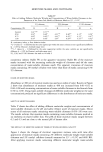
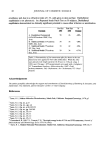
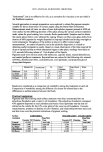
48 JOURNAL OF COSMETIC SCIENCE emolliency and, due to a refractive index of 1.53, adds gloss to skin and hair. Diethylhexyl naphthalate is not phototoxic. In a Repeated Insult Patch Test on 50 subjects, Diethylhexyl naphthalate demonstrated no clinically significant potential to cause either irritation or sensitization. Pre-Sun Post-Sun % Formula SPF SPF Chan!•e A. Unstabilized Commercial 50 26 -48% (16%-18% actives: OMC, Oxy, Avo) B. Stabilized Model (11% actives: 50 36 -28% OMC, Oxy, Avo) C. Stabilized Model (7% actives: 39 42 +8% OT, Oxy, Avo) D. Stabilized Model (7% actives: 29 34 +17% Oxy, Avo) Table 2: Photostability of four sunscreens after five hours in the sun. Sunscreens were applied to Vitro-skin (7MS) slides. When dry, they were placed in the bright sunJ•om 10:30 a.m. to 3:30p. m. (Aug. 3, 1999, near Chicago). SPF measurements were made with a Labat•here UV Transmittance Analyzer. Abbreviation key: OMC=Octyl methoxycinnamate Oxy=Oxybenzone Avo=Avobenzone OT=Octyl triazone Acknowledgements The author gratefully acknowledge the support and contributions of David Steinberg of Steinberg & Associates, and Mark Miller, Pete Marinel!i, and Yin Hessefort of The C.P. Hall Company. References • Turro, N.J., Modem Molecular Photochemistry, Menlo Park, California: Benjamin/Cummings, 1978. p.3 2 Turro, N.J., Op. cit., p.23 3 Turro, N.J., Op. cit.,. pp. 4-6 4 Turro, N.J., Op. cit., p.90,105,352 s Turro, N.J., Op. cit., pp. 364-365 6 Turro, N. J., Op. cit., Ch. 10 7 Turro, N. J., Op. cit., Ch. 11 8 Turro, N. J., Op. cit., Ch. 12 9 Turro, N.J., Op. cit., Ch. 13 •0 Gonzenbach, H., Hill, T.J., Truscott, T.G., The triplet energy levels of UVA and UVB sunscreens, Journal of Photochemistry and Photobiology. B: 16 377-379 (1992) • Turro, N.J., Modern Molecular Photochemistry, Menlo Park, California: Benjamin/Cummings, 1978. Ch. 9
Purchased for the exclusive use of nofirst nolast (unknown)
From: SCC Media Library & Resource Center (library.scconline.org)