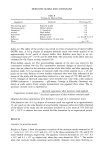
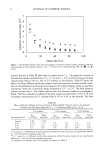
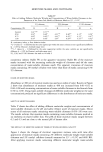
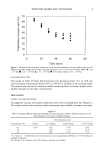
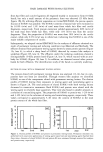
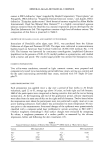
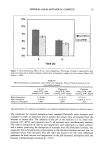
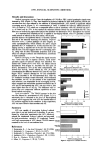
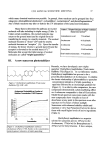
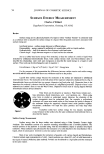
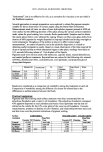
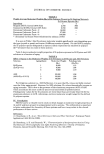
6 JOURNAL OF COSMETIC SCIENCE 7 c•l 0 ! ! 0 3O 60 90 120 Shear rate (l/s) Figure 1. Relationship between shear rate and apparent viscosity of moisture masks containing different concentrations of water-soluble chitosans (1.62 x 10⁶ Da) at 25øC (Concentrations: •, 2% I, 1% ', 0.5%). lutions. Results in Table III show that at a shear rate of 7 s-1, the apparent viscosity of the moisture masks increased from 4.3 x 10³ cp to 6.1 x 10³ cp with increasing chitosan concentration from 0.5% to 1.0% of U3 chitosan in the formula. Table IV shows the effect of adding different molecular weights and concentrations of water-soluble chito- sans on the parameters of the power law equation of the flow behavior index (n) and flow consistency index (k) of moisture masks measured at 23 ø _+ 0.2øC. The flow behavior indexes are less than 1. The results indicate that the moisture masks are pseudoplastic fluids. The flow consistency indexes of moisture masks increased from 4.32 to 6.78 with increasing concentration of U3 chitosan from 0.5% to 1.0% in the formula. The flow Table III Effect of Molecular Weight and Concentration of Water-Soluble Chitosans Used on the Apparent Viscosity and Shear Stress (shear rate of 7 s -•) of Moisture Masks at 23 ø + 0.2øC U3 chitosan U30 chitosan U120 chitosan 'r[ap Shear 'r[a3P p Shear 'r[a2p p Shear Concentration (%) (x 10•Pcps) stress (Pa) (x 10 cps) stress (Pa) (x 10=cps) stress (Pa) Control 2.3 g* 1.97** 0.50 4.3 c'a'e 3.14'5 3.9 e 2.85 3.3 f 2 .46 0.75 4.7 c'a 3.92 4.5 a'• 3.63 4.2 c'a'• 3.43 1.00 6.1 a 4.9 • 5.4 b 4.12 4.8 b'• 3.82'3 * a-g values (n = 3) followed by the same superscript within the same column are not significantly different (p 0.05 by Duncan's multiple-range test). ** 1-7 values (n = 3) followed by the same superscript within the same column are not significantly different (p 0.05 by Duncan's multiple-range test). U3 chitosan, U30 chitosan, and U120 chitosan: the same as in Table I.

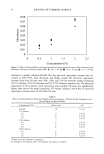
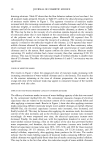
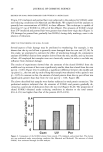
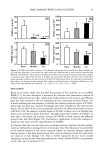
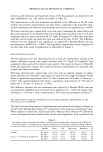
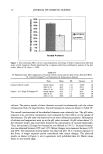
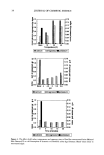
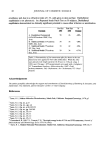
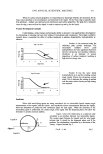
MOISTURE MASKS AND CHITOSANS 7 Table IV Effect of Adding Different Molecular Weights and Concentrations of Water-Soluble Chitosans on the Parameters of the Power Law Models of Moisture Masks at 23 ø _+ 0.2øC U3 chitosan U30 chitosan U120 chitosan Concentration (%) K n K n K n Control 3.417,** 0.51 a,, 0.50 4.325 0.46 b 4.215,6 0.48a,b 4.116 0.50 • 0.75 4.623 0.42 c'd 4.43 ¸ 0.45 c,• 4.335 0.47 s 1.00 6.79 • 0.36 e 5,972 0.39 d'• 4.533'4 0.42 • K: consistency index n: flow behavior index. * a-e values (n = 3) followed by the same superscript within the same column are not significantly different (p 0,05 by Duncan's multiple-range test). ** 1-7 values (n = 3) followed by the same superscript within the same column are not significantly different (p 0.05 by Duncan's multiple-range test). U3, U30, and U120 chitosan: the same as in table I. consistency indexes (Table IV) or the apparent viscosities (Table III) of the moisture masks increased with the increasing molecular weight of chitosans used (of the same concentration of water-soluble chitosans used). The apparent viscosities of moisture masks containing 2% methyl cellulose were lower than those of masks containing 0.5% U3 chitosan. COLOR OF MOISTURE MASKS Absorbance at 490 nm of moisture masks was used as an index of color. Results in Figure 2 show that absorbances of moisture masks at 490 nm increased from 0.01-0.02 to 0.06-0.08 with increasing concentrations of water-soluble chitosans in the formula from 0.5 % to 2.0%. Using water-soluble chitosans of different molecular weights (at the same concentration) produced no significant differences in the absorbances of moisture masks. SAFETY OF MOISTURE MASKS Table V shows the effect of adding different molecular weights and concentrations of water-soluble chitosans on the pH and safety (Draize score) of moisture masks. Draize scores of all moisture masks containing water-soluble chitosans (0.5%-2%) were zero. The results indicate that moisture masks containing water-soluble chitosans resulted in no erythema on shaved rabbit skin. The pHs of those moisture masks ranged between 6.2 and 6.5 and are close to the normal pH of human skin. THE EFFICACY OF MOISTURE MASKS IN TERMS OF WATER-HOLDING CAPACITY Figure 3 shows the changes of electrical capacitance increase ratio with time after application of moisture masks containing 2% different molecular weight water-soluble chitosans and 2% methyl cellulose (control) measured at 23 ø + 0.2øC and 60% RH. After applying moisture masks containing different molecular weight water-soluble
Purchased for the exclusive use of nofirst nolast (unknown)
From: SCC Media Library & Resource Center (library.scconline.org)