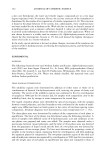
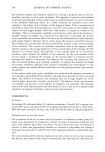
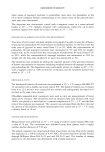
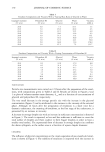
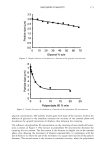
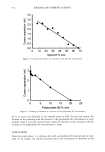
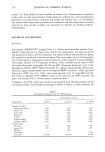
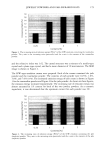
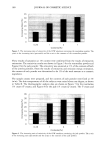
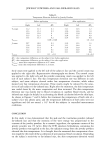
170 JOURNAL OF COSMETIC SCIENCE Table I Emulsion Compositions and Viscosity With a Varying Mass Ratio of Glycerol to Water Isopropyl myristate Polysorbate 80 Glycerol Water Viscosity (% w/w) (% w/w) (% w/w) (% w/w) (mPa s) 20.0 5.0 7.5 67.5 3.5 20.0 5.0 15.0 60.0 4.5 20.0 5.0 22.5 52.5 6.9 20.0 5.0 30.0 45.0 9.3 20.0 5.0 37.5 37.5 15.1 20.0 5.0 45.0 30.0 27.9 20.0 5.0 52.5 22.5 59.0 20.0 5.0 60.0 15.0 178.9 20.0 5.0 67.5 7.5 351.7 Table II Emulsion Compositions and Viscosity With a Varying Concentration of Polysorbate 80 Isopropyl myristate Polysorbate 80 Glycerol Water Viscosity (% w/w) (% w/w) (% w/w) (% w/w) (mPa s) 20.0 0.1 32.0 47.9 8.8 20.0 0.2 31.9 47.9 7.2 20.0 0.5 31.8 47.7 5.3 20.0 1.0 31.6 47.4 5.0 20.0 2.5 31.0 46.5 7.8 20.0 5.0 30.0 45.0 9.3 20.0 10.0 28.0 42.0 16.9 20.0 20.0 24.0 36.0 107.9 PARTICLE SIZE Particle size measurements were carried out 24 hours after the preparation of the emul- sions, with compositions given in Tables I and II. Results are shown in Figures 2 and 3 as plots of volume-number mean diameter, dv• , and as a function of concentrations of glycerol and polysorbate 80, respectively. The very small decrease in the average particle size with the increase in the glycerol concentration (Figure 2) can be attributed to the increase in the viscosity of the external phase. Although 24 hours after the preparation of emulsions is a short time for a dramatic coalescence, the creaming of emulsions, as the first stage of the coalescence, is prevented by an increase in viscosity. A decrease in average droplet size with an increase in surfactant concentration is observed in Figure 3. The result is expected, as less and less surfactant is sufficient to cover the total surface of droplets and these coalesce to form bigger droplets in order to have a smaller total surface. The exponential form of decrease in average droplet size confirms the above syllogism, as the surface area is a function of square droplet diameter. CREAMING The influence of glycerol concentration on the cream separation of one-month-old emul- sions is shown in Figure 4. The stability of emulsions is improved with the increase in

EMULSION STABILITY 171 3.5 3.0 ,.• 2.5 2.0 1.5 1.0 0.5 0 I I I I I II ß 0 10 20 30 40 50 60 70 Glycerol % w/w Figure 2. Droplet diameter of emulsions as a function of the glycerol concentration. 7 6 5 4 3 2 1 0 0 I I I I I 5 10 15 20 25 Polysorbate 80 % w/w Figure 3. Droplet diameter of emulsions as a function of the polysorbate 80 concentration. glycerol concentration. The stability results agree with those of the viscosity. Indeed, the addition of glycerol to the emulsion increases the viscosity of the external phase and decelerates the upward movement of droplets, thus delaying the creaming. The influence of polysorbate 80 concentration on the creaming of one-month-old emul- sions is shown in Figure 5. The increase in polysorbate 80 concentration decreases the creaming for two reasons. The first reason is the decrease in droplet size in the internal phase, thus delaying the movement of droplets exponentially, in compliance with the law of Stoke (13), where the rate of the movement is a square root function of the particle diameter. The second reason is the increase in emulsion viscosity, when the polysorbate
Purchased for the exclusive use of nofirst nolast (unknown)
From: SCC Media Library & Resource Center (library.scconline.org)