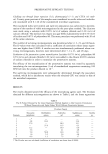
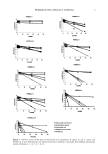
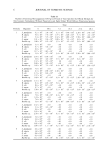
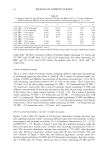
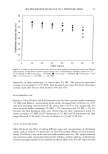
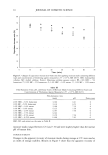
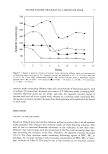
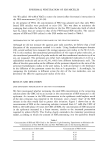
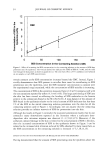
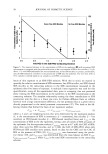
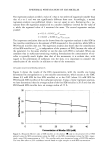
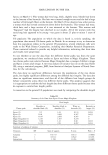
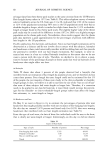
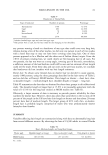
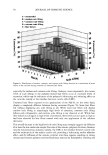
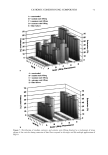
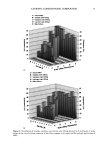
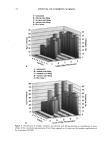
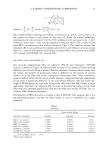
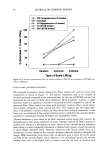
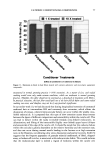
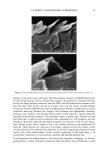
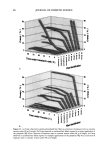
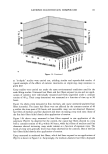
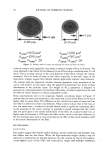
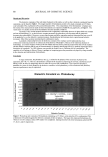
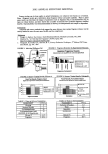
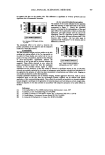
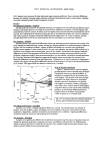
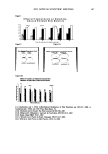
WATER-SOLUBLE MUCILAGE IN A MOISTURE MASK 19 times decreased from 12.05 min to 14.08 min with the increased concentration of mucilage used. This may be because film formation results from an aggregation of film-forming compounds, i.e., HEC, MC or mucilage, after the solvent evaporates (29). Therefore, film-formation time decreased with increasing concentration of film-forming agents. STORAGE STABILITY Results in Figure 5 show that the apparent viscosity of moisture masks containing 2% HEC + 5% humectant or 1% HEC + 1% mucilage was relatively stable within six weeks, and then decreased and leveled off at eight weeks. However, for moisture masks containing 2% MC + 5% humectant or 1% MC + 1% mucilage, the apparent viscosity started to decrease from the beginning, until the fourth or sixth week, and then leveled off. This may be attributed to different time courses of the coalescense of dispersed lipid droplets, and it resulted in the decreases in the apparent viscosity of moisture masks. The apparent viscosity of masks containing HEC was higher than that of those containing MC. The onset times of coalescense of dispersed lipids for those moisture masks con- taining HEC were later than for those containing MC. Therefore, the apparent viscosity of moisture masks containing MC decreased from the beginning of storage and then leveled off after six weeks. Although the apparent viscosity of moisture masks decreased during storage, no phase separation occurred. The moisture masks were stable for more than three months stored at 4øC. CONCLUSION Increasing concentration of water-soluble mucilage in moisture masks increased their water-holding capacity but decreased film-formation time. Moisture masks containing 1% water-soluble mucilage and 1% HEC have a higher water-holding capacity, al- though the apparent viscosity was lower than for those containing 2% MC and 5% humectant. ACKNOWLEDGEMENTS The authors express their gratitude to the National Science Council, Republic of China (Project No. NSC 88-2313-B-019-022) for its financial support. REFERENCES (1) S. Maeshige, Chemical studies on the green alga Monostroma nitidium Wittrock-I components sugar of the mucilage, Bull. Jap. Soc. Sci. Fish, 28, 326-334 (1962). (2) T. Kawabe, T. Nagaoka, G. Nagahama, H. Morita, and A. Ohbayashi, Generation of dimethyl sulfide from dimethyl-[3-propiothetin in an extract of green alga Monostroma nitidium and its retention by cyclodextrin, Agric. Biol. Chem., 53, 2587-2591 (1989). (3) S. Maeshige, Chemical studies on the green alga Monostroma nitidium Wittrock-II low molecular carbohydrate in the alga, Bull. Jap. Soc. Sd. Fish, 28, 606-609 (1962). (4) T.C. Lii, Physico-chemical properties of water-soluble polysaccharides of Monostroma nitidium. MS thesis, National Taiwan Ocean University (in Chinese) (1986).

20 JOURNAL OF COSMETIC SCIENCE (27) (28) (29) (5) M. Tanaka, Recent development of skincare products in Japan from the bio-science standpoint, FragranceJ., 14, 9-15 (in Japanese) (1994). (6) R. S. Summers, B. Summers, P. Chandar, C. Feinberg, R. Gursky, and A. V. Rawlings, The effect of lipids, with and without humectant, on skin xerosis, J. Soc Cosmet. Chem, 47, 27-39 (1996). (7) S. Matsumura, H. C. Cheng, M. Minami, S. Yoshikawa, and T. Karltoni, Synthesis and water uptake and holding capacity of chitin and chitosan derivatives, Oil Chem., 38, 492-500 (1989). (8) E. Vandamme, Bacteria in front mirror: Biocosmetics vis microbial synthesis, Agro Food Industry Hi. Tech., 3-8 (July/August 1996). (9) S. B. Ross-Murphy, "Properties and Uses of Cellulose Solution," in Ce//u/ose Chemistry and Its Appli- cations, T. P. Nevell and S. H. Zeronian, Eds. (Ellis Horwood, West Sussex, UK, 1985), pp. 202-222. (10) T. L. Davidson, Handbook of Water-Soluble Gums and Resins (McGraw Hill, New York, 1980). (11) G.L. Brode, "Polysaccharides: 'Naturals' for Cosmetics and Pharmaceuticals," in Cosmetic and Phar- maceutical Applications of Po/ymers, C. G. Gebelein, T. C. Cheng, and V. C. Yang, Eds. (Plenum, New York, 1991), pp. 105-115. (12) R. H. Chen and R. S. Heh, Sun protection and skin hydration effects and physico-chemical properties of sun screen lotion containing water-soluble chitosan, J. App/. CosmetoL, 17, 56-71 (1999). (13) R. H. Chen and R. S. Heh, Film formation time, skin hydration effects, and physicochemical prop- erties of moisture masks containing different water-soluble chitosans,J. Cosmet. Sci., 51, 1-13 (2000). (14) R. H. Chen and R. S. Heh, Skin hydration effects, physico-chemical properties and vitamin E release ratio of vital moisture creams containing water-soluble chitosan, Int. J. Cosmet. Sci., 22, 349-360 (2000). (15) N. Mekideche and N. Briand, Out of the blue soap, Perfum. Cosmet., 67, 73-78 (1994). (16) H. Iida, K. Nakamura, and T. Tokunaga, Dimethyl sulfide and dimethyl-13-propiothetin in sea algae, Bu//. Jpn. Sot Sci. Fish., 51, 1145-1150 (1985). (17) T. Kajiwara, A. Hatanaka, T. Kawai, M. Iahihara, and T. Tuneya, Long chain aldehydes in the green marine algae Ulvaceae, Nippon Suisan Gakkaishi, 53, 1901 (1987). (18) H. Sakagami, J. Iseda, T. Fujimori, Y. Hara, and M. Chihara, Volatile constituents in marine algae, Nippon Suisan Gakkaishi, 57, 527-533 (1991). (19) K. Fujimoro and T. Kaneda, Screening test for antioxygenic compounds from marine algae and fractionation from Eisenia bicyclis and Undaria pinnatifida, Bull. Jpn. Soc. Sci. Fish, 46, 1125-1130 (1980). (20) J. Tsai and S. Lin, Emulsifying properties of Monostroma nitidium mucilage-protein conjugates,J. Chin. Agric. Chem. Soc., 33, 104-113 (1995). (21) J. Tsai and T. Chiou, Effect of enzymatic hydrolysis on the extraction yield and emulsifying properties of Monostroma nitidium hydrolysate. J. Chin. Agric. Chem. Soc., 34, 241-247 (1996). (22) R. H. Chen and W. Y. Chen, Rheological properties of the water-soluble mucilage of a green laver, Monostroma nitidium, J. Appl. Phycol., 13, 481•488 (2001). (23) AOAC (Association of Official Analytical Chemists), OfjS'cial Methods of Analysis, 14th ed. S. Williams, Ed. (AOAC, Washington DC., 1984). (24) F. Draize, G. Woodard, and H. O. Calvery, Appraisal of the safety of chemicals in food, drugs and cosmetics, Pharmacology, 93, 377-392 (1948). (25) J. L. Leveque and J. De Rigal, Impedance methods for studying skin moisturisation, J. Soc. Cosmet. Chem., 34, 419•428 (1983). (26) W. Gehring, J. Wenz, and M. Gloor, Influence of topically applied creamide/phospholipid mixture on the barrier function of intact skin, atopic skin and experimentally induced barrier damage, Int. J. Cosmet. Sd., 19, 143-156 (1997). Y. Yazan, K. Arslan, and M. Seiller, Formulation and evaluation of a multiple emulsion containing glycolic acid, Drug Cosmet. Ind., 160, 30-37, 101-103 (1997). C. van den Hoek, D. G. Mann, and H. M. Jahns, "Pigments and Chloroplasts," in Algae (Cambridge University Press, Cambridge, UK), pp. 337-338. R. A. Muzzarelli, M. Weckx, O. Filippini, and C. Lough, Characteristic properties of N-carboxybutyl chitosan, Carbohydr. Polym. 11, 307-320 (1989).
Purchased for the exclusive use of nofirst nolast (unknown)
From: SCC Media Library & Resource Center (library.scconline.org)