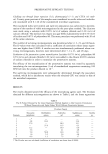
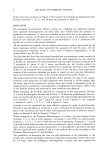
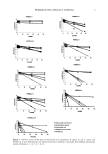
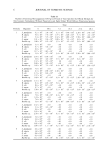
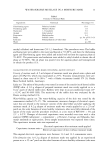
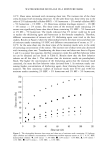
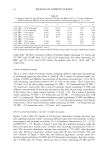
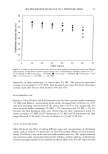
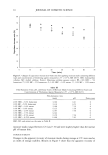
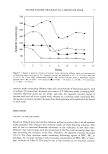
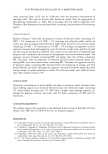
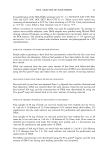
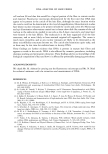
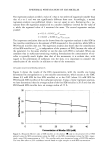
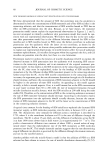
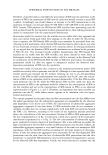
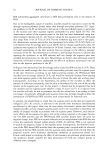
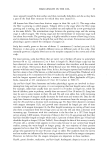
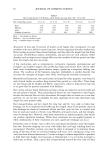
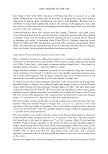
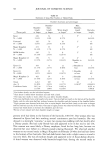
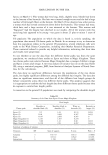
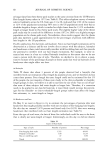
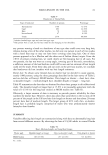
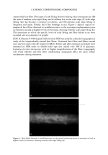
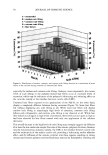
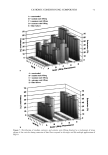
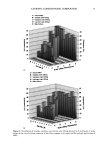
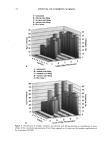
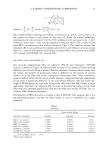
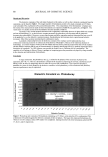
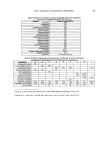
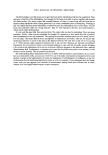
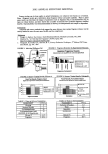
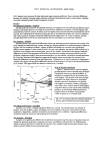
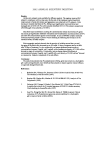
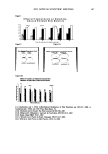
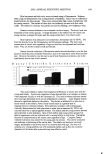
4 JOURNAL OF COSMETIC SCIENCE of the same tests are shown in Figure 1. The number of surviving microorganisms after 48 hours and after 7, 14, 21, and 28 days are presented in Table II. DISCUSSION The evaluation of preservative efficacy consists of a challenge test performed against some standard microorganisms and some other ones isolated from the products or production environment. S. aureus was included in this work due to the application of the cosmetic product on the skin B. cepacia was utilized since it can metabolize many kinds of raw materials and is resistant to antimicrobials (13,14) S. putrefaciens and Bacillus sp. are part of the natural bioburden. All the formulations studied, with or without preservative systems, were tested by the linear regression method, which permitted the assessment of their D-values. All the microorganisms employed, except S. aureus, were considered nonpathogenic, as the tested product was for skin use. The data obtained from the tests whose formulas had no preservative system resulted in inadequate performance, since the reduction of the viable organisms was only observed in Bacillus sp. Among the 40 assays performed with the eight formulas inoculated with S. putrefaciens, B. cepacia, E. co/i, S. aureus, and Bacillus sp., the D-value couldn't be determined in 13 of them, since the coefficients of correlation were lower than 0.9000 (Table I), the minimum value acceptable. In spite of this, the plot of the logarithmic number of the surviving organisms per gram, in regard to time, provided information about the antimicrobial activity of the included preservative system (Figure 1). The results obtained from assays with Bacillus didn't provide a D-value in any sample. However, some reductions of viable organisms were obtained in all the samples after 48 hours, and all the preservative systems were then tested in agreement with the requirements for sporeformer microorganisms, revealing their bacteriostatic effect. Even in the formula without any preservative some reduction was observed. When analyzing the D-values obtained by comparison of the requirements (D-value -- 4 hours for pathogenic bacteria and D-value -- 28 hours for nonpathogenic bacteria, yeast, and mold) only formula 9 was in agreement. The other samples that failed the test were formulas 3, 4, 5, 6, and 7 against B. cepacia 2 and 3 against E. coli 4 against S. putrefaciens and 2, 3, 4, 5, 6, 7, and 8 against S. aureus. Formula 9 can be considered the most effective among the eight studied formulas. Formula 8 was also effective, except for S. aureus. Although the D-value for Bacillus sp. hasn't been calculated, the rate of viable microorganism reduction at different times is higher in formula 8 than in formula 9 (Figure 1). When compared to the European Pharmacopeia (1) criteria, the data obtained from formulas 2, 6, 8, and 9 were adequate. According to the CTFA (4) specifications, formulas 2, 4, 5, 6, 7, 8, and 9 (Table II) were also in agreement. Formulas 2, 7, 8, and 9 showed similar behavior under the same circumstances, which makes it impossible to select the best preservative system among them. It is also difficult to determine the most efficient system between samples 8 and 9 if one analyzes the results according to the European Pharmacopoeia (1) specification. The possibility of foreseeing the time for self-sterilization of any bioburden in the product (6) is another advantage of the linear regression method. Since the D-value must be --4 hours when the pathogenic microorganism is tested, the time required for

PRESERVATIVE EFFICACY TESTING 5 FORI•JL• 1 10 20 30 40 50 FORMULA 3 8 7 .•5 3 1 0 0 10 20 30 40 50 HOURS •5 0 10 20 30 40 50 •LA7 8• 7 • •2• o 10 20 3o 40 50 HOURS FORMULA 2 8 5 0 10 20 30 40 50 HOURS •4 5 1 o 10 20 30 40 50 FORNU.A 6 7 •4 2 1 0 0 10 20 30 40 50 8' •8 o lO •o 3o •o FORMULA 9 ß Shewanella putrefacien.• ß Burkholderia cepacia & Escherichia coti x Staphylococcus aureus ß Bacillus sp. 0 10 20 30 40 50 HOURS Figure 1. Survivor curves of the rates of inactivation of S. putrefaciens, B. cepacia, E. co/i, S. aureus, and Bacillus sp. in nine formulations, one without preservative (formula 1) and eight with different preservative systems (formulas 2, 3, 4, 5, 6, 7, 8, 9).
Purchased for the exclusive use of nofirst nolast (unknown)
From: SCC Media Library & Resource Center (library.scconline.org)