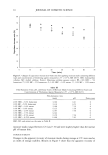
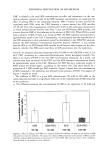
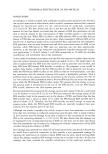
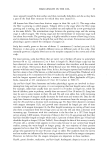
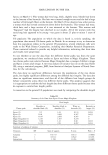
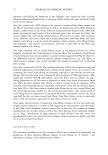
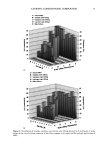
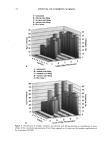
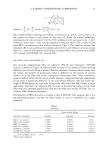
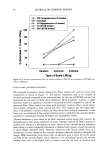
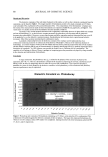
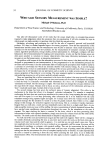
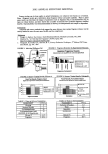
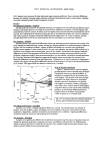
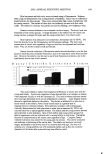
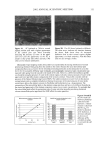
2002 ANNUAL SCIENTIFIC MEETING 101 0.05. Samples were evaluated by type and across types (common attribntes). Due to inherent differences between wet and dry cleansing wipes, attributes evaluated varied between types as shown above. Samples were also evaluated using Principal Component Analysis. Results - Pre-Moistened Samples - Skinfeel Samples performed similarly for afterfeel attributes. All samples were no]Mathering and did not require rinsing. Immediately post-use, the cheek area was low/low moderate in stickiness, was less slippery than untreated skin, had low amount of residue, and was slightly more taut and moist than untreated skin. By 60 seconds, the residual product had dried, leaving the skin at near baseline profiles with very low stickiness and residue amounts. Samples statistically differentiated by slipperiness. At 5 and 10 minutes, the skin changed little from the 60-second measurements and was essentially in pre-treatment condition. Dry Samples - Skinfeel Samples showed more statistical differences within type although practical outcomes were similar. Use of dry samples included lathering, rinsing, and drying. Samples created a low moderate amount of lather on the face with low moderate thickness. Amount of lather and bubble size variation were significantly different across samples. Lather rinsed off with 6-8 warm water splashes, leaving the cheek surface low in stickiness, more slippery than untreated skin, and with low residue. hmnediately after drying, statistical differences existed in the appearance of fine lines. but otherwise samples performed similarly with low stickiness, slipperiness slightly lower than untreated skin, very low residue, and slightly elevated moistness. By 5 minutes, stickiness and slipperiness approached baseline values and residue was extremely low. Statistical differences existed in gloss and slipperiness. Differences at 10 and 20 nfinutes as compared to 5 minutes were slight, with significant differences for facial lines/creases at 10 and 20 minutes and moistness at 10 minutes. Skin approached near baseline conditions by 5 minutes. 1.0 0.5 0.0 -t.0 -t.0 *wet dry* .•lPs dry. • •' STrX10 • d•* d•* TA•10 // • •we• [ TA• • [ } •.$ 0.0 0.$ 1.0 F1 (62.2%) PCA of Skinfeel Attributes Figure I indicates lhat dry and wet samples grouped together when evaluated using Principal Component Analysis on shared attributes. In afterfeel, dry stunpies left the skin moister and more slippery. Wet samples were more strongly correlated with higher tautness in immediate afterfeel, and from immediate to 10 minutes were higher in stickiness, residue, and appear- ance of fine lines. Caution must be made against using PCA data as a sole criterion for evaluating products, as the absolute differences between samples within an attribute were generally within 10 points on a 100-point scale. Fig. I PCA of Shared Skinfeel Afterfeel Attributes for Dry and Pre-Moistened (wet) Facial Wipes Pre-Moistened Samples - Handfeel Samples were similar, although significant differences existed. The samples had a low amount of product, were low in gritty, grainy, and lumpy, and were moderate in fi•zziness. Base sheets were low moderate in slipperiness, moderate in thickness and extremely low in stifflyess. Significant differences existed for grittiness, fuzziness, and thickness of the basesheet. Dry Samides - Handfeel Samples were significantly different for all attributes measured except for amount of product when wet. Ranges for grittiness, graininess, lumpiness, fuzziness, and stiffness indicated that very different base sheets are used as the delivery vehicle for the cleansers. Dry samples tended to hold more cleanser, were thicker and were stiffer than pre-moistened wipes.

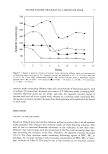
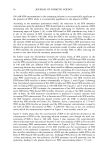
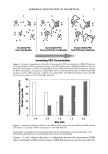
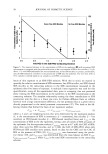
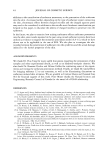
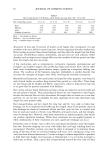
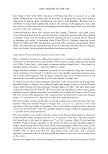
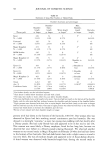
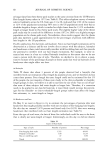
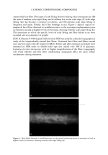
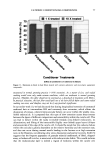
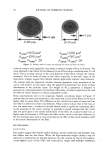
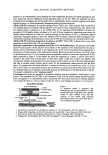
102 JOURNAL OF COSMETIC SCIENCE THE SKIN BARRIER: A UNIQUE INTERPLAY BETWEEN CORNEOCYTES AND LIPIDS Joke Bouwstra', Ph.D., G. Gooris' and M. Ponec s •Leiden/Amsterdam Center Jbr Drug Research, Leiden, The Netherlands 2Department of Dermatology, Leiden University Medical Center, The Netherlands Introduction: One of the most important functions of the skin is to protect the body against unwanted effects from the environment. The barrier for permeation of substances across the skin resides in the outermost layer of the skin, the stratum corneum (SC). The SC consists of dead cells, comeocytes, surrounded by hydrophobic lipid lameline. The interconnection between the lipid lamellae and corneocytes is formed by a monolayer of lipids bound to the cornified envelope. Visualisation studies revealed that the penetration route across the SC resides in the intercellular tortuous pathway between the corneocytes. However, there is at least one exception. Water can be absorbed into the corneocytes in large amounts. For all substances the SC lipids play a key role in the skin barrier function. In SC mainly hydrophobic lipids, such as ceramides (CER), long chain free fatty acids (FFA) (most abundant chain lengths C22 and C24) and cholesterol are present. Eight subclasses of ceramides have been identified in human SC. The ceramides consist of a sphingosine, phytosphingosine or a 6-OH- sphinganine base to which a nonhydroxy fatty acid or an to-hydroxy fatty acid is chemically linked. In Molecular arrangement Lateral packing Figtire 1 Left: The periodicity (d) of the 12.8 and 5.5 Long periodicity (LP) Liquid (high permeability) rllIl lamellar phases. i••ii•!l i• Right. The lateral packing is either liquid (not "•..•b•., . well defined spacings between molecules), the d Hexagonal linedlure permeaioihty) hexagonal packing (equal intermolecular • spacing) and the orthorhombic phase (two •1• .... possible spacing between the molecules) Short periocli,city (SP) . human SC two ceramides, CER1 and CER4, have been identified with a linoleic acid chemically bound to the C31/33 c0-hydroxy fatty acid. Information on the relationship between lipid organization and composition is of great importance to unravel the mechanism controlling the skin barrier function. Methods: Small angle and Wide angle X-ray diffraction: By using small and wide angle X-ray diffraction the following parameters can be determined. A. The periodicity (d) is of one of the imporantant characteristics of the lamellar phases. This is the distance over which the structure of the lamellar phase perpendicular to its basal plane is repeated, see figure 1. B. Lateral packing of SC lipids, which can be liquid, hexagonal and/or orthorhombic. With Electron diffraction is easier to distinguish between a hexagonal and orthorhombic lattice and to study lateral packing in vivo in man. Human stratum cornebro: In human SC two lamellar phases are present with a periodicity of approximately 6.4 nm and 13.4 rim, respectively (1). Since the 13 nm lamellar phase has always been present in all species studied so far, this phase is considered to be important for the skin barrier function. Increasing the hydration level from 0 to 300Vow/w does almost not lead to an increase in the periodicity. This indicates an absence of swelling of the lamellar phases. From the WAXD pattern of human SC the
Purchased for the exclusive use of nofirst nolast (unknown)
From: SCC Media Library & Resource Center (library.scconline.org)