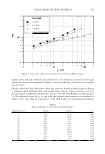
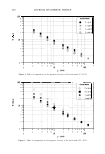
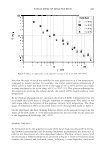
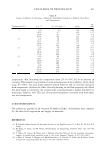
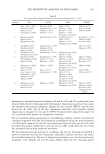
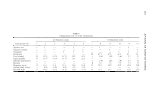
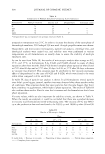
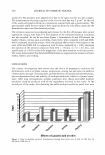
FACIAL MASK OF DEAD SEA MUD 453 Table II Degree and Extent of Thixotropy of Dead Sea Mud Mask, Evaluated at Different Shear Rates and Temperatures 1lo Temperature (°C) -y· (s-1) k X 103 (min- 1 ) 11o/11= (Pas) 5 2.20 0.0 1.00 24.4 10.21 47 1.05 12.7 28.38 121 1.16 6.2 47.43 190 1.23 4.5 15 2.20 28 1.03 22.3 10.21 79 1.05 10.6 28.38 125 1.17 5.2 47.43 361 1.28 2.7 25 2.20 39 1.08 23.5 10.21 139 1.13 10.1 28.38 209 1.20 4.9 47.43 404 1.35 2.8 35 2.20 82 1.34 41.4 10.21 270 1.43 12.2 28.38 280 1.50 5.5 79.02 489 1.51 3.8 45 2.20 150 1.90 17.8 10.21 328 1.93 12.9 28.38 555 1.97 5.2 131.90 618 2.76 2.7 temperature. But increasing the temperature from 20 ° to 45°C led to an increase in viscosity. This behavior was attributed to the gelatinization of the stabilizer. In the third stage, 45°-60 ° C, the mud mask regained normal behavior and its viscosity decreased with temperature. As far as the effect of steady shearing on the flow properties of a Dead Sea mud mask is concerned, the second order structural kinetic model described its thixotropic behavior well. The rate of structural breakdown increased with both shear rate and temperature. ACKNOWLEDGMENTS The authors are grateful to Dr. Hussam El-Haffar and Mrs. Aida Frehatt from Ammon Co. for their kind cooperation and supply of materials. REFERENCES (1) K. Sukenik, Balneotherapy for rheumatic diseases at the Dead Sea area, Isr. J. Med. Sci. 32, Sl6-Sl9 (1996). (2) M. Hagit, 0. Esith, and W. Ronni, Balneotherapy in dermatology, Dernzatol. Ther. 16, 132-140 (2003). (3) S. Halevy, H. Giryes, M. Friger, and S. Sukenik, Dead Sea bath salt for the treatment of psoriasis vulgaris: A double-blind controlled study,]. Eur. Acad Derrnatol. Venereol., 9, 237-242 (1997). (4) Z. Maor, S. Yehuda, S. Magdassi, G. Meshulam-Simon, Y. Gavrieli, Z. Gilad, and D. Efron, Cream composition comprising Dead Sea mud, US Patent 6582709 (2003).

454 JOURNAL OF COSMETIC SCIENCE (5) M. M. J. Soriano, M. J. F. Contreras, and E. S. Flores, Development of a cream from self-emulsifying base and moisturizing actives, Il Farrnaco, 56, 513-5 22 (2001 ). (6) F. B. Ahmad and P. A. Williams, Effect of sugars on the thermal and rheological properties of sago starch, Biopolyrners, 50, 401-412 (1999). (7) R. I. Tanner, Rheology and computation, Theor. Appl. Rheol. l, 12-15 (1992). (8) S. B. Ross-Murphy, Structure and rheology of gelatin gels: Recent progress, Polymers, 33, 2622-2627 (1992). (9) B. Abu-Jdayil, Modelling the time-dependent rheological behavior of semisolid foodstuffs,]. Food Eng., 57, 97-102 (2003). (10) P. Coussot and J.M. Piau, On the behavior of fine mud suspensions, Rheolog. Acta, 33, 175-184 (1994). (11) T. Aubry, T. Razafinimaro, R. Silva Jacinto, and P. Bassoulet, Rheological properties of a natural estuarine mud, Appl. Rheol., 13, 142-149 (2003). (12) P. Coussot, S. Proust, and C. Ancey, Rheological interpretation of deposits of yield stress fluids, J. Non-Newt. Fluid Mech., 66, 55-70 (1996). (13) Q. D. Nguyen and D. V. Boger, Application of rheology to solving tailings disposal problems, Int. J. Min. Process., 54, 217-233 (1998). (14) D. Perret, J. Locat, and P. Martignoni, Thixotropic behavior during shear of a fine-grained mud from Eastern Canada, Eng. Geo!., 43, 31--44 (1996). (15) F. Sofra and D. V. Boger, Environmental rheology for waste minimization in the mineral industry, Chern. Eng.]., 86, 319-330 (2002). (16) B. Abu-Jdayil, M. Mohameed, A. Eassa, Rheology of starch-milk-sugar systems: Effect of heating temperature, Carb. Polyrn., 55, 307-314 (2004). (17) Y. H. Rossm, "Transitions and Transformations in Food Systems," in Handbook of Food Engineering, D.R. Heldman and D. B. Lund, Eds. (Marcel Dekker, New York, 1992), pp. 145-197. (18) H. A. Barnes, Thixotropy-A review, J. Non-Newt. Fluid Mech., 70, 1-33 (1997).
Purchased for the exclusive use of nofirst nolast (unknown)
From: SCC Media Library & Resource Center (library.scconline.org)