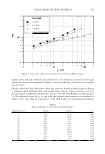
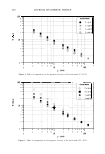
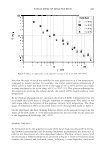
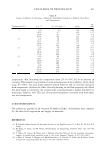
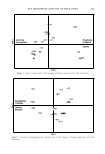
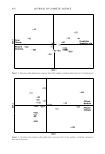
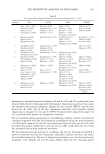
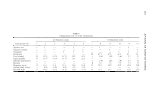
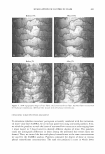
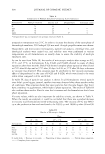
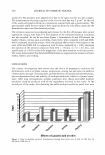
FCP DESCRIPTIVE ANALYSIS OF STICK BASES 461 Table II Descriptors Most Highly Correlated with the First Dimension (r 2: I0.5I) Assessor ASP SDUR SAFT SSMIN Gray color ( -0.65) Stickiness (0.89 Gloss (-0.61) Oiliness (0.77) Exudation (0.95) Spreadability (-CUS) Oiliness (-0.84) Residue (0.66) Opacity (0.91) Coldness (-0.67) Residue (-0.79) Softness (0.65) Uniformity (-0.94) Oiliness (-0.71) Softness (-0.49) Absortion rate (0.85) 2 Exudation (0.96) Spreadability (-0.76) Roughness (0.66) Roughness (-0.66) Opacity (0.91) Gloss (-0.75) Oiliness (0.86) Roughness (0.70) Oiliness (-0.73) Residue (0.95) Absorption rate (0.88) 3 Roughness (0.93) Spreadability (-0.58) Oiliness (0.54) Exudation (0.89) Hardness (0.50) Moistness (0. 51) Opacity (0.88) Oiliness (-0.50) 4 Exudation (0.93) Spreadability (-0.63) Absorption rate (0.63) Transparency (-0.98) Oilness (-0.58) 5 Exudation (0.93) Spreadability (-0.69) Oiliness (-0.66) Oiliness (0.70) Heterogeneity (0.90) Coldness ( -0.72) Moistness (-0.83) Moistness (0.58) Opacity (0.90) Moistness (-0.83) Tautness (0.65) Residue (0.5 l) Absorption rate (0.64) 6 Smoothness (-0.80) Oiliness (-0.83) Oiliness (-0.91) Oiliness (0.90) Opacity (0.95) Absorption rate (0.63) 7 Gloss (-0.75) Gloss (-0.73) Roughness (0.61) Gloss (0.50), Gray color (-0.54) Spreadability (-0.50) Gloss (-0.73) Elasticity (0.75) Uniformity (-0.83) Oiliness (-0,50) Moistness (0.78) Moistness ( -0.87) Opacity (0.89) Stickiness (-0.49) Absorption rate (0.56) 8 Roughness (0.76) Moistness (-0.86) Moistness (-0.70) Oiliness (0.58) Exudation (0.95) Absorption rate (0.64) Moistness (0.69) Opacity (0.92) Residue (0.59) Absorption rate (-0.63) homogeneity correlated negatively. Samples A2 and A3 (4% and 6% octyldecanol) were far apart from the rest, being associated with negative characteristics such as being rough and exudative and lacking uniformity. Samples B 1, B2, and B3 (PPG-5-ceth-20) were located on the other side of the first dimension, associated with desirable sensory characteristics. Samples Cl, C2, and C3 (PPG-15-stearyl ether) along with sample Al (2% octyldodecanol) showed an intermediate behavior. For the sensations-during-application set, spreadability, coldness, oiliness, and moisture correlated negatively with the first dimension, spreadability being the most frequently cited descriptor. Samples A2 and A3 were again apart from the rest, perceived as easily spreadable but greasy. Samples B, C, and Al did not differ clearly from the rest, being less spreadable and lacking undesired attributes. For the sensations-after-application set, roughness and the rate of absorption showed a positive correlation with the first dimension, while gloss, oiliness, moisture, and sticki ness correlated negatively. The rate of absorption and oiliness were the descriptors most frequently cited. Samples A2 and A3 again differed from the rest, showing greater

462 JOURNAL OF COSMETIC SCIENCE oiliness and a slower absorption rate. Even though the group of samples B, C, and Al did not differ clearly from the rest, sample Cl (2% PPG-15- stearyl ether) moved slightly towards the left quadrant. Regarding the sensations-five-minutes-after-application data set, oiliness, moisture, resi due, and softness correlated positively, oiliness and residue being the most frequently mentioned. Samples A3, A2, and Cl differed from the rest, having greater oiliness and residue. CONCLUSIONS • Formulations containing 4% and 6% octyldodecanol (A2, A22 and A3, A33) and 2% PPG-15-stearyl ether (Cl, C11) were considered inadequate, since they showed un wanted qualities such as exudation, a slow absorption rate, high oiliness, and residue. • Formulations containing 2% octyldodecanol 2, 4 and 6% PPG-5-ceteth-20 and 4 and 6% PPG-15-stearyl ether presented different characteristics regarding the four categories of descriptors evaluated, all of them being acceptable considering the properties sought. • FCP provided relatively quick and useful information about the samples, being an efficient tool to gather reliable data for the kind of problem approached, in a relatively short period of time. REFERENCES (1) M. E. Parente and R. Lombardi, La barra y su generalizaci6n como forma de aplicaci6n sobre la piel, VI Congreso de la Federaci6n Sudamericana, 26-28 de abril 2000, Montevideo, Uruguay (2000). (2) L. B. Aust, L. P. Oddo, J. E. Wild, 0. H. Mills, and J. S. Deupree. The descriptive analysis of skin care products by a trained panel of judges,]. Soc. Cosmet. Chem., 38, 443-449 (1987). (3) E. Parente, A. Gambaro, and G. Solana, Study of sensory properties of emollients used in cosmetics and their correlation with physicochemical properties, J. Cosmet. Sci., 56, 175-182 (2005). (4) A. M. Munoz and G. V. Civille. "The Spectrum Descriptive Analysis Method," in ASTM Manual Series MNL 13, RC Hootman, Ed. (American Society for Testing and Materials, Baltimore, 1992), pp. 22-34. (5) H. Stone, "Quantitative Descriptive Analysis," in ASTM Manual Series MNL 13, RC Hootman, Ed. (American Society for Testing and Materials, Baltimore, 1992), pp. 15-21. (6) H. Stone and J. Sid el, Sensory Evaluation Practices (Academic Press, USA, 1985 ), pp. 194-226. (7) M. H. Damasio, "Analise Descritiva: Metodologia do Perfil Livre versus Metodologias Tradicionais," in Avances en Analisis Sensorial (Livraira Varela, Sao Paulo, Brasil, 1999), pp. 35-48. (8) M. G. Arnold and A. A. Williams, "The Use of Generalized Procrustes Techniques in Sensory Analy sis," in Statistical Procesures in Food Research, J. R. Piggot, Ed. (Elsevier Appl. Sci. Publ. Ltd., Essex, England, 1986), pp. 233-253. (9) D. C. Oreskovick B. P. Klein, and J. W. Sutherland, "Procustes Analysis and Its Applications to Free-Choice and Other Sensory Profiling," in Sensory Science Theory and Applications in Foods, H. T. Lawless and B. P. Klein, Eds. (Marcel Dekker, New York, 1991), pp. 353-394. (10) A. A. Williams and G. M. Arnold. A comparison of the aromas of six coffees characterized by con ventional profiling, free-choice profiling and similarity scaling methods, J. Sci. Food. Agr., 36: 204- 209 (1985). (11) A. A. Williams and S. P. Langron, The use of free-choice profiling for the evaluation of commercial ports,]. Sci. Food Agric., 35, 558-568 (1984). (12) E. Costell, C. Trujillo, M. H. Damasio, and L Duran, Texture of sweet orange gels by free-choice profiling,]. Sens. Stud., 10, 163-179 0995).
Purchased for the exclusive use of nofirst nolast (unknown)
From: SCC Media Library & Resource Center (library.scconline.org)