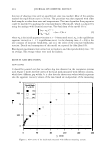
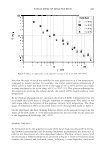
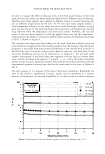
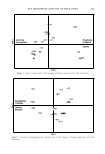
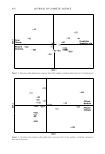
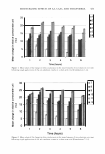
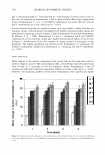
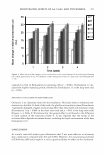
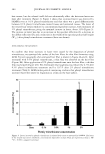
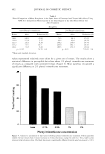
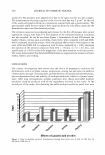
492 JOURNAL OF COSMETIC SCIENCE study (25). The products were applied every day to the same sites for ten days straight. The actual amount of product applied to the test site each day was 2 g/cm2 . At the end of the study each panelist filled out a permission consent form and a questionnaire. The questionnaire asked the test subjects their opinions about the side effects caused by the formulations when used for chemical peeling. The irritation sensation was evaluated each minute for the first 20 minutes after topical application, using a scale from 0--4. The duration of the irritation sensation in minutes was also recorded. As can be seen from Figure 1, formulations G and GD showed the highest redness, itching, pain, and edema, respectively, when compared to GS and GDS, which contained strontium nitrate, while the peeling effects were a little higher in the cases of GS and GDS. GS in comparison with G alone, markedly (p 0.01) shortened the duration of the irritation sensation from 20.6 ± 3.8 min. to 7 .2 ± 2.6 min., and significantly (p 0.05) reduced the magnitude of the pain sensation at all time points. The study demonstrated that GS and GDS formulations suppressed the sensation of pain, edema, redness, and itching. CONCLUSIONS The current investigations have shown that the choice of preparation conditions for formulations, such as oil phase volume, temperature, mixing rate and time, the addition of electrolytes, the type of mixing shaft, and the densities of internal and external phases, play an important role in the stability of multiple emulsions, which is of prime impor tance. After long investigations, optimal conditions were chosen and stable multiple emulsions could be produced with all the ingredients involved in this study. In the second part of the study, after obtaining the stable multiple emulsions, panel tests were 10· 9 8 7 6 5- 4- 3 2- 1 a Effects of glycolic acid on skin Figure 1. Data of multiple emulsion formulations obtained from panel test. G (bar l) GD (bar 2) GS (bar3) GDS (bar 4).

GLYCOLIC ACID IN W/0/W EMULSION 493 performed and, depending on the data from the panel test results, formulation GDS containing GA, D, and S, which was prepared by polymeric lypophilic surfactant (Abil EM-90) was found to be the most suitable multiple emulsion formulation with respect to stability, effectiveness, and reduced side effects. Results showed that the incorporation of strontium nitrate and dexpanthenol to topical chemical peeling formulations of glycolic acid in multiple emulsion form enhanced product efficacy and reduced the side effects that sometimes caused interruption of application. ACKNOWLEDGMENT This work was supported by the Research Fund of Istanbul University, project no. UDP-198/03092003. REFERENCES (1) H. Murad, A. T. Shamban, P. S. Premo, The use of glycolic acid as a peeling agent, Derrnatol. Clin., 13, 285-307 (1995). (2) E. Van Scott and R. J. Yu, Alpha hydroxy acids: Science and therapeutic use,]. Cosrnet. Derrnatol., 7 (suppl.), 12-20 (1994). (3) J. W. Slavin, Considerations in alpha hydroxy acid peels, Clin. Plast. Surg., 25, 45-52 (1998). (4) Z. Erbagci and C. Akcali, Biweekly serial glycolic acid peels vs. long-term daily use of topical low-strength glycolic acid in the treatment of atrophic acne scars, Int. J. Derrnatol., 39, 789-794 (2000). (5) M. J. Stiller, J. Bartolone, R. Stern, S. Smith, N. Kollias, R. Gillies, and L. Drake, Topical 8% glycolic acid and 8 % 1-lactic acid creams for treatment of photodamaged skin, Arch. Dermatol, 132, 631-636 (1996). (6) C. Litton and G. Trinidad, Complications of chemical face peeling as evaluated by a questionnaire, Plast. Reconstr. Surg., 67 738-744 (1981). (7) P. Perugini, I. Genta, F. Pavanetto, B. Conti, S. Scalia, and A. Baruffini, Study on glycolic acid delivery by liposomes and microspheres, Int. J. Pharrn., 196, 51-61 (2000). (8) S. S. Resnik and B. I. Resnik, Complications of chemical peeling, Clin. Plast. Surg., 28, 231-234 (2001). (9) H. Zhai, W. Hannon, G. S. Hahn, A Pelosi, R. A. Harper, and H. I. Maibach, Strontium nitrate suppresses chemically-induced sensory irritation in humans, Contact Dermatitis, 42, 98-100 (2000). (10) G. S. Hahn, Strontium is a potent and selective inhibitor of sensory irritation, Dermatol. Surg., 25, 689-694 (1999). (11) H. Zhai, W. Hannon, G. S. Hahn, R. A. Harper, A. Pelosi, and H. I. Maibach, Strontium nitrate decreased histamine-induced itch magnitude and duration in man, Dermatology, 200, 244-246 (2000). (12) W. Gehring and M. Gloor, Effect of topically applied dexpanthenol on epidermal barrier function and stratum corneum hydration, Arzneim. Forch.!Drug Res., 50, 659-663 (2000). (13) D. A. Omotosho, T. L. Whateley, and A. T. Florence, Methotrexate transport from the internal phase of multiple w/o/w emulsions,]. Microencaps., 6, 183-192 (1989). (14) A. Silva-Cunha, J. L. Grossiord, F. Puisieux, and M. Seiller, Insulin in w/o/w multiple emulsions: Preparation, characterization and determination of stability towards proteases in vitro,]. Microencaps., 14, 311-319 (1997). (15) F. Bonina, S. Bader, L. Montenegro, C. Scofani, and M. Visca, Three phase emulsions for controlled delivery in cosmetic field, Int.]. Cosrnet. Sci., 14, 65-74 (1992). (16) N. S. Tokgoz, A. Fructus, P. Prognon, M. Seiller, and J. L. Grossiord, Incorporation of the L-ascorbic acid and the N-acetyl L-cysteine in the inner aqueous phase of a w/o/w multiple emulsion: Stability, characterization and aging studies, Proc. 1st World Meeting, APGI/APV, Budapest, 666-667 (1995). (17) Y. Katsunori, S. Tomoko, M. Fumioki, Y. Toshio, and Y. Michihiro, Stability of vitamin A in oil-in-water-in oil type multiple emulsions,]. Am. Oil Chern. Soc., 76, 195-200 (1999). (18) A. Silva-Cunha, J. L. Grossiord, F. Puisieux, and M. Seiller, w/o/w multiple emulsions of insulin
Purchased for the exclusive use of nofirst nolast (unknown)
From: SCC Media Library & Resource Center (library.scconline.org)