2 JOURNAL OF COSMETIC SCIENCE
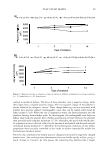
of this phenomenon. This report presents equilibrium water sorption and desorption
isotherms for human nail, as well as interpretation thereof in terms of isotherm models.
Related reports will describe the effects of hydration on water diffusivity in nail and on
the permeability of nail to an antifungal drug, ketoconazole.
Equilibrium water sorption in nails from mixed mammalian species has been reported
by Baden (17). He found a maximum water uptake of 0.3 g H
2
O/g dry nail in studies
conducted at 26°C. No hysteresis between uptake and desorption curves was noted.
These data are discussed and quantitatively analyzed in this report, along with our own
observations. Comparisons are also made to equilibrium water uptake in other kerati-
nized tissues.
MATERIALS AND METHODS
Frozen intact cadaver nails were obtained from ScienceCare Anatomical (Phoenix, AZ).
Human nail clippings were collected from several donors in our facility. Demographic
information for each nail sample (nail clippings and intact cadaver finger and toe nails)
was obtained. Nail samples were washed with a mild liquid detergent (containing
sodium laureth sulfate and cocamidopropyl betaine) and dried at 45°C to a constant
weight (Mettler AE 100). Intact cadaver nails from three different donors were used with
n =4-6 nails per donor. Their average dry weight ranged from 0.08 g (for little finger
nails) to 0.50 g (for big toe nails). Nail clippings from multiple donors were pooled, then
divided into six samples ranging from 0.26-0.40 g dry weight. In the analysis they were
considered as from one donor, with n =6. The water-binding capacity of nail samples
was determined by transferring individual nail samples to a weighing dish and exposing
samples to the vapor phase of solutions of varying relative humidity (RH) in a glass
chamber maintained at 32°C. RH ranging from 11 %to 100% was maintained with
various concentrations of H
2
SO
4,
NaCl, K
2
CO
3, and Li Cl in water. Standard tabulations
of molal osmotic coefficients cp over a range of temperatures were interpolated to 32°C,
then converted to RH using the relationship RH =100 x exp(=vmcp/55.51), where vis
the number of ions per molecule of electrolyte and mis the molality of the solution (18).
Details may be found in (19). Sorption and desorption curves were obtained by sequen-
tially exposing the same nail to increasing and decreasing RH, respectively. At each RH
the samples came to constant weight in 3-5 days, which was taken as the measure of
equilibrium.
DATA ANALYSIS
The relative pressure of water vapor, x =plp0 ,was calculated as RH/100. This value is
essentially the water activity, aw (20). The amount of water absorbed by the nail samples
at each value of x was expressed as the adsorption volume, v, calculated as (g of water/ g
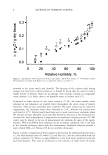
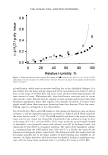
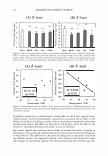
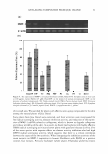
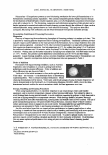
of dry tissue). The water uptake values in the plot are the mean values of nail clipping
data considered as from one donor (n =6) and three sets of intact cadaver nails (n =
4-5/donor). These variables were related according to equilibrium sorption isotherms
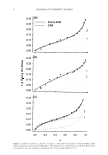
used previously to describe water uptake in other keratinized tissues. In particular we
have considered the D' Arey-Watt model (8), modified to exclude the linear term as
described in (21). This relationship is:
of this phenomenon. This report presents equilibrium water sorption and desorption
isotherms for human nail, as well as interpretation thereof in terms of isotherm models.
Related reports will describe the effects of hydration on water diffusivity in nail and on
the permeability of nail to an antifungal drug, ketoconazole.
Equilibrium water sorption in nails from mixed mammalian species has been reported
by Baden (17). He found a maximum water uptake of 0.3 g H
2
O/g dry nail in studies
conducted at 26°C. No hysteresis between uptake and desorption curves was noted.
These data are discussed and quantitatively analyzed in this report, along with our own
observations. Comparisons are also made to equilibrium water uptake in other kerati-
nized tissues.
MATERIALS AND METHODS
Frozen intact cadaver nails were obtained from ScienceCare Anatomical (Phoenix, AZ).
Human nail clippings were collected from several donors in our facility. Demographic
information for each nail sample (nail clippings and intact cadaver finger and toe nails)
was obtained. Nail samples were washed with a mild liquid detergent (containing
sodium laureth sulfate and cocamidopropyl betaine) and dried at 45°C to a constant
weight (Mettler AE 100). Intact cadaver nails from three different donors were used with
n =4-6 nails per donor. Their average dry weight ranged from 0.08 g (for little finger
nails) to 0.50 g (for big toe nails). Nail clippings from multiple donors were pooled, then
divided into six samples ranging from 0.26-0.40 g dry weight. In the analysis they were
considered as from one donor, with n =6. The water-binding capacity of nail samples
was determined by transferring individual nail samples to a weighing dish and exposing
samples to the vapor phase of solutions of varying relative humidity (RH) in a glass
chamber maintained at 32°C. RH ranging from 11 %to 100% was maintained with
various concentrations of H
2
SO
4,
NaCl, K
2
CO
3, and Li Cl in water. Standard tabulations
of molal osmotic coefficients cp over a range of temperatures were interpolated to 32°C,
then converted to RH using the relationship RH =100 x exp(=vmcp/55.51), where vis
the number of ions per molecule of electrolyte and mis the molality of the solution (18).
Details may be found in (19). Sorption and desorption curves were obtained by sequen-
tially exposing the same nail to increasing and decreasing RH, respectively. At each RH
the samples came to constant weight in 3-5 days, which was taken as the measure of
equilibrium.
DATA ANALYSIS
The relative pressure of water vapor, x =plp0 ,was calculated as RH/100. This value is
essentially the water activity, aw (20). The amount of water absorbed by the nail samples
at each value of x was expressed as the adsorption volume, v, calculated as (g of water/ g
of dry tissue). The water uptake values in the plot are the mean values of nail clipping
data considered as from one donor (n =6) and three sets of intact cadaver nails (n =
4-5/donor). These variables were related according to equilibrium sorption isotherms
used previously to describe water uptake in other keratinized tissues. In particular we
have considered the D' Arey-Watt model (8), modified to exclude the linear term as
described in (21). This relationship is: