4 JOURNAL OF COSMETIC SCIENCE
Q)
0.3 J 2
:::::,
u,
u,
� 0.2 alt
"C )(-jJ
Cl 6 6 0 X !•
---....+••
0 0 )()(!0.1
X • ♦
Cl
•
-:::.-i 6
�
0.0 • •
0 20 40 60 80 100
Relative Humidity, %
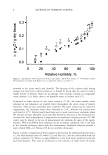
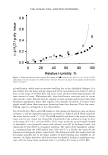
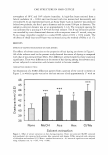
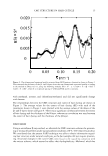
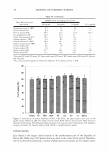
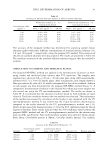
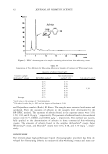
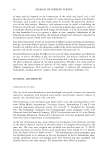
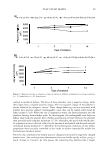
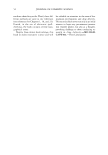
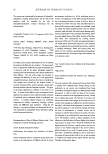
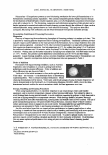
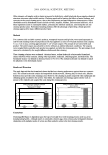
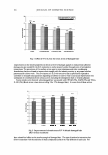
Figure 1. Equilibrium water sorption for human nail (mean ± SD of four donors, n =4-6/donor). Uptake
(•), desorption (0). Data from Baden (17) (x) and from Turek et al. (28) (+).
network as the tissue swells and deswells. The freezing of the cadaver nails during
storage may have been a factor however, it should be noted that the water in nail is
highly bound to keratin. Based on an analogy with stratum corneum at comparable
water contents, it is likely there is no freezable water in cadaver nails (27).
Compared to other reports of nail water sorption (17 ,28), the water uptake values
obtained in our laboratory are slightly lower throughout the entire range of relative
humidity. They are also somewhat more scattered. The lower values may be related to
temperature the literature values were obtained at 25 ° C, whereas our studies were
performed at 32°C. Similar results have been seen in wool-water vapor isotherms where
the amount of water adsorbed at any specified humidity decreases as the temperature is
increased (8). Such a dependence is expected for an exothermic sorption process (29). The
scatter may be related to the use of nonsaturated salt solutions for most of the equili-
brations. While the RH of these solutions can be accurately calculated (18), it can drift
as the solution exchanges water with the environment. Saturated solutions provide a
more reliable RH-see Yabuza (30) for an excellent discussion.
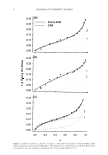
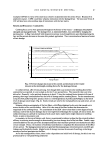
Figure 2 shows a comparison of water uptake in nail to that for other keratinized tissues,
i.e., the hard keratins horn (9), wool (31), and hair (31), and the soft keratin found in
stratum corneum (21). There is a major difference in the total water uptake between soft
and hard keratins. This may be attributed to the presence of high levels of cystine
Q)
0.3 J 2
:::::,
u,
u,
� 0.2 alt
"C )(-jJ
Cl 6 6 0 X !•
---....+••
0 0 )()(!0.1
X • ♦
Cl
•
-:::.-i 6
�
0.0 • •
0 20 40 60 80 100
Relative Humidity, %
Figure 1. Equilibrium water sorption for human nail (mean ± SD of four donors, n =4-6/donor). Uptake
(•), desorption (0). Data from Baden (17) (x) and from Turek et al. (28) (+).
network as the tissue swells and deswells. The freezing of the cadaver nails during
storage may have been a factor however, it should be noted that the water in nail is
highly bound to keratin. Based on an analogy with stratum corneum at comparable
water contents, it is likely there is no freezable water in cadaver nails (27).
Compared to other reports of nail water sorption (17 ,28), the water uptake values
obtained in our laboratory are slightly lower throughout the entire range of relative
humidity. They are also somewhat more scattered. The lower values may be related to
temperature the literature values were obtained at 25 ° C, whereas our studies were
performed at 32°C. Similar results have been seen in wool-water vapor isotherms where
the amount of water adsorbed at any specified humidity decreases as the temperature is
increased (8). Such a dependence is expected for an exothermic sorption process (29). The
scatter may be related to the use of nonsaturated salt solutions for most of the equili-
brations. While the RH of these solutions can be accurately calculated (18), it can drift
as the solution exchanges water with the environment. Saturated solutions provide a
more reliable RH-see Yabuza (30) for an excellent discussion.
Figure 2 shows a comparison of water uptake in nail to that for other keratinized tissues,
i.e., the hard keratins horn (9), wool (31), and hair (31), and the soft keratin found in
stratum corneum (21). There is a major difference in the total water uptake between soft
and hard keratins. This may be attributed to the presence of high levels of cystine