2006 ANNUAL SCIENTIFIC MEETING 73
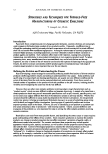
Investigating and Identifying Factors Affecting Emulsion Quality
Precise control of chemical composition in the production batch is crucial, as inaccurate weighing or
the use of the wrong raw materials can certainly cause variations in many important chemical/physical
properties related to product quaJity and shelf life. Equally important, however, are "Process Variables,"
which can also exert strong influence on perceived product quality. Most cosmetic emulsions on the
market are processed by a batch process, using kettles and mixers. By nature, batch processing is
accompanied by numerous process variables which are difficult to control precisely, and which may affect
emulsion quality. Process variables are those variables introduced during the manufacturing process
including emulsification temperature, mixing speed, the rate and the order in which the two phases are
combined, cooling rate and even filling speed. Depending on the type of product and formulation, some
process variables can be very important while others may be insignificant. Better control of process
variables can often be attained by adopting a continuous process, but this method is not often used in
cosmetic production because of the high engineering and equipment costs and the lack offlexibility.
Understanding the Nature of Emulsion Products
One reason why so many emu1sion products are tricky to manufacture and pose difficu1ty in controlling
the quality of every batch is that most emulsions, except microemulsions, are non-equilibrium systems.
As such, they are subject to the Second Law of thermodynamics and there is a strong tendency for the oil
phase to become separated from the water phase, even when surfactants and polymers are used to retard
this process. In general, a non-equilibrium product such as an 0/W cream, consisting of incompatible oil
and water phases, is much more susceptible to process variables and more troublesome to process than is a
single phase product like a toning lotion consisting mainly of water and ethanol in an equilibrium state.
Many process variables, such as shear stress from mixing and even the speed of adding one phase to
another, if not carefully controlled, can affect emu1sion properties and shelf life. Thus, a 1000 gram
sample of a new cream made in a beaker in the product development laboratory may have a shelf life of 3
years while the first production batch from the same formula, produced in a I 000 gallon tank, may end up
having only a 6-month shelf life. If the shortened shelf life is not detected before shipment, a costly
product recall could result. Scaling-up of a new product from the laboratory to production is a very
important step in prudent emulsion product development and carefully controlled piJot batch experiments
go a long way in preventing production disasters.
Manufacturing Trouble Prevention Program
To avoid problems in manufacturing a new emulsion formulation, it is essential for the development
chemists, quality control staff and process engineers to work together to develop an effective trouble
prevention program. Early detection and identification of potential manufacturing problems is crucial.
The product development chemists in charge of the new product should be alert to communicating
potential processing problems to the QC and engineering staff. Since each emulsion formulation is
unique and may be affected differently by different process variables, it is often advisable to carry out pilot
process experiments to determine the best way of processing and scaling up a new emulsion.
The importance of staff training cannot be overemphasized in our fast-changing industry. Companies
are expanding production by installing larger kettles and bigger mixers. Changing batch size often means
introduction of many process variables which can affect product quality and stability. It is not surprising
that some emulsions made in a new larger kettle can often produce batches having lower quality or
shortened shelf life. An experienced staff may be able to detect signs pending trouble from the appearance
of a batch sample and take corrective, or at least cautionary action. Proper staff training and open
communication among manufacturing staff, QC and development chemists are very important in
formulating a sound strategy for trouble-free manufacturing of cosmetic emulsions.
References
(1) T. J. Lin, Rheology Fundamentals and Applications in Cosmetics Formulation, Manufacturing and
Quality Control, The Chemistry and Manufacture of Cosmetics, M. L. Schlossman, editor, Allured
Publishing Corp. volumel, pp 341-371 (2000)
Investigating and Identifying Factors Affecting Emulsion Quality
Precise control of chemical composition in the production batch is crucial, as inaccurate weighing or
the use of the wrong raw materials can certainly cause variations in many important chemical/physical
properties related to product quaJity and shelf life. Equally important, however, are "Process Variables,"
which can also exert strong influence on perceived product quality. Most cosmetic emulsions on the
market are processed by a batch process, using kettles and mixers. By nature, batch processing is
accompanied by numerous process variables which are difficult to control precisely, and which may affect
emulsion quality. Process variables are those variables introduced during the manufacturing process
including emulsification temperature, mixing speed, the rate and the order in which the two phases are
combined, cooling rate and even filling speed. Depending on the type of product and formulation, some
process variables can be very important while others may be insignificant. Better control of process
variables can often be attained by adopting a continuous process, but this method is not often used in
cosmetic production because of the high engineering and equipment costs and the lack offlexibility.
Understanding the Nature of Emulsion Products
One reason why so many emu1sion products are tricky to manufacture and pose difficu1ty in controlling
the quality of every batch is that most emulsions, except microemulsions, are non-equilibrium systems.
As such, they are subject to the Second Law of thermodynamics and there is a strong tendency for the oil
phase to become separated from the water phase, even when surfactants and polymers are used to retard
this process. In general, a non-equilibrium product such as an 0/W cream, consisting of incompatible oil
and water phases, is much more susceptible to process variables and more troublesome to process than is a
single phase product like a toning lotion consisting mainly of water and ethanol in an equilibrium state.
Many process variables, such as shear stress from mixing and even the speed of adding one phase to
another, if not carefully controlled, can affect emu1sion properties and shelf life. Thus, a 1000 gram
sample of a new cream made in a beaker in the product development laboratory may have a shelf life of 3
years while the first production batch from the same formula, produced in a I 000 gallon tank, may end up
having only a 6-month shelf life. If the shortened shelf life is not detected before shipment, a costly
product recall could result. Scaling-up of a new product from the laboratory to production is a very
important step in prudent emulsion product development and carefully controlled piJot batch experiments
go a long way in preventing production disasters.
Manufacturing Trouble Prevention Program
To avoid problems in manufacturing a new emulsion formulation, it is essential for the development
chemists, quality control staff and process engineers to work together to develop an effective trouble
prevention program. Early detection and identification of potential manufacturing problems is crucial.
The product development chemists in charge of the new product should be alert to communicating
potential processing problems to the QC and engineering staff. Since each emulsion formulation is
unique and may be affected differently by different process variables, it is often advisable to carry out pilot
process experiments to determine the best way of processing and scaling up a new emulsion.
The importance of staff training cannot be overemphasized in our fast-changing industry. Companies
are expanding production by installing larger kettles and bigger mixers. Changing batch size often means
introduction of many process variables which can affect product quality and stability. It is not surprising
that some emulsions made in a new larger kettle can often produce batches having lower quality or
shortened shelf life. An experienced staff may be able to detect signs pending trouble from the appearance
of a batch sample and take corrective, or at least cautionary action. Proper staff training and open
communication among manufacturing staff, QC and development chemists are very important in
formulating a sound strategy for trouble-free manufacturing of cosmetic emulsions.
References
(1) T. J. Lin, Rheology Fundamentals and Applications in Cosmetics Formulation, Manufacturing and
Quality Control, The Chemistry and Manufacture of Cosmetics, M. L. Schlossman, editor, Allured
Publishing Corp. volumel, pp 341-371 (2000)