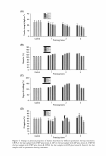
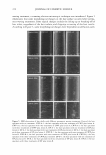
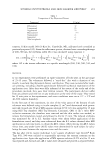
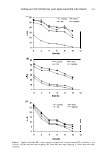
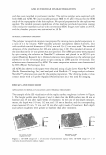
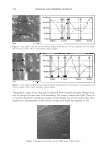
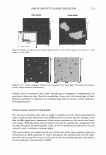
CHANGES IN HAIR DURING PERMANENT WAVING 207 To calculate the degree of swelling of the hair shafts in percentage, the hair materials were immersed in distilled water (50 ml) for 30 min, filtered through a filter paper, and then blot-dried on the filter paper. The percentage degree of swelling was calculated as follows: Degree of swelling (%) = [(diameter of the hair absorbed - diameter of the dried hair)/diameter of the dried hair] x 100 The data obtained were provided with the values±SD (standard deviation) calculated with three bundles (60 samples) of the hair shafts (Figure 1) for each measurement. SCANNING ELECTRON MICROSCOPY For scanning electron microscopy, the hair specimen was coated with gold (20 nm thick) using a vacuum ion spotter (Hitachi, E-1010, Japan). Each gold-coated hair specimen was then observed with a scanning electron microscope (Hitachi, S-2400, Japan) at a probe energy level of 15 KV, and its image was photographed at magnifications of 0.8 Kx or 2.0 Kx. RESULTS AND DISCUSSION EFFECTS OF PERMANENT WAVING TREATMENT ON CHANGES IN PROTEIN CONTENT AND PROFILE The protein content of the total hair mass consisted of approximately 80% of keratinized protein matrix (14), which is a key component in the determination of hair shape (15). It is well known that physicochemical properties of these keratinized proteins are closely implicated in hair styling because the keratin polypeptide chains are embedded with each other or bundled into twisted formations to form cables that support the hair shape (1,2). The reduction and oxidation treatments conducted necessarily during the process of permanent waving would result in a decrease in hair components such as hair proteins, which leads to hair damage (6-8). Figure 2 shows that there was a decreasing trend in the protein content of the human head hairs, on the whole, after the permanent waving treatment, although its decreasing degree was different with different treatments. From Figure 2, the following three important results were obtained: First, a higher decrease in the protein content of the hairs was found in DP (18-58% decrease the average decrease is 36.7%) than in CWP hair styling (13-32% decrease the average decrease is 24.2%). This result may be attributable to a difference in the setting temperature between the two perming methods (50°C for CWP and 100°-120°C for DP) because a high temperature is more capable of changing most proteins, including the keratinized proteins, which are the major component polypeptides of human hair shafts (3, 6-8). Secondly, application of waving lotions A and B induced a decrease in the protein content, and a lower protein content was detected with the latter lotion (36.7% decrease on the average) when compared with the former (24.5% decrease on the average). These results suggest that the permanent waving lotion has a negative influence on changing the protein content of human head hairs. In addition, a greater protein decrease was found with waving lotion B than with lotion A, indicating that lotion B was more contributive to protein loss. Thirdly, as the perming times increased, the protein content of the human head hairs diminished (Figure 2). Moreover, the remarkable decrease in

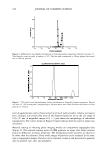
208 JOURNAL OF COSMETIC SCIENCE 300 - - CWP-A DP-A -CWP-B DP-B 250 - c::J Centro! - -- 200 - -- -- §3 ,... � 6 ..c:: blJ 150 == � -s � 0 �� -- -- -- - -- - -- -- 100 - 50 - 0 I I I I Control 1 2 3 Penning times Figure 2. Change in protein content of human head hairs by different waving treatments. CWP-A: the hair sample with CWP plus lotion A. DP-A: the hair sample with DP plus lotion A. CWP-B: the hair sample with CWP plus lotion B. DP-B: the hair sample with DP plus lotion B. Control: the hair sample with no permanent waving treatment. protein content (by 58%) was observed in the hair shafts processed after three treatments with permanent waving method DP, using lotion B (Figure 2), indicating that this type of permanent waving treatment may result in hair damage. Some workers (2,6,7) have also provided evidence that permanent waving treatment leads to a decrease or structural changes in human hair protein. Their data may support our results that the permanent waving treatment is directly associated with a decrease in the protein content of human head hairs. For analysis of the protein profile in human head hairs by the permanent treatment, SDS-PAGE was carried out. As shown in Figure 3, several polypeptides with various sizes ranging from 10 to 200 kDa were seen in an acrylamide gel. The two most abundant polypeptides were approximately 48 kDa and 60 kDa (Figure 3). Among the polypeptides, the largest polypeptide was approximately 200 kDa, and two smaller polypeptides with sizes of approximately 18 kDa and 10 kDa were also observed. The band signals of other minor polypeptides were present or absent in the gel (the boxed area and arrows on the gel), depending on the permanent waving treatments. According to the figure, three polypeptides were affected by the permanent waving treatment. The band signals of two large polypeptides with sizes of approximately 200 kDa and 210 kDa were slightly weaker (two arrows in lanes 1 and 2) or much weaker (two arrows in lanes 3 and 4) than those of the control (with no permanent waving treatment lane C),
Purchased for the exclusive use of nofirst nolast (unknown)
From: SCC Media Library & Resource Center (library.scconline.org)