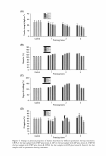
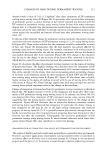
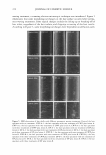
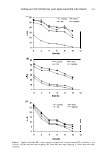
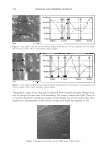
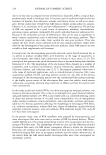
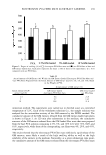
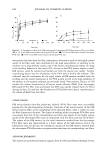
(kDa) 201 119 98 56 37 29 20 7 CHANGES IN HAIR DURING PERMANENT WAVING 209 M C 1 2 3 4 Figure 3. SDS-PAGE analysis of protein variation by various permanent waving treatments. M: molecular size marker. C: control (the hair sample with no permanent waving treatment). 1: the hair sample with three treatments of CWP plus lotion A. 2: the hair sample with three treatments of DP plus lotion A. 3: the hair sample with three treatments of CWP plus lotion B. 4: the hair sample with three treatments of DP plus lotion B. suggesting that some amounts of polypeptides might be lost by various treatments performed during the process of permanent waving. More importantly, some faint band signals were observed in the treatment by waving lotion B (the arrows in Figure 3), assuming that the hair protein might respond more to lotion B. Another feature of the protein variation was that one smaller polypeptide with approximately 31 kDa was very weakly identified in three treatments of both CWP and DP using waving lotion A (lane C of the boxed region), which was not recognized in other treatments. Although some previous studies showed that there may be eight different hair polypeptides based on the electrophoretic patterns extracted from human head hair materials (16,17), the results of our experiments demonstrate that slightly different electrophoretic profiles (lane C of Figure 3) were recognized and that some loss of certain polypeptides by the permanent waving treatments was exemplified using SDS-P AGE analysis (lanes 1-4 of Figure 3). EFFECTS OF PERMANENT WAVING TREATMENT ON CHANGES IN PHYSICAL PROPERTIES OF HUMAN HEAD HAIRS Several physical parameters have been used to estimate the effects of permanent waving treatment on the changes in human head hairs. Such major parameters include changes in tensile strength and hair diameter, the degree of swelling of the hair shafts, and hair elongation (2). Figure 4 displays that their overall responses to the permanent waving treatments were dependent on the method of permanent waving. Figure 4A demon strates the change in tensile strength of the hair shafts after the permanent waving treatment. On the whole, there was a decrease in tensile strength of the hairs in all treatments as the perming time increased (Figure 4A). The lowest tensile strength was

(A) (B) ,.0 � ... Q) a (C) ,o C' rn Q) (D) (o' � § ·-= 6 � 40 10 CWP-A DP-A CWP-8 DP-8 Control 0 .....__.-,.....,.,.,....__.,__________________..__,,_________. ...... _ Control 180 160 140 120 100 80 60 40 20 . 0 Control 200 . 150 100 :z: ;a: ;I ;E . � " i,,.. ... 50 i ! ... I' � j 0 - ..: - Control 90 80 70 60 I: I r 50 . 40 30 20 � ,. 10 0 I Control 1 - CWP-A I DP-A CWP-8 DP-8 Control I l ow "'I DP-A CWP-8 DP-8 Control I l ow ,� I DP-A CWP-B DP-B control . . . 2 Pennmg tunes 2 Penning times 2 Perming times - . - -- - I I 2 Penning times 3 3 3 -� - - - I 3 Figure 4. Change in physical properties of human head hairs by different permanent waving treatments. CWP-A: the hair sample with CWP plus lotion A. DP-A: the hair sample with DP plus lotion A. CWP-B: the hair sample with CWP plus lotion B. DP-B: the hair sample with DP plus lotion B. Control: the hair sample with no permanent waving treatment.
Purchased for the exclusive use of nofirst nolast (unknown)
From: SCC Media Library & Resource Center (library.scconline.org)