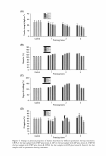
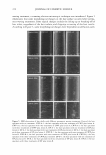
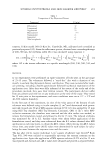
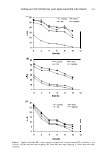
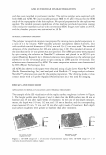
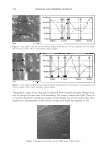
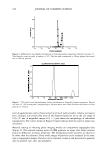
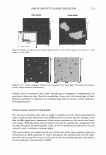
CHANGES IN HAIR DURING PERMANENT WAVING 211 observed with a value of 14.1 ± 1.3 kgf/mm2 after three treatments of DP permanent waving using waving lotion B (Figure 4A). In particular, after two and three treatments of permanent waving, a greater decrease in hair tensile strength was detected with the DP method of permanent waving using waving lotion B than with other treatments (Figure 4A). It is thought that this decrease has resulted from changes in the secondary structure such as the ratio of �-sheet to a-helix content in certain proteins present in the cortex region (the microfibril and matrix) of head hairs after permanent waving treat ment. (6). In the case of hair diameter change by permanent waving treatment, the greatest increase was found with two treatments of DP permanent waving (132.2%) using waving lotion B (Figure 4B). These results indicate that this treatment would be undesirable in terms of hair care. Figure 4B demonstrates that the hair diameter was greatly affected by perming times and the waving lotion. For example, treatment with waving lotion B increased the hair diameter after one and two perming treatments, whereas the diameter was slightly decreased after three treatments (Figure 4B). This change in hair diameter may be due to the change in the structure of the keratin fiber contained in the hairs, which may be caused by an interaction between the permanent treatments (2,4,5). Figure 4C illustrates the effect of permanent waving treatment on the degree of swelling of human head hairs. The highest swelling was identified after two treatments of DP permanent waving using waving lotion B (approximately 40% increase compared with that of the control). On the whole, there was an increasing pattern in swelling changes of the hairs in all treatments except for three treatments of both CWP and DP perma nent waving using waving lotion B (Figure 4C). Figure 4C also shows that a slightly higher increase in the degree of swelling occurred with the use of waving lotion B than with lotion A (Figure 4C). These findings explain that both the perming time and the waving lotion played important roles in the change in hair swelling. Change of elongation in human head hairs by permanent waving treatments is shown in Figure 4D. The highest increase (74.5%) in the elongation was found after three treat ments of DP permanent waving using waving lotion A. In contrast, the lowest (46.5%) was detected after three treatments of DP permanent waving using waving lotion B, suggesting that the waving lotion could be an important factor in the change in hair elongation. Figure 4D also illustrates that an interaction between permanent method and waving lotion used influenced hair elongation. In particular, the drastic change in hair elongation by DP may be due to the high setting temperature and chemical property of waving lotion B (2). It is generally known that severely damaged hairs are hardly recovered because their original physical properties have been disrupted or their function lost after the treatments. Consequently, the successive performance of DP permanent waving using waving lotion B, which showed relatively much lower elon gation values (Figure 4D), may contribute to severe hair damage. SEM OBSERVATION OF HUMAN HEAD HAIR SHAFTS WITH PERMANENT WAVING TREATMENT The surface of healthy and well-conditioned natural hairs is generally shiny and smooth. However, successive applications of permanent waving treatment seem to contribute to an adverse effect on the hairs such as structural damage or a change in the mechanical properties of the hairs (1,2). To monitor a visual change in the hair surface by permanent

212 JOURNAL OF COSMETIC SCIENCE waving treatment, a scanning electron microscopic technique was introduced. Figure 5 illuminates that some morphological changes in the hair surface occurred after perma nent waving treatments. Some typical changes include the lifting-up or breaking-off of hair scales, raggedness of the hair surface, and chipping or tearing of the hair cuticle. According to Figure 5, some morphological changes were dependent on all factors used, Figure 5. SEM observation of hair shafts with different permanent waving treatments. Control: the hair specimen with no treatment. CWP-A-1: the hair specimen with one treatment of CWP plus lotion A. CWP-A-2: the hair specimen with two treatments of CWP plus lotion A. CWP-A-3: the hair specimen with three treatments of CWP plus lotion A. DP-A-1: the hair specimen with one treatment of DP plus lotion A. DP-A-2: the hair specimen with two treatments of DP plus lotion A. DP-A-3: the hair specimen with three treatments of DP plus lotion A. CWP-B-1: the hair specimen with one treatment of CWP plus lotion B. CWP-B-2 the hair specimen with two treatments of CWP plus lotion B. CWP-B-3: the hair specimen with three treatments of CWP plus lotion B. DP-B-1: the hair specimen with one treatment of DP plus lotion B. DP-B-2: the hair specimen with two treatments of DP plus lotion B. DP-B-3: the hair specimen with three treatments of DP plus lotion B.
Purchased for the exclusive use of nofirst nolast (unknown)
From: SCC Media Library & Resource Center (library.scconline.org)