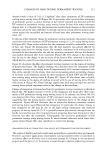
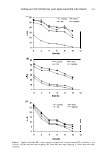
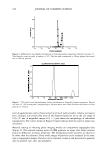
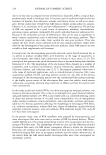
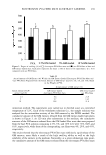
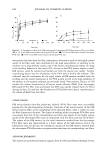
240 a) 100 80 60 .::: 40 20 u '$- 0 0 20 40 JOURNAL OF COSMETIC SCIENCE 60 80 100 120 140 Time(min) 100 80 60 40 20 0 b) 0 20 40 60 80 100 120 140 Time(min) Figure 3. % Cumulative release of (a) GM extract-loaded electrospun PVA fiber mats and (b) as-cast films. ( ♦) 2.5% initial GM extract-loaded electrospun PVA mat. (■) 5% initial GM extract-loaded electrospun PVA mat. (,._) 10% initial GM extract-loaded electrospun PVA mat. was greater than that from the film counterparts, obviously a result of the highly porous nature of the fiber mats that contributed to the high susceptibility to swelling in the medium. For a drug delivery system, one of the factors controlling the release of a drug is the swelling behavior of the carrier (29). As soon as the PV A matrix begins to swell, GM extracts could be solvated and leached out from the matrix very readily. Another contributing factor was the dissolution of the PV A matrix within the medium. This indicated that the mechanism for the rapid release of GM extracts included both the swelling and the partial dissolution of the PV A matrix as well as the high solubility of the extracts in the aqueous medium, as previously noted. Very recently, Zeng et al. (30) studied the release characteristics of bovine serum albumin (BSA) from electrospun BSA-loaded PVA fiber mats and found that BSA was rapidly released from the fibers during the first 2 h and that the dissolution of PV A fibers was a factor contributing to the release of BSA from the fibers. CONCLUSIONS GM extract-loaded ultra-fine poly(vinyl alcohol) (PV A) fiber mats were successfully prepared by the electrospinning technique. Variation of the initial content of the GM extracts had no effect on the morphology of the obtained fibers, while it tended to cause the fiber diameters to decrease. The degree of swelling of the electrospun PVA fiber mats was greater than that of the corresponding cast films, due largely to the highly porous nature of the electrospun fiber mats in comparison with the dense structure of the films. The release of the GM extracts by the total immersion method from the electrospun PVA fiber mats was characterized as a burst release of the GM extracts, and at the submersion time of 120 min, the cumulative amount of the GM extracts released from the electrospun PVA fiber mats was greater than that from the corresponding cast films. ACKNOWLEDGMENTS The authors are grateful for financial support from the National Nanotechnology Center

ELECTROSPUN PVA FIBER MATS AS EXTRACT CARRIERS 241 (NANOTEC), Thailand (grant number: BR0108). O.S. acknowledges a doctoral schol arship from the Thailand Graduate Institute of Science and Technology (TGIST) (TG- 5 5-09-49-069D). REFERENCES (1) B. M. Sundaram, C. Gopalakrishnan, S. Subramanian, D. Shankaranarayanun, and L. Kameswaran, Antimicrobial activities of Garcinia mangostana, Planta Med., 48, 59-60 (1983). (2) P. Moongkarndi, N. Kosem, 0. Luanratana, S. Jongsomboonkusol, and N. Pongpan, Antiproliferative activity of Thai medicinal plant extracts on human breast adenocarcinoma cell line, Fitoterapia, 75, 375-377 (2004). (3) P. Moongkarndi, N. Kosem, S. Kaslungka, 0. Luanratana, N. Pongpan, and N. Neungton, Antipro liferation, antioxidation and induction of apoptosis by Garcinia mangostana (mangosteen) on SKBR3 human breast cancer cell line,]. Ethnopharmacol., 90, 161-166 (2004). (4) W. Weecharangsan, P. Opanasopit, M. Sukma, T. Ngawhirunpat, U. Sotanaphun, and P. Siripong, Antioxidative and neuroprotective activities of extracts from the fruit hull of mangosteen (Garcinia mangostana Linn.), Med. Prine. Pract., 15, 281-287 (2006). (5) H. A. Jung, B. N. Su, W. J. Keller, R. G. Mehta, and A. D. Kinghorn, Antioxidant xanthones from pericap of Garcinia mangostana (mangosteen),]. Agric. Food Chem., 54, 2077-2082 (2006). (6) P. Williams, M. Ongsakul, J. Proudfoot, K. Croft, and L. Beilin, Mangostin inhibits the oxidative modification of human low density lipoprotein, Free Radie. Res., 23, 175-184 (1995). (7) N. Chairungsrilerd, K. Furukawa, T. Ohta, S. Nozoe, and Y. Ohizumi, Histaminergic and serotonergic receptor blocking substances from the medicinal plant Garcinia mangostana, Planta Med., 62, 471-472 (1996). (8) K. Nakatani, M. Atsumi, T. Arakawa, K. Oosawa, S. Shimura, N. Nakahata, and Y. Ohizumi, Inhibitions of histamine release and prostaglandin E2 synthesis by mangosteen, a Thai medicinal plant, Biol. Pharm. Bull., 25, 1137-1141 (2002). (9) D. Shankaranarayan, C. Gopalakrishnan, and L. Kameswaran, Pharmacological profile of mangostin and its derivatives, Arch. Int. Pharmacodyn., 239, 257-269 (1979). (10) C. Gopalakrishnan, D. Shankaranarayanan, L. Kameswaran, and S. K. Nazimudeen, Effect of mangos tin, a xanthone from Garcinia mangostana in immunopathological and inflammatory reactions, Ind.]. Exp. Biol., 18, 843-846 (1980). (11) N. R. Farnsworth and N. Bunyapraphatsara, Thai Medicinal Plant: Recommended for Primary Health Care System (Prachachon Company, Bangkok, 1992), pp. 25-50. (12) J. Y. Lu, C. Normal, K. A. Abboud, and A. Ison, Crystal engineering of an inclusion coordination polymer with cationic pocket-like structure and its property to form metal-organic nanofibers, Inorg. Chem. Commun., 4, 459-461 (2001). (13) J. Doshi and D. H. Reneker, Electrospinning process and applications of electrospun fibers,]. Elec trostat., 35, 151-160 (1995). (14) C. Zhang, X. Yuan, L. Wu, Y. Han, and J. Sheng, Study on morphology of electrospun poly(vinyl alcohol) mats, Eur. Polym. ]., 41, 423-432 (2005). (15) Y. M. Shim, M. M. Hohman, M. P. Brenner, and G. C. Rutledge, Experimental characterization of electrospinning: The electrically forced jet and instabilities, Polymer, 42, 9955-9967 (2001). (16) S. A. Theron, E. Zussman, and A. L. Yarin, Experimental investigation of the governing parameters in the electrospinning of polymer solutions, Polymer, 45, 2017-2030 (2004). (17) B. Ding, H. Y. Kim, S. C. Lee, C. L. Shao, D. R. Lee, S. J. Park, G. B. Kwag, and K. J. Choi, Preparation and characterization of a nanoscale poly(vinyl alcohol) fibre aggregate produced by an electrospinning method,]. Polym. Sci. Polym. Phys., 40, 1261-1268 (2002). (18) L. L. Wu, X. Y. Yuan, and J. Sheng, Immobilization of cellulose in nanofibrous PVA membranes by electrospinning,J. Membr. Sci., 250, 167-173 (2005). (19) J. S. Choi, S. W. Lee, L. Jeong, S. H. Bae, B. C. Min, J. H. Youk, and W. H. Park, Effect of organo soluble salts on the nanofibrous structure of electrospun poly(3-hydroxybutyrate-co-3- hydroxyvalerate), Int.]. Biol. Macromol., 34, 249-256 (2004). (20) K. Kim, Y. K. Luu, C. Chang, D. F. Fang, B. S. Hsiao, B. Chu, and M. Hadjiargyrou, Incorporation and controlled release of a hydrophilic antibiotic using poly(lactide-co-glycolide)-based electrospun nanofibrous scaffolds,]. Control. Release, 98, 47-56 (2004).
Purchased for the exclusive use of nofirst nolast (unknown)
From: SCC Media Library & Resource Center (library.scconline.org)