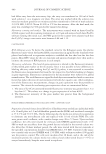
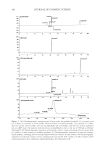
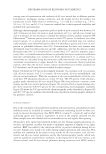
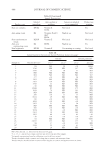
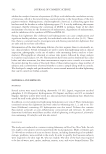
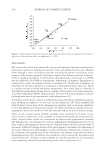
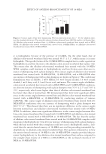
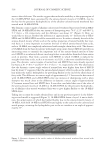
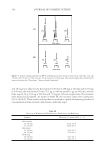
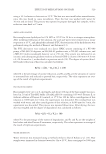
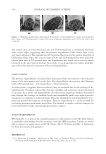
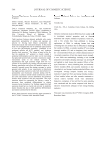
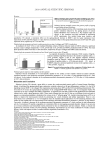
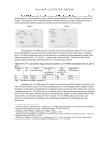
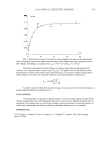
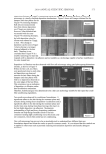
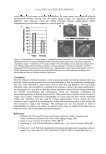
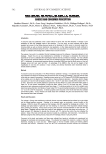
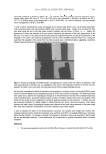
JOURNAL OF COSMETIC SCIENCE 534 The lateral areas of CA-permed hair (b) and CYS-permed hair (c) exhibited relatively clear cuticle edges, suggesting that the protease degradation of the cuticle layer is not very much advanced. The degradation of CA-permed hair was a little greater than that of CYS-permed hair. Since the cross sections of CA- and CYS-permed hair were relatively plainer than that of TG-permed hair, the degradation was found to be not very much advanced in the inner part of the hair. As a result, it was found that the surface morphol- ogy of hair after protease treatment refl ects its degradability. CONCLUSIONS The protease degradability of reduced hair and permed hair was related to the reduction power of the mercaptans used on the hair. The degradability increased in the following order: CYS-treated hair CA-treated hair TG-treated hair. In reduced hair, it appears that accessibility may be increased due to the cleavage of di- sulfi de bonds. Therefore, reduced hair became swellable and enzymatic attack was found to increase. As a result, the degradability of reduced hair progresses further. In permed hair, though the cleavage of disulfi de bonds was remarkably small even with repetitive treatment, accessibility is relatively high. Thus the swellability and degradability of re- petitively permed hair appears to progress. Protease degradation is a useful method for evaluating damaged permanent-waved hair. The method is simple, and hair damage can be assessed both visually and through gravimetric analysis. ACKNOWLEDGMENTS We thank Dr. T. J. Lin for his valuable guidance in this research work. Mr. Koji Takano is gratefully acknowledged for his assistance with the SEM procedure. Finally, we would like to express our appreciation to Mr. M. Okano, Mr. T. Yoshida, and Mrs. A. Karasawa, for their discussions and guidance. REFERENCES (1) C. Zviak and A. Sabbagh, “The Science of Hair Care,” in Permanent Waving and Hair Straightening, B. Claude and W. John, Eds. (CRC Press, Boca Raton, FL, 2005), pp. 201–228. Figure 7. SEM photographs of hair after pronase E treatment. (a) TG-permed hair, 3 times. (b) CA-permed hair, 3 times. (c) CYS-permed hair, 3 times. The extent of protease degradation is (a) 19.2%, (b) 16.9%, and (c) 16.2%.

EFFECTS OF MERCAPTANS ON HAIR 535 (2) M. Okano, H. Oka, T. Hatakeyama, and R. Endo, Effect of thiol structures on reduction of hair, J. Soc. Cosmet. Chem. Japan, 32, 43–51 (1998). (3) K. Inoue, Y. Iwakiri, and T. Hatakeyama, Hair permeability, Cosmet. Toilet., 111, 33–39 (1996). (4) A. Kuzuhara, I. Tabata, and T. Hori, Study on the diffusion behavior of thioglycolic acid and l-cysteine in human hair with a microspectrophotometer (in Japanese), Sen’i Gakkaishi, 59, 128–132 (2003). (5) A. Karasawa, T. Yoshida, C. Numata, J. Tanaka, and M. Okano, Effect of cysteamine on reduction of human hair, IFSCC International Conference, Florence (2005). (6) J. A. Swift, “Formation and Structure of Human Hair,” in Morphology and Histochemistry of Human Hair, P. Jollès, H. Zahn, and H. Höcker, Eds. (Birkhäuser Verlag, Switzerland, 1997), pp. 149–175. (7) R. Kon, A. Nakamura, and N. Hirabayashi, Analysis of the damaged components of permed hair using biochemical technique, J. Cosmet. Sci., 49, 13–22 (1998). (8) C. R. Robbins, “Chemical and Physical Behavior of Human Hair,” in Morphological and Macromolecular Structure, 4th ed. (Springer-Verlag, New York, 2002), pp. 105–152. (9) T. Inoue, M. Itoh, and K. Kizawa, Labile proteins accumulated in damaged hair upon permanent wav- ing and bleaching treatments, J. Cosmet. Sci., 53, 337–344 (2002). (10) C. Yamauchi, W. Okazaki, K. Inoue, and A. Sakaino, Enzymatic method for assessing hair damage with reduction and subsequent oxidation, Sen’i Gakkaishi, 63, 33–38 (2007). (11) C. Yamauchi and W. Okazaki, Application of an enzymatic method for identifying hair treatments, J. Health Sci., 53, 708–714 (2007). (12) M. A. Manuszak, E. T. Borish, and R. R. Wickett, Reduction of human hair by cysteamine and am- monium thioglycolate: A correlation of amino acid analysis and single-fi ber tensile kinetic data, J. Soc. Cosmet. Chem., 47, 213–227 (1996). (13) H. P. J. Bennett and S. Solomon, Use of pico-tag methodology in the chemical analysis of peptides with carboxyl-terminal amides, J. Chromatogr., 359, 221–230 (1986). (14) C. Yamauchi, W. Okazaki, T. Yoshida, and A. Karasawa, Enzymatic degradation of keratin fi lms and keratin fi bers prepared from human hair, Biol. Pharm. Bull., 31, 994–997 (2008). (15) N. Kohara, M. Kanei, and T. Nakajima, Effect of reduction and succinylation on water absorbance of wool fi bers, Textile Res. J., 71, 1095–1098 (2001). (16) G. G. Gumprecht, K. Patel, and R. P. Bono, Effectiveness of reduction and oxidation in acid and alka- line permanent waving, J. Soc. Cosmet. Chem., 28, 717–732 (1977). (17) L. Scalce, J. J. Cinocotta, S. Barrow, A. Rubinstein, and E. J. Klemm, Reduction of hair in the presence of exogenous disulfi de, J. Soc. Cosmet. Chem., 38, 99–107 (1987). (18) S. Ogawa, K. Fujii, K. Kaneyama, and K. Arai, Action of thioglycolic acid and l-cystein to disulfi de cross-links in human fi bers during permanent waving treatment, Sen’i Gakkaishi, 64, 137–144 (2008).
Purchased for the exclusive use of nofirst nolast (unknown)
From: SCC Media Library & Resource Center (library.scconline.org)