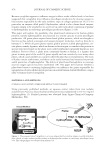
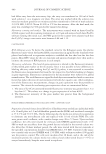
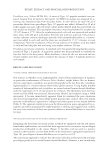
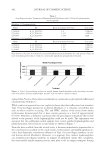
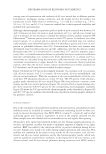
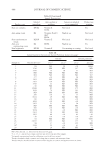
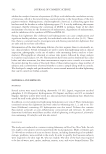
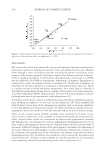
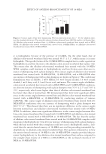
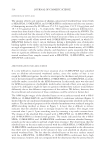
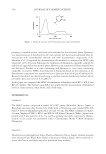
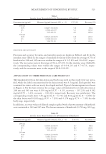
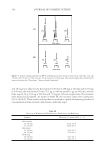
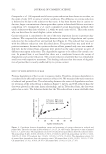
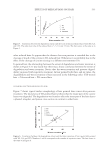
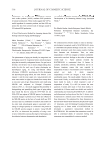
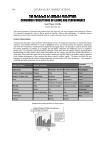
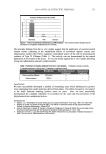
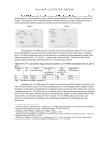
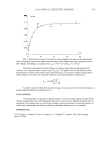
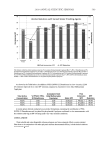
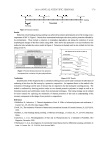
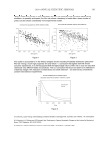
JOURNAL OF COSMETIC SCIENCE 532 Gumprecht et al. (16) reported much lower cystine reduction than shown in our data, on the order of only 20% in spite of similar conditions. The difference in cystine reduction is believed to be due to the solution-to-hair ratio. It has been known that in cystine re- duction, larger concentrations of mercaptan than cystine in hair should drive a reaction to completion (17). Gumprecht et al. used a simulated actual hair-waving method they used a solution-to-hair ratio of about 1:1, while we used a ratio of 10:1. This is the reason why our data show the much higher cystine reduction. Cystine reduction is considered to be one of the most important factors in protease deg- radation. We compared the relationship between the extent of degradation and cystine reduction for the reduced hair and permed hair (Figure 4). The reduced hair was used with the different reduction time described above. The permed hair was used with re- petitive treatment, because the cystine reduction of hair permed only once was remark- ably low. In the reduced hair, all points were plotted on the same curvature in spite of different mercaptan reductions. The degradation appears to be affected by cystine con- tent. In permed hair, it was found that there was a correlation between the extent of degradation and cystine reduction. The cystine reduction of permed hair was remarkably small even with repetitive treatment. This fi nding indicates that the extent of degrada- tion of permed hair is nearly unaffected by its cystine content. EFFECT OF WATER RETENTION OF HAIR Protease degradation of hair occurs in aqueous media. Therefore, protease degradation is considered to be affected by water retention of hair (14). We measured the water retention of reduced and permed hair. The relationship between the extent of degradation and wa- ter retention of the reduced hair is shown in Figure 5. In CA- and CYS-reduced hair, the data were plotted in the same linear relationship, and in TG-reduced hair, the data were plotted on a curve. The behavior shows that the TG-reduced hair is more swellable than Figure 4. Correlation between degradation extent and percentage of cystine reduction in reduced and permed hair. The reduction time in reduced hair is 5, 10, 15, 20, and 30 min. The repetitive time of permed hair is 1, 3, and 5 times. The degradation extent (%) of reduced hair (parentheses show the reduction time): TG-reduced hair: 8.4(0), 16.0(5), 20.0(10), 23.5(15), 27.0(20), 32.4(30). CA- reduced hair: 14.5(5), 17.1(10), 19.8(15), 21.2(30). CYS-reduced hair: 12.6(5), 13.5(10), 14.7(15), 15.6(30). The degradation extent (%) of permed hair (parentheses show the repetitive time): TG-permed hair: 8.4(0), 14.0(1), 19.2(3), 27.5(5). CA-permed hair: 13.5(1), 16.9(3), 18.5(5). CYS-permed hair: 13.0(1), 16.2(3), 17.3(5).

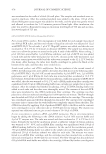
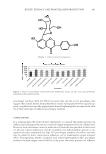
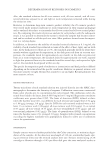
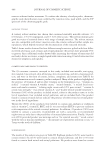
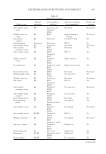
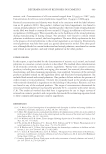
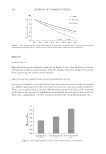
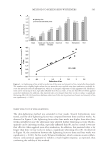
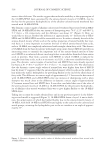
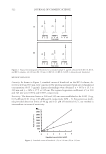
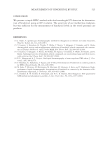
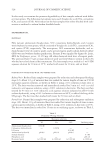
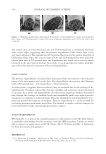
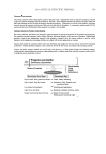
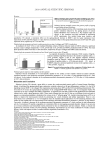
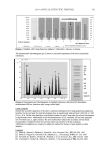
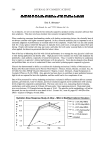
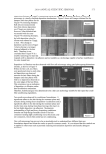
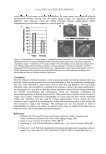
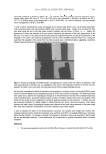
EFFECTS OF MERCAPTANS ON HAIR 533 other reduced hairs. It appears that the distance between proteins is extended due to the cleavage of much of the cystine in TG-reduced hair. Otherwise it was probably due to the effect of the cleavage of cystine existing in a different environment (18). In permed hair, the relationship between the extent of degradation and water retention is shown in Figure 6. It was found that there was a linear correlation between the extent of degradation and water retention. Notice that the water retention and protease degrad- ability increased with repetitive treatment. In hair permed both three and six times, the degradability and water retention of hair increased in the following order: CYS-treated hair CA-treated hair TG-treated hair. SCANNING ELECTRON MICROSCOPY (SEM) Figure 7 shows typical surface morphology of hair permed three times after protease treatment. The lateral area of TG-permed hair (a) shows that the major part of the cuticle layers was degraded. The degradation was found to affect the inner part of the hair due to a pleated, irregular, and porous cross-section in contrast to other hairs. Figure 5. Correlation between the degradation extent and the water retention of hair reduced with TG, CA, and CYS. The reduction time of the reduced hair is 3, 5, 10, and 15 min. The hair source is the same as in Figure 4. Figure 6. Correlation between the degradation extent and the water retention of hair repetitively permed with TG, CA, and CYS. Numbers 3 and 6 correspond to the number of repetitive times. The hair source is the same as in Figure 4.
Purchased for the exclusive use of nofirst nolast (unknown)
From: SCC Media Library & Resource Center (library.scconline.org)