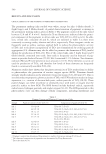
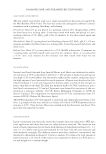
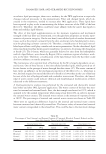
JOURNAL OF COSMETIC SCIENCE 540 RESULTS AND DISCUSSION CHARACTERISTICS OF THE PIGMENTS IN PERMANENT MAKEUP INKS The permanent makeup inks studied were white, except for inks 4 (fl esh-colored), 5 (light beige), and 9 (fl esh-colored). A partial characterization of pigments occurring in the permanent makeup inks is given in Table I. The pigment content of the inks varied between 32.8 and 67.8 w/w%. Analysis by X-ray fl uorescence indicated that the princi- pal component of the pigments in all ten inks was TiO2 (85.9 to 99.8 w/w%). In addi- tion, several inks contained Al and Si, which are reported in Table I as their most commonly occurring oxides, alumina and silica, respectively. These inorganic oxides are frequently used as surface coatings, applied both to reduce the photocatalytic activity of TiO2 and to facilitate incorporation of TiO2 into formulations by reducing particle aggregation (24). Alumina may also be added to promote the formation of TiO2 (rutile) during the production of TiO2 (24). Two of the colored inks, inks 5 (light beige) and 9 (fl esh-colored), contained iron oxide. Iron oxide is frequently used in mixtures of pig- ments to provide shades of brown (25,26). Ink 4 contained 0.3 % chlorine. Two elements, niobium (Nb) and P, were present in trace amounts (0.1%). These elements occur in ore used for production of TiO2, and therefore low levels of these elements are frequently found in commercially available TiO2 (24). Numerous studies have shown that the photocytotoxicity of TiO2 results from its ability to photocatalyze the generation of reactive oxygen species (ROS). Titanium dioxide strongly absorbs radiation in the ultraviolet A spectral region (320–400 nm) (27). Due to its semiconductor properties, photoexcitation of TiO2with UVA radiation results in charge separation, i.e., creation of electron-hole pairs, within particles of TiO2 (28,29). These paired charges can either recombine or ultimately react with water or oxygen near the particle’s surface to form ROS. The ROS formed include hydroxyl radical, superoxide radical anion, hydrogen peroxide, and singlet oxygen (30–32). The ROS generated in this photocatalytic cycle can then damage cellular components, including membranes and Table I Pigment Content and Elemental Composition of Inks Sample Pigment content of ink∗ (w/w %) Composition of pigmenta (w/w %) Ink 1 33.0 ± 0.8 TiO2 (99.7), P (trb) Ink 2 44.9 ± 1.8 TiO2 (99.2), Al2O3 (0.2), SiO2 (0.2), P (tr) Ink 3 38.1 ± 1.4 TiO2 (99.6), P (tr) Ink 4 52.5 ± 1.2 TiO2 (95.8), Al2O3 (2.6), SiO2 (0.8), CI (0.3), P (tr) Ink 5 57.5 ± 2.9 TiO2 (98.4), Al2O3 (0.1), SiO2 (0.3), P (tr), Fe2O3 (0.6), Nb (tr) Ink 6 32.8 ± 0.5 TiO2 (99.7), P (tr) Ink 7 45.8 ± 1.3 TiO2 (99.8), P (tr) Ink 8 46.8 ± 0.1 TiO2 (95.7), Al2O3 (4.2) Ink 9 67.8 ± 1.9 TiO2 (85.9), Al2O3 (3.8), Fe2O3 (10.2) Ink 10 37.8 ± 2.7 TiO2 (95.3), Al2O3 (4.6) ∗ Pigment content was determined by gravimetric analysis. Entries are average ± S.D (n=4). a The elemental composition of pigments was determined by X-ray fl uorescence. b Trace (less than 0.1%).

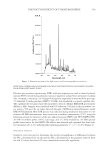
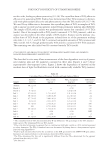
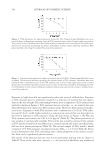
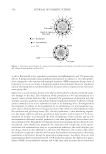
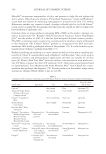
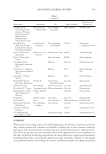
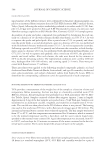
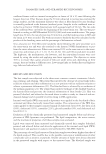
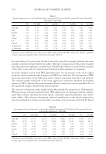
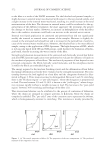
PHOTOCYTOTOXICITY OF TITANIUM DIOXIDE 541 nucleic acids, leading to photocytotoxicity (32–36). The crystalline form of TiO2 affects its effi ciency for generating ROS. Studies have demonstrated that TiO2 (anatase) is dramati- cally more photocatalytically active and photocytotoxic than the TiO2 (rutile) (24,33,37–39). We used X-ray diffraction to determine the crystalline phase of TiO2 in samples of TiO2 sold as anatase or rutile and in pigments isolated from permanent makeup inks (Table II). The sample of TiO2 sold as anatase was predominately anatase but contained 1.8 % TiO2 (rutile). One of the samples sold as TiO2 (rutile) contained 4.7% TiO2 (anatase), while no anatase was detectable in the other sample of TiO2 (rutile). Anatase was the primary crys- talline form of TiO2 found in the pigments isolated from six of the permanent makeup inks (inks 1, 2, 3, 6, 7, and 10). Ink 5 contained comparable amounts of TiO2 (anatase) and TiO2 (rutile). Ink 4, though predominately TiO2 (rutile), contained 0.6% TiO2 (anatase). The remaining two inks (inks 8 and 9) contained entirely TiO2 (rutile). CYTOTOXICITY AND PHOTOCYTOTOXICITY OF PERMANENT MAKEUP INKS AND PIGMENTS ISOLATED FROM PERMANENT MAKEUP INKS The described in vitro assay allows measurement of the dose-dependent toxicity of perma- nent makeup inks and the pigments contained in these inks. Figures 2 and 3 depict representative dose-response curves. Figure 2 shows the dependence of survival on the incident dose of light for fi broblasts treated with commercially available TiO2 (anatase). Table II Crystalline Phase of Titanium Dioxide and Light-Induced Effects Sample Anatase* (w/w %) PD50a of ink (μg/cm2) PD50 of pigment (μg/cm2) ESR relative intensityb Anatase 98.2 ± 0.4 — 0.83 ± 0.14 100 Rutile 1 0 — 150 27 Rutile 2 4.7 ± 0.1 — 1.20 ± 0.18 21 Ink 1 97.9 ± 0.2 1.73 ± 0.10c 1.41 ± 0.18 69 Ink 2 98.5 ± 0.3 3.18 ± 0.28c 2.12 ± 0.23 24 Ink 3 97.7 ± 0.5 2.08 ± 0.19 2.97 ± 0.45 65 Ink 4 0.6 ± 0.1 2.44 ± 0.15c 1.23 ± 0.10 19 Ink 5 54.7 ± 0.3 2.74 ± 0.23 2.93 ± 0.16 106 Ink 6 100 0.73 ± 0.09 1.03 ± 0.11 156 Ink 7 99.1 ± 0.4 1.74 ± 0.35 1.10 ± 0.18 100 Ink 8 0 150 150 NDd Ink 9 0 150 150 2 Ink 10 97.1 ± 0.3 2.44 ± 0.08 2.26 ± 0.14 ND ∗ The crystalline form of TiO2 was determined by X-ray diffraction. The percentage in the TiO2 (anatase) form is given. The remaining TiO2 was TiO2 (rutile). a PD50 is the level of exposure to pigment that, in combination with light, results in a 50% survival measured as colony formation. The PD50 ± standard error was determined by fi tting data to a four-parameter logistic function using SigmaPlot 8. b Peak-to-peak intensity observed for the second line in the ESR spectrum for the DMPO-OH spin adduct. Intensities are expressed relative to the intensity observed for TiO2 (anatase). c The PD50 determined for this ink is signifi cantly different from the PD50 determined for the pigment isolated from this ink (p 0.05). d Not detected.
Purchased for the exclusive use of nofirst nolast (unknown)
From: SCC Media Library & Resource Center (library.scconline.org)