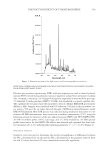
JOURNAL OF COSMETIC SCIENCE 568 HAIR LIPID ANALYSES Lipid analyses of the different extracts were performed by thin-layer chromatography cou- pled to an automated fl ame ionization detector (TLC-FID), Iatroscan MK-5 analyzer (Iatron, Tokyo, Japan), following the analysis methodology referred to in earlier works (12,18). Sam- ples (15–20 μg) were spotted on Silica gel S-III Chromarods by means of a precision 2-μl Hamilton syringe coupled to an SES (Nieder-Olm, Germany) 3202/15-01 sample spotter. An analysis of apolar and polar compounds was performed by developing the rods ini- tially to a distance of 10 cm with n-hexane/diethyl ether/formic acid (53:17:0.3, by vol) to separate the apolar and polar lipids. After a partial scan of 72% to quantify and elimi- nate the apolar lipids, a second development, again to a distance of 10 cm, was performed with chloroform/n-hexane/ methanol/acetone (55:5:3:7, by vol) to separate the ceramides. Following a partial scan of 85% to quantify and eliminate the ceramides, a third develop- ment, again to a distance of 10 cm, was performed with chloroform/methanol/formic acid (57:12:0.3, by vol) to separate and quantify, after a total scan of 100%, the glycosilcer- amides and sterol sulfate. After each elution, the rods were heated for fi ve minutes at 60°C to dry the remaining solvent. The experimental conditions were: air fl ow 2000 ml/ min, hydrogen fl ow 160–180 ml/min, and scanning speed 2–3 mm/s. Data were pro- cessed with Boreal version 2.5 software. These procedures were applied to the following standard compounds: palmitic acid and cholesterol from Fluka Chemicals (Buchs, Switzerland), and type II ceramides, cholesterol ester, galactoceramides, and sodium cholesteryl sulfate from Sigma (St. Louis, MO), to determine the corresponding calibration curves for quantifi cation of each compound. MOISTURE RETENTION BY THERMOGRAVIMETRIC ANALYSIS (TGA) TGA provides a measurement of the weight loss of the sample as a function of time and temperature. Before measuring, the hair was kept in a humidity-controlled room (55% RH) for 24 hours. All investigations were performed on a TGA instrument (TG-50, Met- tler Toledo, Spain). Samples consisted of short fi ber snippets (approx. 2 mm in length). Approximately 6 mg of the hair samples were packed into a 70-μl TGA pan. Samples were transferred to an aluminum crucible, weighted, and sealed for an elapsed time of 30 sec- onds. The crucible was then placed in the TGA balance where it was pierced. The heating rate used in this study was 20°C/min, with a fl ow rate of nitrogen gas of 200 ml/min. The internal and external water contents were evaluated separately. The hair sample was heated from 25° to 65°C, and this temperature was maintained for 40 minutes, which is assumed to be the normal temperature used by a hair dryer, and the water content found corre- sponded to the external water content (19). Again the temperature was increased, from 65° to 180°C, and was kept for 30 minutes to measure all the water contained in the hair (in- ternal water content). TGA curves showed the amount of water in the samples. STRENGTH MEASUREMENTS Stress-strain test. Five fi bers were randomly taken from samples previously conditioned for 48 hours in a standard atmosphere (20°C, 65% RH) and centrally attached to a pair of

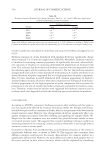
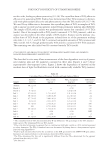
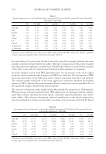
DAMAGED HAIR AND CERAMIDE-RICH LIPOSOMES 569 cardboard frames with an internal rectangular cut frame of 50 × 25 mm following the longest direction. Fiber fi neness along the 50 mm subjected to testing was examined by image analysis, and the minimum diameter was taken as fi ber fi neness because breakage is normally produced at the thinnest (weakest) point. Samples in the cardboard were at- tached to an Instron 5500R dynamometer with a gauge length of 50 mm. The two sides of the cardboard were cut before the beginning of the stress-strain test. The test was per- formed according to ASTM Standard D 3822 (1980) with some modifi cations. The gauge length was 50 mm, the rate of strain was 30 mm/min, and the breaking stress in MPa and the strain in % were recorded. The work necessary to break the hair was calculated as the product of the breaking stress and the percentage of deformation at break. Stress-relaxation test. Five fi bers were randomly taken following the same procedure as in the stress-strain test and were also attached to the Instron 5500R dynamometer to per- form the stress-relaxation test. Fibers were strained 30% at the same rate as in the stress- strain test, and stresses at 0, 2, 5, 10, 15, 30, 45, 60, 120, and 180 seconds were recorded. The high-rate, the medium-rate, the low-rate, and the non-relaxed stresses were esti- mated by using the results and applying non-linear regression. The objective to strain 30% is to ensure that a great amount of links are under stress and, depending on their energy, they are broken at different rates. Low-energy links are broken fi rst and high-en- ergy links are broken later (20). RESULTS AND DISCUSSION The hair sample was subjected to the three most common cosmetic treatments: bleach- ing, perming, and relaxing. The permed hair involves the cleavage of cystine links with a reduction solution and their reformation in a new position with an oxidation solution to achieve a permanent deformation (21). The bleached hair is achieved by an oxidation of the melanin pigments (21). The relaxed hair involves breakage of the disulfi de bonds in the keratin fi bers and prevents the chemical reformation of these bonds (22). Hair was permed, bleached, and relaxed as discussed above in order to study its chemical and me- chanical damage and its possible recovery owing to IWL application. Internal wool lipids (IWL) structured as liposomes were applied to the four kinds of hair: untreated and three chemically treated hair samples. The composition of the IWL lipo- somes applied to these samples consisted mainly of cholesterol esters (4%), free fatty acids (18%), cholesterol (13%), ceramides (22%), glycosilceramides (9%), and cholesterol sul- fate (8%) (11). Evaluation of all the chemically pretreated and nontreated samples before and after ap- plication of IWL liposomes was performed. The lipid composition, the water content, and the mechanical properties of all these samples were evaluated. Lipids were extracted from untreated and chemically treated hair samples (bleached, permed, and relaxed) before and after the application of the internal wool lipid (IWL). Quantitative and qualitative analyses were performed by TLC-FID (Table I). The percentage of total lipids extracted from hair samples was always higher than that of the lipids analyzed. This could be due to the possible extraction or solubilization of other compounds such as proteins or peptides. Smaller amounts of lipids were always obtained in the pretreated samples with respect to the untreated ones. The bleached sample was
Purchased for the exclusive use of nofirst nolast (unknown)
From: SCC Media Library & Resource Center (library.scconline.org)