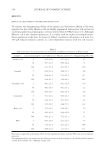
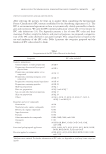
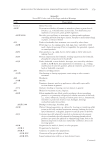
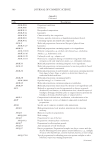
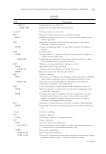
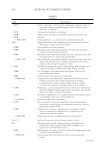
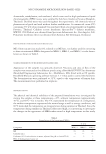
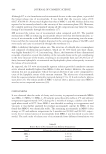
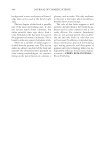
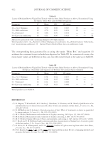
HOW COULD TECHNOLOGICAL FORECASTING HELP COSMETIC CHEMISTS 367 PATENT CLASSIFICATION AND QUANTIFICATION After selecting the patents, we went on to analyze them considering the International Patent Classifi cation (IPC) system established by the Strasbourg Agreement (12). The IPC is an international agreement on how to systematically classify patentable technolo- gies and inventions. We used the IPC internet publication version 2011.01 to browse for IPC code defi nitions (13). The Appendix presents a list of some IPC codes and their meanings. Further, simply for didactic and practical purposes, we proposed a categoriza- tion of the IPC codes observed in our patent sample. This categorization is based on the use and similarity of the IPC codes. Table I presents the categories proposed and the families of IPC codes related to them. Categories IPC codes includeda Cosmetic preparations General cosmetic or toilet preparations A61K 8 Preparations characterized by a special physical form A61K 9 Preparations containing organic active compounds A61K 31 Preparations containing inorganic active compounds A61K 33 Preparations containing natural ingredients A61K 36 Preparations containing peptides A61K 38 Make-up preparations A61Q 1 Hair care preparations A61Q 5 and A61Q 7 Sun care and other barrier preparations A61Q 17 Skin care preparations A61Q 19 Others A61K 6, A61K 35, A61K 39, A61K 47, A61L 9, A61Q 3, and A61Q 15 Excipients and active compounds Preservatives A01N Non-heterocyclic organic compounds C07C Heterocyclic organic compounds C07D Sugar derivatives C07H Peptides C07K Other macromolecular compounds C08B, C08F, C08G, and C08L Detergents C11D Others A61P, B32B, B60C, C01B, C07F, C07G, C08J, and C08K Functional packaging and applicators A45D, A46B, A47L, A61F, A61H, A61J, B43K, B43M, B65B, B65D, B67D, F25D, and G01F Processes applied to cosmetics A23B, A23C, A23J, A23L, B01J, B05D, C11B, C12N, and C12P Table I Categorization of the IPC Codes Observed in this Study a Subclasses were omitted. For further information on IPC codes, see Appendix or visit http://www. wipo.int/ ipcpub.

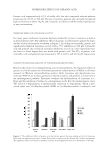
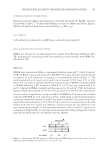
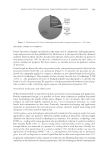
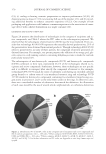
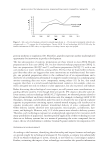
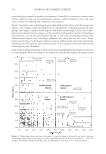
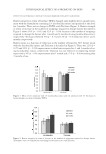
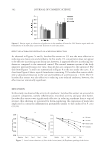
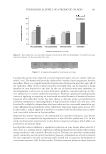
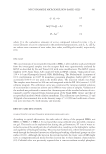
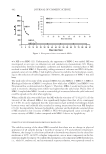
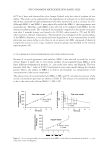
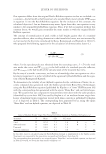
JOURNAL OF COSMETIC SCIENCE 368 Once each IPC code was established to have a different meaning and to represent an indi- vidual technology or a group of technologies, we proceeded with their quantifi cation and interpretation. Out of the sample of 335 patents, two patents were not classifi ed accord- ing to the IPC system, therefore, we excluded them. Some patents presented more than one IPC code and some codes were repeated in different patents. Then, we found a total of 341 different IPC codes or a total of 876 IPC codes if repetitions were considered. Thus, we presented the quantifi cation results as a percentage of the total frequency of IPC codes (n = 876 codes). We also presented a life cycle of technologies related to natural ingredients, whether the technology is primarily related (n = 45 patents) or generally related (n = 72 patents). CROSS-IMPACT ANALYSIS Cross-impact analysis is a mathematical model based on the theory of probability that allows us to determine the infl uence of one event over another (9,14). In this survey, we employed the cross-impact analysis to calculate the impact index of a certain technology “A” over a certain technology “B.” We considered each IPC code as a technology of inter- est and calculated the conditional probability between different codes. We followed the method proposed by Choi et al. (9), adapted from Blanning and Reinig’s (14), which uses patent classifi cation systems to quantitatively estimate the impact index of technology A on B. The impact index was calculated according to equation 1 (9). Impact A,B B| A n A B /n A p (1) In equation 1, the term “ n A B ” represents the total number of patents included both in technology A and B and the term “ n A ” represents the total number of patents in- cluded in technology A. The impact index score ranges from 0 to 1. The closer the impact index is to 1, the higher the impact of technology A on B (9). For the purpose of this survey, we set the threshold value at 0.5. We classifi ed the impact scores as low (if equal or lower than 0.5 for both technologies), unidirectional (if higher than 0.5 for only one technology), or bidirectional (if higher than 0.5 for both technologies). In this analysis, we excluded the technologies observed only once to avoid occasional misleading impacts (n = 109 codes, 32% of the number of codes). RESULTS AND DISCUSSION THE CATEGORIZATION OF IPC CODES We proposed the categories presented in Table I especially for the sample of patents of this survey. Possibly, a different patent sample would require different categories due to the complexity of the IPC system. Further, we proposed the categories based on our as- sumptions of the technologies and of the organization of IPC codes, but other authors would likely compose them differently. Nonetheless, these categories allowed us to per- form a better analysis of the information available in the patents. Figure 1 presents the distribution of the technologies observed in the patents, according to the main categories defi ned in Table I. In the next sections, we will comment on the results for each category.
Purchased for the exclusive use of nofirst nolast (unknown)
From: SCC Media Library & Resource Center (library.scconline.org)