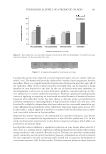
NICOTINAMIDE MICROEMULSION-BASED GELS 405 MBG-1 ME CC. The addition of colloidal silica as a thickening agent in MBG-1 resulted in high release of nicotinamide due to loose structure of the matrix gel as well as low affi nity between the hydrophilic nicotinamide and the external hydrophobic phase of the formulation. On the basis of screening formulations, it was concluded that MBG-1 was a suitable formulation for topical nicotinamide due to its appearance, viscosity, sta- bility, and in vitro release characteristics. ACKNOWLEDGMENT The authors are grateful for fi nancial support received from Graduate School and Faculty of Pharmaceutical Sciences, Prince of Songkla University, Thailand. REFERENCES (1) M. Seiberg, C. Paine, E. Sharlow, P. Andrade-Gordon, M. Costanzo, M. Eisinger, and S. S. Shapiro, In- hibition of melanosome transfer results in skin lightening, J. Invest. Dermatol., 115, 162–167 (2000). (2) N. Otte, C. Borelli, and H. C. Korting, Nicotinamide – biologic actions of an emerging cosmetic in- gredient, Int. J. Cosmet. Sci., 27, 255–261 (2005). (3) D. L. Damian, C. R. Patterson, M. Stapelberg, J. Park, R. S. Barnetson, and G. M. Halliday, UV radiation- induced immunosuppression is greater in men and prevented by topical nicotinamide, J. Invest. Dermatol., 128, 447–454 (2008). (4) A. Kawada, N. Konishi, N. Oiso, S. Kawara, and A. Date, Evaluation of anti-wrinkle effects of a novel cosmetic containing niaciamide, J. Dermatol., 35, 637–642 (2008). (5) B. W. Barry, Novel mechanisms and devices to enable successful transdermal drug delivery, Eur. J. Pharm. Sci., 14, 101–114 (2001). (6) V. B. Junyaprasert and P. Boonme, Microemulsions for topical drug delivery, J. Ind. Pharm., 5, 21–29 (2002). (7) P. Boonme, Applications of microemulsions in cosmetics, J. Cosmet. Dermatol., 6, 223–228 (2007). (8) P. Boonme, Uses of microemulsions as novel vehicles in skin care products, HPC Today, 3, 18–20 (2009). (9) P. Boonme and S. Yotsawimonwat, Anti-ageing microemulsions and nanoemulsions, HPC Today, 5, 42–46 (2011). (10) P. Spiclin, M. Gasperlin, and V. Kmetec, Stability of ascorbyl palmitate in topical microemulsions, Int. J. Pharm., 222, 271–279 (2001). (11) P. Spiclin, M. Homar, A. Zupancic-Valant, and M. Gasperlin, Sodium ascorbyl phosphate in topical microemulsions, Int. J. Pharm., 256, 65–73 (2003). (12) M. Gallarate, M. E. Carlotti, M. Trotta, A. E. Grande, and C. Talarico, Photostability of naturally oc- curring whitening agents in cosmetic microemulsions, J. Cosmet. Sci., 55, 139–148 (2004). (13) N. Pakpayat, F. Nielloud, R. Fortune, C. Tourne-Peteilh, A. Villarreal, I. Grillo, and B. Bataille, For- mulation of ascorbic acid microemulsions with alkyl polyglycosides, Eur. J. Pharm. Biopharm., 72, 444– 452 (2009). (14) P. Boonme, V. B. Junyaprasert, N. Suksawad, and S. Songkro, Microemulsions and nanoemulsions: Novel vehicles for whitening cosmeceuticals, J. Biomed. Nanotechnol., 5, 373–383 (2009). (15) N. Suksawad, S. Songkro, and P. Boonme, Phase behavior of systems composed of oleth-10, water, vari- ous oils and cosurfactants, CD-ROM Proceedings of the 35th Congress on Science and Technology of Thailand (STT. 35), Chonburi, Thailand, M_M0003.pdf (2009). (16) N. Suksawad, S. Songkro, and P. Boonme, Kine tics of in vitro release of nicotinamide from non-ionic microemulsions, Proceedings of the 1st Current Drug Development International Conference (CDD2010), Phuket, Thailand, 212–215 (2010). (17) International Conference on Harmonization (ICH), Guidance for Industry, Q1A(R2): Stability Testing of New Drug Substances and Products, 2003, accessed November 2011, www.fda.gov/downloads/regulatory- information/guidances/ ucm128204.pdf. (18) L. Kumar and R. Verma, In-vitro evaluation of prepared topical gel of nimesulide, J. Chem. Pharm. Res., 2, 273–279 (2010).

JOURNAL OF COSMETIC SCIENCE 406 (19) Q. A. Xu and L. A. Trissel, Stability-Indicating HPLC Methods for Drug Analysis, 2nd Ed. (Pharmaceutical Press, London, 2003), pp. 464–465. (20) S. R. Raghavan and S. A. Khan, Shear-thickening response of fumed silica suspension under steady and oscillatory shear, J. Colloid Interface Sci., 185, 57–67 (1997). (21) M. Kamibayashi, H. Ogura, and Y. Otsubo, Viscosity behavior of silica suspensions fl occulated by as- sociating polymers, J. Colloid Interface Sci., 290, 592–597 (2005). (22) I. Abarkan, T. Doussineau, and M. Smaïhi, Tailored macro/microstructural properties of colloidal silica nanoparticles via microemulsion preparation, Polyhedron, 25, 1763–1770 (2006). (23) S. Kantaria, G. D. Rees, and M. J. Lawrence, Gelatin-stabilised microemulsion-based organogels: rheol- ogy and application in iontophoretic transdermal drug delivery, J. Control. Release, 60, 355–365 (1999). (24) B. Rozman, M. Gasperlin, E. Tinois-Tessoneaud, F. Pirot, and F. Falson, Simultaneous absorption of vitamins C and E from topical microemulsions using reconstructed human epidermis as a skin model, Eur. J. Pharm. Biopharm., 72, 69–75 (2009). (25) W. Wongpoowarak, W. Pichayakorn, K. Oungbho, W. Boontaweesakul, S. Sirivongmongkol, and P. Boonme, Model of degradation kinetics for coconut oil at various heating temperatures, Silpakorn Univ. Sci. Technol. J., 2, 43–49 (2008). (26) S. Santoyo, A. Arellano, P. Ygartua, and C. Martin, In vitro percutaneous absorption of piroxicam through synthetic membranes and abdominal rat skin, Pharm Acta Helv., 71, 141–146 (1996). (27) J. Frelichowska, M. A. Bolzinger, J. P. Valour, H. Mouaziz, J. Pelletier, and Y. Chevalier, Pickering w/o emulsions: Drug release and topical delivery, Int. J. Pharm., 368, 7–15 (2009). (28) I. M. M. Salvado, F. M. A. Margaca, and J. Teixeira, Structure of mineral gels, J. Molecular Structure, 383, 271–276 (1996). (29) S. Simovic and C. A. Prestidge, Nanoparticle layers controlling drug release from emulsions, Eur. J. Pharm. Biopharm., 67, 39–47 (2007). (30) E. B. Souto and P. Boonme, “Nanoemulsions and Lipid Nanoparticles Based Gels for Transdermal Ac- tive Pharmaceutical Ingredients Delivery,” in Skin Anatomy and Physiology Research Developments, L. F. Bukowskiy, Ed. (Nova Science Publishers, New York, 2009), pp. 1–24.
Purchased for the exclusive use of nofirst nolast (unknown)
From: SCC Media Library & Resource Center (library.scconline.org)