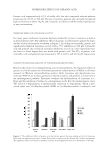
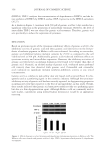
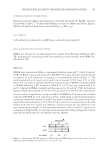
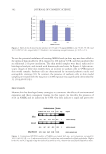
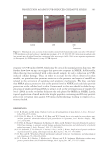
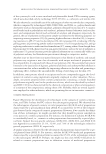
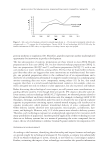
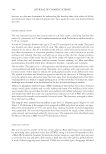
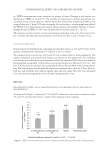
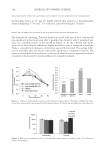
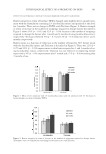
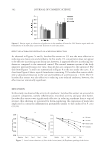
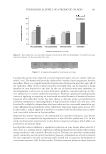
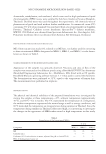
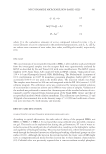
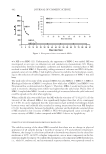
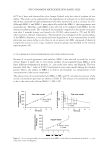
PHYSIOLOGICAL EFFECT OF A PROBIOTIC ON SKIN 391 EFFECT OF LACTOBACILLUS EXTRACT ON SKIN BARRIER INTEGRITY AND REPAIR Barrier integrity in terms of baseline TEWL changed only slightly after 1-month treat- ment with the formulation containing 1% lactobacillus extract and persisted at this level for 2 months. There was no change in TEWL with Triclosan (Figure 4). Barrier strength in terms of increase in the number of strippings required to disrupt barrier described in Figure 5 shows 16% (p = 0.41) and 52% (p = 0.18) increase in the number of strippings required to disrupt the barrier after 1 month and 2 months of using lactobacillus extract, respectively. Triclosan exhibited 3% (p = 0.7) and 12% (p = 0.4) reduction after 1 and 2 months, respectively. Barrier repair as a function of reduction in the number of hours for 50% barrier repair with the lactobacillus extract and Triclosan is described in Figure 6. There was 22% (p = 0.25) and 30% (p = 0.19) improvement in skin barrier repair after 1 and 2 months of us- ing lactobacillus extract, respectively. Triclosan was not effective in improving barrier repair with a 4% (p = 0.6) improvement after 1 month and a 7% (p = 0.8) worsening after 2 months of use. Figure 4. Effect of o/w emulsions with 1% lactobacillus extract and o/w emulsion with 1% Triclosan on barrier integrity in terms of baseline TEWL. Figure 5. Barrier integrity in terms of increase in the number of strippings required to disrupt barrier. Treatments were o/w formulations containing lactobacillus extract and Triclosan.

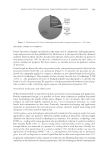
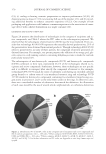
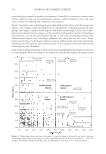
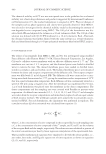
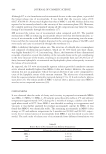
JOURNAL OF COSMETIC SCIENCE 392 EFFECT OF LACTOBACILLUS EXTRACT ON ACNE LESION REDUCTION As observed in Figures 7a and b, lactobacillus extract at 5% was the most effective in reducing acne lesion size and erythema. In this study, 1% concentration does not appear to be effective in reducing acne lesion size however, it appeared effective in reducing ery- thema as compared to the untreated control. The natural immune system of the body improves untreated lesions over time, thus all data are compared to the untreated. The data from Figures 7a and b are summarized in Figure 8 as the area under the curve. It is clear from Figure 8 that a topical formulation containing 5% lactobacillus extract exhib- ited a substantial reduction in the size and erythema of acne lesions (p 0.05). The 1% lactobacillus extract was also effective in reducing acne-induced erythema, however, the effect was not statistically signifi cant. DISCUSSION In this study, we observed the activity of a probiotic: lactobacillus extract on acne and its causative components, namely infl ammation, microbial activity, and poor skin barrier. Lactobacillus extract was signifi cantly effective in reducing erythema from a topical irritant, thus showing its potential for down-regulating the expression of molecules implicated in cutaneous infl ammation presumably similar to that induced by P. acnes (23,24). Figure 6. Barrier repair as a function of reduction in the number of hours for 50% barrier repair with o/w formulations of lactobacillus extract and Triclosan at each time point. Figure 7. Acne lesion reduction. (a) Size of the lesion (mm). (b) Erythema grading of the lesion.
Purchased for the exclusive use of nofirst nolast (unknown)
From: SCC Media Library & Resource Center (library.scconline.org)